Showing posts with label Wigmore Hall. Show all posts

Wednesday, 17 December 2025

Maturity of expression and astonishing virtuosity in Jaeden Izik-Dzurko's Wigmore Hall debut

Jaeden Izik-Dzurko
© Wigmore Hall/Darius Weinberg

Jaeden Izik-Dzurko (piano)

7.30pm, Monday 15 December, 2025
Wigmore Hall, London

★★★★★


Bach, Johann Sebastian (1685-1750): Partita No. 4 in D major, BWV828
Franck, César (1822-1890): Prélude, choral et fugue
Scriabin, Alexander (1872-1915): Fantasie, Op. 28
Rachmaninov, Sergei (1873-1943): 10 Preludes, Op. 23
Encores:
Medtner, Nikolai (1880-1951): Skazki (Fairy Tales), Op. 51 No. 6
Peterson, Oscar (1925-2007): Place St. Henri


Bach:
'Impressively mature Bach, setting out his stall as way more than a firework display'.

Franck:
'Izik-Dzurko’s opening Prelude was flowing and opaque, with the yearning melodic line surrounded by effortless cascades'. 

Scriabin:
'Izik-Dzurko showed he has the big guns, but also subtlety and finesse, and a deep understanding of this expressive yet at times darkly introspective work'.

Rachmaninov:
'An impressive reading throughout, capturing Rachmaninov’s shifts of mood, all with highly expressive and expansive tone'.

'Izik-Dzurko is definitely a talent to watch, and I am sure there’s a lot more to come'.

Read my full review on Bachtrack here.

Friday, 20 June 2025

Joyful energy from Rachel Podger and The Mozartists at Wigmore Hall

Rachel Podger, Ian Page & The Mozartists
© The Mozartists

Rachel Podger (violin)
Ian Page (conductor)

7.30pm, Wednesday 18 June, 2025
Wigmore Hall, London

★★★★★

Haydn, Franz Joseph (1732-1809): Symphony No. 66 in B flat major
Mozart, Wolfgang Amadeus (1756-1791): 
Violin Concerto No. 2 in D major, K211
Symphony in D major, K196+121(207a)
Violin Concerto No. 5 in A major, 'Turkish', K219


Haydn:
'Racing violins and rasping horns, and a bounce in Page’s step showed they meant business'.

Rachel Podger
© Nick Boston
Mozart:
Violin Concerto No. 2:
'The Second Violin Concerto opened with a jolly Allegro, Podger’s face radiating pleasure, her solo line singing above the orchestral texture'.

Symphony:
'Delightful, with nimble violins and robust woodwinds, all over in a flash'.

Violin Concerto No. 5:
'When they reached the “alla turca” section, they were all having great fun. Podger enjoyed the surging waves, taking Page and the orchestra with her, whilst the cellos and double bass added percussive slaps'.

Rachel Podger, Ian Page & The Mozartists
© Nick Boston
'A joyous evening, with incisive and energetic playing throughout'. 


Read my full review on Bachtrack here.


Friday, 20 December 2024

Savall and Hespèrion XXI celebrate 50 years with effortless style

Jordi Savall & Hespèrion XXI
© The Wigmore Hall Trust
Hespèrion XXI
Jordi Savall (director, treble viol)
Christophe Coin (treble viol)
Anna Lachegyi (tenor viol)
Lixsania Fernández (tenor viol)
Xavier Díaz-Latorre (theorbo, guitar)
Filipa Meneses (bass viol)
Philippe Pierlot (bass viol)
David Mayoral (percussion)

7.30pm, Wednesday 18 December 2024
Wigmore Hall, London

★★★★★


Jordi Savall
© The Wigmore Hall Trust

Innocentio Alberti (c.1535-1615): Pavin of Albarti - Gallyard
Christopher Tye (c.1505-1572): In Nomine a5 'Crye' 

Robert Parsons (c.1535-1571): The song called trumpets a6 

Pierre Attaingnant (1494-1552): Pavane de la Guerre 

Orlando Gibbons (1583-1625): In Nomine a5 No. 1 (pub. c.1610) 

John Dowland (1563-1626): Semper Dowland semper dolens (pub. 1604) 

                                              The King of Denmark's Galliard (pub. 1605) 

Giovanni Maria Trabaci (c.1575-1647): Toccata di Durezze et Ligature 

Gioseffo Guami (1542-1611): Canzon a4 sopra 'La Battaglia' 

Clement Woodcock (c.1540-1590): Browning my dear 

Antony Holborne (1545-1602): Galliard No. 24 

John Ward (c.1589-1638): Fantasia No. 4 

Anon.: Pavane de la petite Guerre & Gaillarde 

           Bourrée d’Avignonez 

William Brade (1560-1630): Turkische Intrada 

Alfonso Ferrabosco (1543-1588): Four-note pavan 

William Brade: Galliard a6 

John Jenkins (1592-1678): The Bell Pavan 

Sebastián Aguilera de Heredia (1561-1627): Tiento de batalla 

Samuel Scheidt (1587-1654): Galliard Battaglia 

William Lawes (1602-1645): Paven from Consort Sett a5 in C 

Robert Johnson (c.1583-1633) & William Brade: The King's Morisco 

Henry Purcell (1659-1695): Fantasia upon one note in F Z745 (c.1680) 

Johann Sebastian Bach (1685-1750): Contrapunctus 9 from the Art of Fugue BWV1080 (by 1742, rev. 1745-9) 

Juan Bautista José Cabanilles (c.1644-1712): Obertura - Corrente Italiana 

Encores:

Anon.: Tonada del Chimo, from Codex Martínez Compañón

Anon.: Scottish Dance.


Jordi Savall & Hespèrion XXI
© Nick Boston

'Drums were used to great effect to announce and accompany the battle pieces, such as the rat-a-tat rhythms of Gioseffo Guami’s Canzon a4 sopra “La Battaglia”, with virtuosic ornamented lines from Savall at the top of the texture'. 

'Savall and friends delivered every gem with assured and effortless precision, letting slip an occasional sense of their enjoyment in their craft at the more boisterous moments'. 


'... the Oberture e Corrente Italian by Cabanilles... the drums announced the majestic opening, then there was a deft switch from theorbo to guitar for the livelier rhythms of the Corrente, with tambourine and cascading viol lines dancing to the very end'.

Jordi Savall
© Nick Boston

'Rocking theorbo rhythms and joyous dance energy from the players was topped with virtuosic riffing from Savall'.


'The velvet viol sounds, the spirited percussion, the subtle theorbo or strumming guitar, with occasional virtuosic bursts of ornamented energy proved that this music is their joy, and it was a privilege to witness it. Happy 50th birthday, Hespèrion XXI!'


Read my full review on Bachtrack here.


Saturday, 22 June 2024

Wihan Quartet dedicates Wigmore Hall Concert to Cavatina Chamber Music Trust founder Simon Majaro to celebrate his 95th birthday

The Wihan Quartet
© Petra Hajska
The Wihan Quartet is dedicating its concert on 24 June at London’s Wigmore Hall to Simon Majaro, the London-based philanthropist and founder of the Cavatina Chamber Music Trust, who celebrates his 95th birthday the following day. It performs works by Smetana, Janáček, and Dvořák, showcasing the deep Czech musical heritage that has defined its career. 

The Wihan Quartet met Simon Majaro and his late wife, Pamela, after their triumphant win at the 1991 London International String Quartet Competition. Hugely impressed, the Majaros have supported and championed the Quartet since then, earning them the endearing title, ‘Our English Parents’ from the Quartet’s members.
In 1998, the Majaros founded the Cavatina Chamber Music Trust which enriches the lives of young people by providing opportunities to experience live chamber music through schools concerts and a special ticketing scheme which provides free tickets to young people (aged 5-25) in more than 50 partner venues across the country. Simon Majaro received an MBE for voluntary services to the Trust in 2011.
Following a distinguished academic career in the Business field, Simon Majaro published an acclaimed memoir 'Jerusalem’s Doctor of the Poor' and his debut novel 'Who is Mr. Poliakoff?'. He also fulfilled a long-term ambition to become a luthier (stringed-instrument maker). His instruments have been used by many professional musicians, including the Wihan Quartet, who performed with them at Wigmore Hall during the COVID-19 pandemic, having travelled to the UK without their own instruments.

The concert also marks the ‘Year of Czech Music 2024’, whose personalities have been commemorated every ten years since 1924, and, specifically, the 200th anniversary of Bedřich Smetana's birth.  “In music is the life of the Czechs” declared Smetana at the laying of the foundation stone of Prague’s National Theatre.
The day before its Wigmore Hall evening concert, the Wihan Quartet performs an all-Haydn programme at one of Wigmore Hall’s popular Sunday Morning concerts, at 11.30 a.m. on Sunday 23 June.

Wihan Quartet:
Leoš Čepický (violin)
Jan Schulmeister (violin)
Jakub Čepický (viola)
Michal Kaňka (cello) 

Sunday 23 June 2024 11:30am - https://www.wigmore-hall.org.uk/whats-on/202406231130

Haydn String Quartet in C Op. 76 No. 3 'The Emperor'
Haydn String Quartet in D Op. 64 No. 5 'The Lark' 

Monday 24 June 2024 7:30pm - https://www.wigmore-hall.org.uk/whats-on/202406241930

Smetana String Quartet No. 2 in D minor
Dvořák String Quartet in F Op. 96 'American'
Janáček String Quartet No. 2 'Intimate Letters'

(Press release from Tashmina Artists)

Interview with Simon Majaro from 2017 on Bachtrack here.

Tuesday, 13 February 2024

Intensity, virtuosity and life-affirming energy from the Pavel Haas Quartet's all-Czech evening

The Pavel Haas Quartet
© The Wigmore Hall Trust, 2024
Pavel Haas Quartet

Veronika Jarůšková (violin)

Marek Zwiebel (violin)

Šimon Truszka (viola)

Peter Jarůšek (cello)


7.30pm, Monday 12 February 2024

Wigmore Hall, London


★★★★


Bohuslav Martinů (1890-1959): String Quartet No. 3


Vitězslava Kaprálová (1915-1940): String Quartet No. 1, Op. 8


Antonín Dvořák (1841-1904): String Quartet in C major, Op. 61


The Pavel Haas Quartet
© The Wigmore Hall Trust, 2024
'Now in their 22nd year, the Pavel Haas Quartet 
continue to impress with their sheer dedication and virtuosic intensity, and tonight was no exception'.

Martinů:
'Truszka gave a richly sensuous tone to the slow movement’s bluesy solo, as well as driving the setup for the finale’s dance'.

Kaprálová:
'... after a tender conclusion to the slow movement, the finale danced away, building to a joyful climax, the Haas players proving powerful advocates for this strikingly individual quartet'.

Dvořák:
'The players’ flowing momentum, with some especially poised birdlike calls from Jarůšková, and their sheer enjoyment in the rousing lead into the recapitulation communicated perfect elegance and style, before subsiding into its quiet final chords'.

'The Pavel Haas Quartet performed throughout with such ease of command, never overstated yet full of life and commitment, making for a joyous celebration of these three fine works'.


Read my full review on Bachtrack here.

Friday, 15 December 2023

Bye bye, Miss Hope Springs, Hello Ty Jeffries!

Ty Jeffries
Despite Ty Jeffries having performed as his alter ego, Miss Hope Springs for many years now, I have to confess to coming somewhat late to the party. Ty performed a lunchtime concert in Brighton in 2022 as himself, his first in fact, and it was there that I came across his hauntingly beautiful piano music, as well as some of his poignantly witty songs. Of course, I then had to see the larger than life legend that is Miss Hope Springs, and just in the nick of time, as it turns out. After nearly 30 years performing as Miss Hope, Ty has decided to shed the costume and perform as himself, putting his beloved character into cryogenic suspension for one hundred years. He has numerous recitals planned coming up next year, including one at the Wigmore Hall in London, and with two previously recorded albums of his piano music, he hopes to record more. 

So how to describe his piano music? Well, think jazz and 1920s cabaret mixed in with the sadness and expressionism of Satie and Debussy. Throw in some sixties film music, hints of Brel and Michel Legrand, and you’re getting the idea. But having written so many songs for Miss Hope and others, his melody writing shines through, and there is always a strong lyricism running through. Many pieces conjure up instant atmosphere and a sense of place just from their titles – Waltz Buenos Aires, Dusk in the Luxembourg Gardens, St Petersburg, for example. Ty says that they are not intentionally directly descriptive of places, more a mood – as Rodin said, ‘the work of art is already within the block of marble’ – and for Ty, the pieces come out more or less fully formed as a result. In fact several tracks on his albums were improvised on the spot, and that improvisatory feel runs through. Yet one readily projects full back stories onto some – Miss Dickinson is not at Home 
is a case in point, with its nursery rhyme-like melody full of achingly nostalgic and mysterious sadness. A hint of Satie-esque Gymnopedie is given a lilt in Yekatarinberg, and St Petersburg, with its fin de Siècle waltz has a flavour of Satie’s Gnossiennes, whereas Brazilian Waltz evokes Chopin, but also Cuban pianist composer, Cevantes. But none of these references imply pastiche or imitation – there is a distinctive style that is Ty’s, and it is probably that nostalgic, filmic lyricism that is the common thread. The sounds of waves and seagulls bookend the Last Summer at Terijoki album, from its opening, lapping La Mer to the closing rippling, almost minimalist figures of And the Tide Comes in Like Glass. 


Miss Hope Springs
Ty tells me he began playing the piano aged 5, on a Steinway that had somehow found its way into the family potting shed. As the son of actor and director Lionel Jeffries and actor Eileen Walsh, the household was frequented by many great names from the world of acting and music. Ty clearly had a gift at the piano that was spotted by the like of Sir John Mills (who taught him jazz chords) and Elmer Bernstein, as well as later being mentored by Vangelis. He studied at The Purcell School of music, and from there played keyboards for Billy Mackenzie and The Associates in the 1990s, also working with Neneh Cherry and Chaka Khan. He has written songs (of course, many to be performed by Miss Hope Springs) and piano pieces ever since, and now finally feels it is time to focus on this side of his talent.  

Ty Jeffries

So I would highly recommend you check out his piano music, with two albums available on Bandcamp, and numerous tracks available on YouTube and elsewhere. And look out for performances in the New Year, when he will be performing selections of his solo songs and piano music. Ty returns to Crazy Coqs in London (where he had a very successful 12 year residency as Miss Hope) on Friday 22 March and Saturday 27 April, and he will also be performing at the Wigmore Hall at 10pm on 7 June. He is also giving a fundraising performance for The Ledward Centre in Brighton on Saturday 13 January - details here. 


Wednesday, 22 March 2023

Singing vocal lines plus phenomenal power in Lugansky's Rachmaninov


7.30pm, Monday 20 March, 2023

Wigmore Hall, London

★★★★★


Sergey Rachmaninov (1873-1943):

            10 Preludes, Op. 23

                        Prelude in F sharp minor

                        Prelude in B flat

                        Prelude in D minor

                        Prelude in D

                        Prelude in G minor

                        Prelude in E flat

                        Prelude in C minor

                        Prelude in A flat

                        Prelude in E flat minor

                        Prelude in G flat

            Variations on a Theme of Corelli, Op. 42

            Études-tableaux, Op. 39

                        Étude-tableau in C minor

                        Étude-tableau in A minor

                        Étude-tableau in F sharp minor

                        Étude-tableau in B minor

                        Étude-tableau in E flat minor

                        Étude-tableau in A minor

                        Étude-tableau in C minor

                        Étude-tableau in D minor

                        Étude-tableau in D

Encores:

            Friedrich Kreisler (1875-1962), arr. Rachmaninov:

                        Liebesleid

            Rachmaninov:

                        Oriental Sketch


'Lugansky is a cool performer yet never aloof, and his smile in response to enthusiastic applause showed genuine pleasure. That pleasure also shone through in those lyrical melodies'.


Preludes:

'He also offered the full range of Rachmaninov's beloved bells, from an incredibly light touch in the high single notes at the end of that D major Prelude, to the weighty tolls at the end of the A flat Prelude'. 


Corelli Variations:

'Lugansky was mesmerising in the rapid virtuosity, but it was in the Intermezzo's improvisatory melody, and the wandering arabesque of the 15th, with its insistent blue note, that he was at his most captivating'.


Études-tableaux:

'In the Op.39 Études-tableaux, Lugansky showed us even more drive, with phenomenal, almost crazy rapid action at the top of the keyboard in no. 3'.


'It was impossible not to delight in a performer so clearly at home in his repertoire'.


Read my full review on Bachtrack here.

Tuesday, 14 February 2023

Emotionally compelling Lenau settings from Gerhaher and Huber at Wigmore Hall

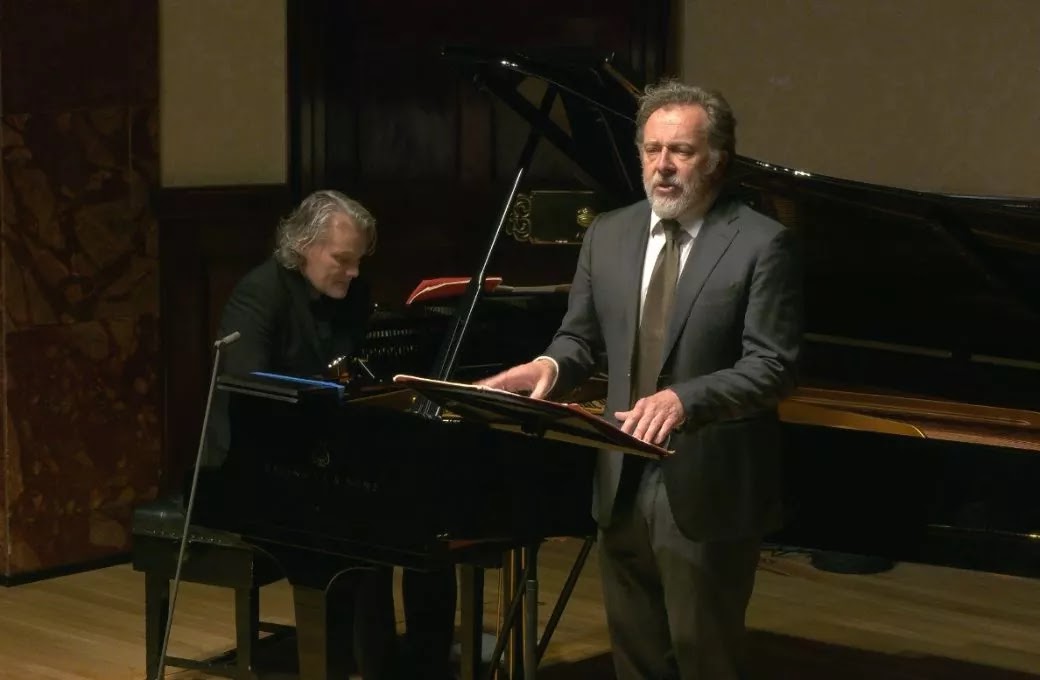
Christian Gerhaher & Gerold Huber
© Wigmore Hall Trust

Christian Gerhaher
(baritone)
Gerold Huber (piano)

7.30pm, Sunday 12 February 2023

Wigmore Hall, London

★★★★★


Heinz Holliger (b.1939): Elis: Verkündigung des Todes, Todesangst und Gnade, Himmelfahrt

Hugo Wolf (1860-1903): Abendbilder

Heinz Holliger: Lunea: Wirf o Thor, Die Jahre flogen, Die Himmelsschlange, Ich will, Weit, Dein Blick, Transsubstantiatio, Der Mensch, Ich habe, Serenum, Der Eisenhammer, Ein Tropfen, Verächtlich, Man grüsst, Der Schwimmer, Mein Widerhall, Der Frühling, Der schwarze Schleier, Der Zweifel, Der Himmel, Der Mond, Die Wüstenwanderer, Einklang (Nachwort)

Robert Schumann (1810-1856): 4 Husarenlieder, Op. 117: Der Husar, trara!, Der leidige Frieden, Den grünen Zeigern, Da liegt der Feinde gestreckte Schar, 

Othmar Schoeck (1886-1957): Elegie, Op. 36: An den Wind, Herbstgefühl, Verlorenes Glück, Das Mondlicht, Herbstentschluss, Welke Rose

Robert Schumann: 6 Gedichte von N Lenau und Requiem, Op. 90: Lied eines Schmiedes, Meine Rose, Kommen und Schieden, Die Seine, Einsamkeit, Der schwere Abend, Requiem

Encore:
Othmar Shock: Elegie, Op. 36: Zweifelnder Wunsch

Christian Gerhaher
© Wigmore Hall Trust
Holliger:
'Gerhaher ... immediately drew us into the dark, introspective world that would pervade the programme to come. Huber’s glassy, ethereal playing, with layered pedalling also set a darkly atmospheric scene'.   

'Gerhaher delivered the twistingly tormented, leaping lines with remarkable, chilling clarity, with striking stillness on stage, oblivious to Huber’s frequent forays into the piano’s interior'.

Schoeck:
'Gerhaher gave us pleading, icy tones, and the final journey of Herbstentschluss dripped with sadness, before the heartbreaking Welke Rose, Huber’s soft-toned accompaniment in the distance'.

Schumann:
'But it was with the Sechs Gedichte von N Lenau that Gerhaher truly tugged the heartstrings. Words were exquisitely pointed in Meine Rose, with a wishful blossoming on “freudig”. Despite some gloriously ringing tone at the top of his range, he returned to oppressive darkness for Einsamkeit'.

Read my full review on Bachtrack here.

Watch the concert streamed by the Wigmore Hall here.