Showing posts with label BBC Philharmonic. Show all posts

Friday, 9 August 2024

Beauty without the beast: BBC Philharmonic, Feldman and Bihlmaier at the BBC Proms

Tobias Feldmann, Anja Bihlmaier & the BBC Philharmonic
© BBC/Andy Paradise

Anja Bihlmaier (conductor)


BBC Prom 26

7.30pm, Thursday 8 August 2024

Royal Albert Hall, London


Ludwig van Beethoven (1770-1827): Violin Concerto in D major, Op. 61


Encore:

Edward Elgar (1857-1934): Salut d’amour, Op. 12


Sarah Gibson (1995-2024): warp & weft


Johannes Brahms (1833-1897): Symphony No. 4 in E minor, Op. 98


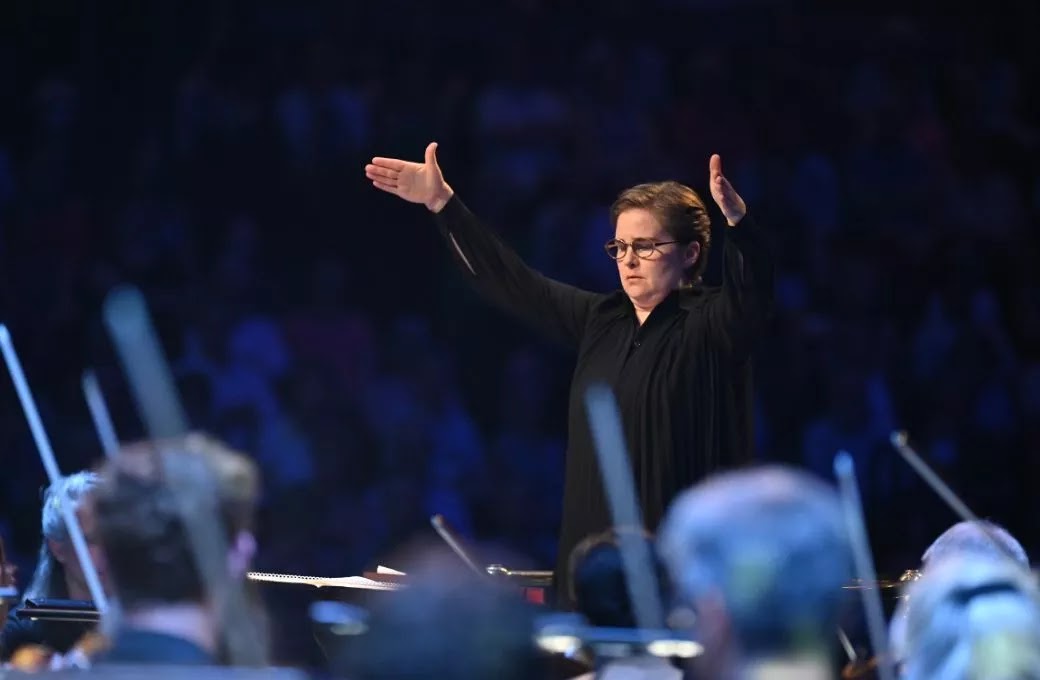
Anja Bihlmaier conducts the BBC Philharmonic
© BBC/Andy Paradise

Beethoven:

'A highly engaging performance from Feldmann, producing a bright, lively tone and lyrical line throughout'. 


'... a performance of great beauty, with strong orchestral playing from the woodwinds in particular, but missing bite at the more dramatic moments'.


Gibson:

'Bihlmaier steered the orchestra through the complex rhythms in a work full of interest and challenge'.


Brahms:

'Bihlmaier gave the opening, which launches without introduction, a watery flow, (think Smetana’s Vltava), setting the tone for a fluid reading'. 


'Bihlmaier shaped the progress of the unfolding variations with a strong architectural sense'. 


Read my full review on Bachtrack here.

Wednesday, 23 August 2023

Strong performances of Shostakovich Symphonies 12 & 15 from John Storgårds & the BBC Philharmonic

John Storgårds and the BBC Philharmonic return to their Shostakovich with a double - the 12th and 15th Symphonies. Although not dissimilar in length at around 40 and 45 minutes respectively, making this very generous for a single disc release, they couldn’t be more different in character. The Symphony No. 12, Op. 112, ‘The Year 1917’ is, it’s fair to say, one of Shostakovich’s least popular, for various reasons. It certainly suffered from being seen on paper as overtly and simplistically celebratory of the Soviet regime, with a programme for its four movements including Revolutionary Petrograd, Razliv (Lenin’s country retreat), Aurora (the battleship that launched the salvo attack on the Winter Palace), and ending with ‘The Dawn of Humanity’, a celebration of the new world that the Revolution supposedly brought in. But was it about towing the party line, as he and his work was going through some kind of rehabilitation by the Communist regime, and he also finally agreed to join the party? Or, as ever with Shostakovich, is there a more subversive reading, with its quote from nationalist Sibelius’ Lemminkäinen in Tuonela in the midst of Razliv (Razliv is in Finland), and its meandering questioning both in this movement, but also in the midst of the supposedly defiant final movement? Storgårds takes a relatively straightforward approach here, neither over-emphasising the bombastic, triumphant elements, nor digging too deeply into the darker moments. As a result, this is a performance that leaves us to decide on its merit. The BBC Philharmonic’s playing is tight and precise, with some particularly deft work from the woodwind in the opening movement, especially the bassoons. Rattling drums at the first movement’s climax, and gunfire percussion in the Scherzo add bite, and the brass statement in the finale avoids being overblown, yet has clear strength. A fine performance of a symphony that is ultimately harder to admire than others. Turning to Symphony No. 15, Op. 141, from around ten years later, and his final symphony, we are in such different territory. There is greater invention here, with use of twelve tone motifs as well as constant quotes and references, not least Wagner, Glinka, and even direct use of the them from Rossini’s William Tell Overture. Given the fact that Shostakovich’s health was pretty poor by this stage, having had one heart attack, and soon to suffer a second shortly after completing this work, it is surprisingly upbeat, particularly the ‘toyshop’ opening movement, with its playful William Tell quotes, extensive use of percussion and the high wire circus act solo violin part (played here with caustic precision by BBC Philharmonic leader, Yuri Torchinsky). Storgårds handles this with a deft touch, particularly the squabbling polymetric woodwind passages towards the end of the movement. In the slow movement however there is real agony, with the cello solo plaintive and fragmentary, and then the mournful trombone solo to follow (sadly both soloists uncredited here). But following the mocking scherzo, the finale, despite a mournful brass opening with ominous timpani, soon skips along gently, with those Wagner and Glinka allusions, before the Passacaglia bassline is introduced by the cellos and double basses. Around this the scrabbling intensifies, swirling up to a climax, from which Shostakovich then remarkably descends into a gentle dance and a quiet end from celesta and percussion. As in the 12th, Storgårds steers us through without ever over-stating detail, but here the performance comes alive through the sheer invention and contrast of material that Shostakovich has on offer. It is this clarity of rendition of these two symphonies side by side that highlight the complexity of deciphering the ‘true’ voice of the composer.


Friday, 11 August 2023

Prom 33: Sumptuous song and assured Rachmaninov from Connolly, Storgårds and the BBC Philharmonic

John Storgårds (conductor)

7pm, Wednesday 9 August, 2023


Carl Maria von Weber (1786-1826): Oberon, Overture


Dora Pejačević (1885-1923):   Zwei Schmetterlingslieder, Op. 52

                                                I. Gold’ne Sterne, blaue Glöckchen

                                                II. Schwebe, du Schmetterling

                                                Verwandlung, Op. 37b

                                                Liebeslied


Alma Mahler-Werfel (1879-1964), orch. Colin & David Matthews:

                                                Five Lieder No. 1, Die stille Stadt

                                                Four Lieder No. 1, Licht in der Nacht

                                                Five Lieder No. 4, Bei dir ist es traut


Sergei Rachmaninov (1873-1943): Symphony No. 1 in D minor


John Storgårds conducting the BBC Philharmonic
© BBC/Chris Christodoulou
Weber:
'Storgårds drove the gallop with great energy, with some particularly fleet-of-foot work from the violins'.


Pejačević:

'Connolly’s warm tone was matched well with an agile touch from the orchestra'.


Mahler-Werfel:

'In the mysterious Die stille Stadt, Connolly shaped the melodic line with strong dramatic interest, and delivered the strangely angular Licht in der Nacht with ominous darkness, exploiting her depth of range on the very low 'Nacht''.


Rachmaninov:

'Storgårds managed the first movement’s frequent tempo transitions coherently, with oceanic waves of string arpeggios and a deft accelerando to finish'. 


'Storgårds drove on with the offbeat rhythms, building to a blistering pace for the conclusion, with tam-tam and timpani adding the final element of drama'. 


Read my full review on Bachtrack here.

Saturday, 5 August 2023

Prom 26: Lyrical virtuosity from Ehnes, with majestic Sibelius from Storgårds and the BBC Philharmonic

7.30pm, Thursday 3 August 2023


Gerald Barry (b.1952): Kafka's Earplugs
William Walton (1902-1983): Violin Concerto
Encore:
Johann Sebastian Bach (1685-1750): Sonata No. 3 for solo violin in C major, BWV1005, IV. Allegro assai
Jean Sibelius (1865-1957): Symphony No. 1 in E minor, Op. 39

James Ehnes & the BBC Philharmonic
© BBC/Mark Allan
Barry:
'Storgårds and the BBC Philharmonic managed to effectively keep a lid on things throughout, yet occasionally allowing tantalising glimpses to break through the texture'.

Walton:
'Ehnes was suitably wild in its virtuosic passages, but he also gave us delicate decorative adornments to the horn’s canzonetta theme'.

Bach: 
'Ehnes then treated us to a fleet-of-foot account of the finale to J.S. Bach’s Sonata no. 3 in C major, BWV 1005, with seamlessly smooth string crossing and sensitive use of echo effects'.

Sibelius:
'With a sense of urgency, Storgård steered the orchestra to a sunlit climax'.

'Storgårds’ drive and the tightness of the BBC Philharmonic’s ensemble, as well as strong solo work from many, made for a memorable performance here'. 

Read my full review on Bachtrack here.

Thursday, 27 October 2022

CD Reviews - November 2022

Pianist Clare Hammond’s new disc (realised 4 November) of Études by Hélène de Montgeroult (1764-1836) is a complete revelation. Eight years younger than Mozart, Montgeroult, from a noble background, led a dramatic life involving a secret diplomatic mission, kidnap and imprisonment. Despite this, she was made professor of piano at Paris Conservatoire de Musique, and published nine sonatas, three fantasies, and her ‘Cours complet’ containing 114 études and over 900 exercises, as well as various other pieces. The style is so ahead of her time, in terms of what we might expect, that it is hard not to think that her work was not heard by the likes of Beethoven, Schubert, Mendelssohn, Brahms and Chopin. It is often the case that we fall into the trap of listening to unknown music composed by women and constantly liken it to that of male composers, as if to say they must have been the prime influence. Here it is so clearly the other way around, as many of the characteristics of her compositions, in terms of adventurous harmonies, complexity of texture, tempo changes and singing melodies, are foretastes of what we hear in the Romantic composers that followed her. The études were composed from around 1788 to 1812, by which time Schumann and Chopin were just 2 and Mendelssohn 3 years old. Yet if you didn’t know otherwise, the singing melodies over perpetual motion accompaniment of Études nos. 26 and 41, or the dancing energy or percussive textures of nos. 35 & 65, or the virtuosic trilling and insistent rhythmic energy of nos. 100 & 103, could be mistaken for Mendelssohn, Schubert or Chopin respectively. There are Beethovenian bagatalles, Field-like nocturnes, poignancy foreshadowing late Schubert, and even Brahmsian impromptus. Yet there is a clear individuality too in her expressive use of melody and her dense, rapid-moving textures. Did all of these composers know her work? There are possible connections to Mendelssohn via one of his teachers, and Clara Schumann’s father used the Cours complet in his teaching. But beyond that, we can’t be sure. We can only conclude from the quality and creative invention of her compositions that, had she not been a woman, her work would surely be better known today. Hammond has absorbed her soundworld and performs these gems with nuance, warmth and virtuosic fluidity throughout. Given that there are 29 études from the 114 here, there is surely scope for a follow-up, which would be greatly welcomed.

Montgeroult, H. de. 2022. Études. Clare Hammond. Hybrid Super Audio Compact Disc. BIS Records BIS-2603

American pianist Sarah Cahill returns with the second volume of her survey of keyboard music composed by women, The Future is Female. As with the first volume, the choice is eclectic, ranging from the late 17thcentury to the present day, and the loose theme this time is The Dance. She opens with the delightful Suite No. 1 from Élisabeth Jacquet de la Guerre’s (1665-1729) Pièces de clavecin. If we put to oneside any concerns about this being performed on a modern piano, Cahill’s approach is light and delicate, with rippling ornaments and the five short movements bounce along with a gentle lilt. The middle Sarabande is quiet and contemplative, whilst the final Gigue, whilst not overly extravagant, is pacier, within an overall introspective soundworld. Clara Schumann (1819-1896) is next, and her Variations of a theme of Robert Schumann, Op. 20. Written as a present for her husband’s 43rd birthday, it was one of her last compositions for the piano. The theme itself is rather mournful, almost funereal – and it was her husband’s last birthday before entering the asylum where he would end his days. However, she creates romantic passion in the variations that follow, increasing the intensity and rhythmic energy and moving the melody around in the texture. Yet she returns several times to the chorale-like plainness of the theme, and the six variation is particularly poignant and questioning. Cahill captures the atmosphere of this deeply personal composition with understated affection. We leap forward to 1957 for Germaine Tailleferre’s (1892-1983) Partita, with its wandering melodic lines and jazzy harmonies, and a playfully balletic dance to end. We move through the latter half of the twentieth century with a mournfully nostalgic Rhapsody from Zenobia Powell Perry (1908-2004) and two evocative movements from Madeleine Dring’s (1923-1977) Colour Suite, full of cabaret-style swing and dance rhythms. Elena Kats-Chernin’s (b.1957) Peggy’s Rag is delightfully nostalgic, and Betsy Jolas’ (b.1926) Tango Si deconstructs elements of the dance, with stop-start hints of tango rhythms. The St Petersburg Waltz by Meredith Monk (b.1942) swirls around repeated chords with Eastern European inflections and distant cries from the top of the keyboard. Mexican composer Gabriela Ortiz’s (b.1964) Preludio y Estudio No. 3 has a mysterious, free prelude with high outbursts contrasting with a drone-like bass, and the virtuosic Estudio is full of insistent driving rhythms, splashing chords and metallic use of the very top of the instrument. The disc ends with a dramatically expressive piece, ‘She Dances Naked Under Palm Trees’, by Theresa Wong (b.1976), with haunting use of the pedal to create ringing notes, thundering textures, glissandi and a deeply unsettling 13-beat metre. As with the first disc, with such a fascinating and well-chosen selection of diverse works, it is easy to forget the pianist here, and once again Cahill demonstrates an impressive command of such a wide variety of styles, so as well as being a great testament to the women composers here, high praise is deserved for these performances too.


Various. 2022. The Future is Female, Vol. 2, The Dance. Sarah Cahill. Compact Disc. First Hand Records FHR132.


Ruth Gipps (1921-1999) was an English composer, oboist, pianist and conductor, studying the oboe at the Royal College of Music with Léon Goossens, and composition with Gordon Jacob and Vaughan Williams. Her music eschewed serialism or atonalism and as such, perhaps fell out of fashion somewhat – and of course she sadly suffered at the hands of a misogynistic and male-dominated world of composition in the early to mid-twentieth century. Thankfully, her music is experiencing something of a revival, and Chandos’ second volume of her orchestral music further demonstrates the inventiveness of her orchestration and her understanding of orchestral colour. Her youthful Oboe Concerto, Op. 20, expertly performed here by Juliana Koch, along with the BBC Philharmonic conducted by Rumon Gamba, is full of lively writing for the oboe, along with lyricism in the slow movement, folksy dancing melodies in its finale. But its strengths also lie in the delicacy of the scoring, with just muted strings in the central Andante, and mysterious string textures in the opening movement. There are two short orchestral works here too, firstly an Overture to a never completed opera, Chanticleer, Op. 28, with atmospheric wind writing and surging strings, as well as rasping brass evoking the cockerel of the title. There is also a dark elegy on war, Death on the Pale Horse, Op. 25 (written in 1943), drawing inspiration from Blake’s painting of the same name. Here, gently pulsing timpani build to the climactic moments, and the opening horn solo, repeated at various points, adds to the sense of doom. The rest of the disc is given over to Gipps’ Symphony No. 3, Op. 57. Written in 1965, the style was surely running against the fashions of the time, which might explain its relative obscurity, but the wealth of expression and orchestral colour on offer here is immediately attractive. The shifting tonalities of the opening movement, with rich string writing, builds to exhilharating, surging climaxes, and the Theme and Variations second movement is warm and lush, with highly imaginative use of percussion. Again, unusual orchestral colour is on display in the Scherzo, with an ostinato (repeated figure) for harp and glockenspiel, against skittish string writing. The finale is jaunty, with some striking moments for the brass – she certainly knows how to make the most of all parts of orchestral textures, and Gamba and the BBC Philharmonic exploit this to the full. I missed Volume 1, and will certainly now be seeking it out.


Gipps, R. 2022. Ruth Gipps Orchestral Works, Vol. 2. Juliana Koch, BBC Philharmonic, Rumon Gamba. Compact Disc. Chandos CHAN 20161.


Friday, 12 August 2022

Prom 34: atmospheric Thorvaldsdottir and intimate Elgar from BBC Philharmonic

Eva Ollikainen
© Chris Christodoulou
Kian Soltani (cello)

Eva Ollikainen (conductor)

7.30pm, Thursday 11 August 2022


Anna Thorvaldsdottir (b.1977): ARCHORA


Edward Elgar (1857-1934): Cello Concerto in E minor, Op. 85


Encore: 

Trad., arr. Kian Soltani (b.1992): ‘Lovely Minka, I must away’


Jean Sibelius (1865-1957): Symphony No. 2 in D major, Op. 43


Anna Thorvaldsdottir & Eva Ollikainen
© Chris Christodoulou

Thorvaldsdottir:
'Ollikainen steered the BBC Philharmonic players through this dark landscape with a clear and expansive beat. Thorvaldsdottir uses the orchestra to create remarkably haunting atmospheres and textures'.


Elgar:

'Soltani's Elgar was strong, with command of the virtuosic demands a given and expressively singing tone in the slower moments'.


'Ollikainen succeeded in bringing each (tutti) back to allow for Soltani’s attention to detail to shine through'.


Kian Soltani
© Chris Christodoulou

Sibelius:
'Nothing was overplayed or forced, and there was thoughtful attention to detail throughout'.


'There were moments where Ollikainen drove proceedings with greater energy, such as the immediate pulsing energy of the opening, and encouraging intensity of response from the violins in the build to the big tune'.


Read my full review on Bachtrack here.

Thursday, 7 July 2016

CD Reviews - July 2016

Ensemble Diderot, lead by Johannes Pramsohler, have completed a project begun by the great Reinhard Goebel with Musica Antiqua Köln (who disbanded in 2007). Goebel & MAK recorded six of Johann Friedrich Meister’s (c1638-1697) twelve Trio Sonatas, ‘Il Giardino del piacere’ as their final enterprise, and Goebel himself asked Pramsohler and the Ensemble Diderot to record the final six.  All the Sonatas have multiple, relatively short movements, based on dance forms, but Meister was one of the first, if not the first German composer to take the prevailing style of Lully and others and move the music away from the ‘danceable’ forms to what became Ars combinatoria. So the French and Italian styles were developed and combined, creating a more intellectual ‘art music’. So whilst the Gigue in this ninth sonata has a real bounce, played by the Ensemble Diderot with lively spirit, it is no longer obviously a simple dance. The Corrente of the twelfth sonata has real rhythmic spice, with accented offbeats, and the Allemanda of the same piece has striking upbeats, all creating great interest and once again moving the form away from the expected. The Ensemble Diderot vary the textures too, with the harpsichord dropping out of the Sarabanda in the twelfth, leaving the cello to provide a walking bass line.  On the other hand, the harpsichord provides delicate touches to the seventh sonata’s Sarabanda, and the violins stylishly emphasise the offbeats in the first sonata’s Sarabanda, demonstrating the variety Meister creates in a seemingly homogenous choice of structure. The third sonata contains a beautiful Adagio, with the cello starting each phrase with long held notes over which the violins and harpsichord weave plangent cries – here cellist Gulrim Choi maintains a perfectly even, semplice sound for the others to work off. The Fuga movements are often brief, but allow for great interplay between the two violins, particularly noticeable in the seventh sonata. These are exquisite sonatas, and from the performances here, it was easy to see how much the players have taken this music to heart.


Sergei Prokofiev’s (1891-1953) three Piano Sonatas, Nos. 6, 7 and 8 were completed between 1940 and 1944, although he had begun work in 1939, and they are perhaps understandably collectively known as the ‘War Sonatas’ (although when he composed the first of these, the Soviet Union were still to enter the war).  Prokofiev didn’t necessarily conceive them to be performed as a trilogy, but there are clear links between them, both in specific detail such as the ‘fate’ motif which crops up in all three, but also in emotional depth and content, and world events of the time are never far from one’s mind when hearing them.  There is a consistent mood of conflict here, never fully resolved, with moments of highly disturbing tension.  Even in the more romantic calm of the 8th Sonata, fate is still present, although perhaps there is a hint of happier thoughts, given that Prokofiev dedicated this sonata to Mira Mendelssohn, for who he left his first wife and family in 1939.  Peter Donohoe gives the slow movement in particular of this sonata full lyricism and weighty emotion.  In total contrast, his finale of the 7th Sonata is truly exciting and he gives the incessant repeated notes real energy and drive.  Yet it is in the 6th Sonata’s slow movement that Donohoe achieves the most disturbing combination of moments of surface lyricism over dark, ominous harmonies, before showing total command in the relentless toccata-like finale.  There is a darkness throughout these works that is sometimes lost in performances that focus purely on the virtuosic demands – of which there are many – and Donohoe is able to fully exploit the complex undercurrents of these great works. Donohoe recorded the 7th Sonata a staggering 33 years ago, and then again with the other two War Sonatas in 1991, and these performances were acclaimed at the time.  So he has clearly lived with these sonatas for a long time, and having recorded the other six sonatas in two previous volumes, it is perhaps significant that he has saved the War Sonatas for last in this highly authoritative complete cycle.


Violinist Tasmin Little has brought three little known works for violin and orchestra by English composers to her latest recording with Sir Andrew Davis and the BBC Philharmonic.  First comes the lyrical Concerto, Op. 80 by Samuel Coleridge-Taylor (1875-1912).  Born in London to a male medical student from Sierra Leone and an English woman, he trained as a violinist and composer from an early age at the Royal College of Music, but in his latter years became successful in the US, where he was rather dubiously dubbed ‘the black Mahler’ on account of his impressive conducting.  His most successful work, Hiawatha’s Wedding Feast, was for many years a staple of British choral societies, yet little of the rest of his music is regularly performed today.  His first version of his Violin Concerto used a number of African-American melodies and spirituals, with a finale based on ‘Yankee Doodle’.  However, he changed his mind, completely rewriting the work using his own melodic material instead. A Dvořák-esque flavour remains, à la New World Symphony, but the touchingly lyrical slow movement has real inspiration. The finale is full of joy and spirit, and Little enjoys the syncopation and use of the violin’s upper reaches here.  Frederick Delius (1862-1934) composed his Suite for Violin and Orchestra in Paris around 1888, and its four movements have a beautiful simplicity in their individual characters.  An opening lyrical Pastorale is followed by a dancing Intermezzo. The song-like Élégie contains some lush brass writing, but this is basically a chance for the violin to sing in an unashamedly romantic fashion – and Little exploits this to the full.  The Finale has a rather conventional feel, with less of an individual Delius voice, but is not without interest. Finally, we have a Concerto from Haydn Wood (1882-1959).  Yorkshire born, he grew up on the Isle of Man, but like Coleridge-Taylor, studied the violin from an early age at the RCM, also studying composition with Stanford. Perhaps more famous for writing songs (eg. Roses of Picardy), musical comedies and light orchestral music, he nevertheless produced a small number of larger scale works, of which the Violin Concerto is one.  This is warm, romantic music, without any edge – yet with moments of deft touch in orchestration, such as the use of harp in the opening movement, and the exquisite horn solo at the beginning of the slow movement leading to the violin’s first entry.  Little is supported throughout by warm and sensitive playing from the BBC Philharmonic, Davis keeping tempi moving to avoid overindulgence.


(Edited versions of these reviews first appeared in GScene, July 2016)