Showing posts with label Elgar. Show all posts

Friday, 28 November 2025

Beth Taylor’s commanding Sea Pictures the highlight of the LPO’s all-Elgar evening

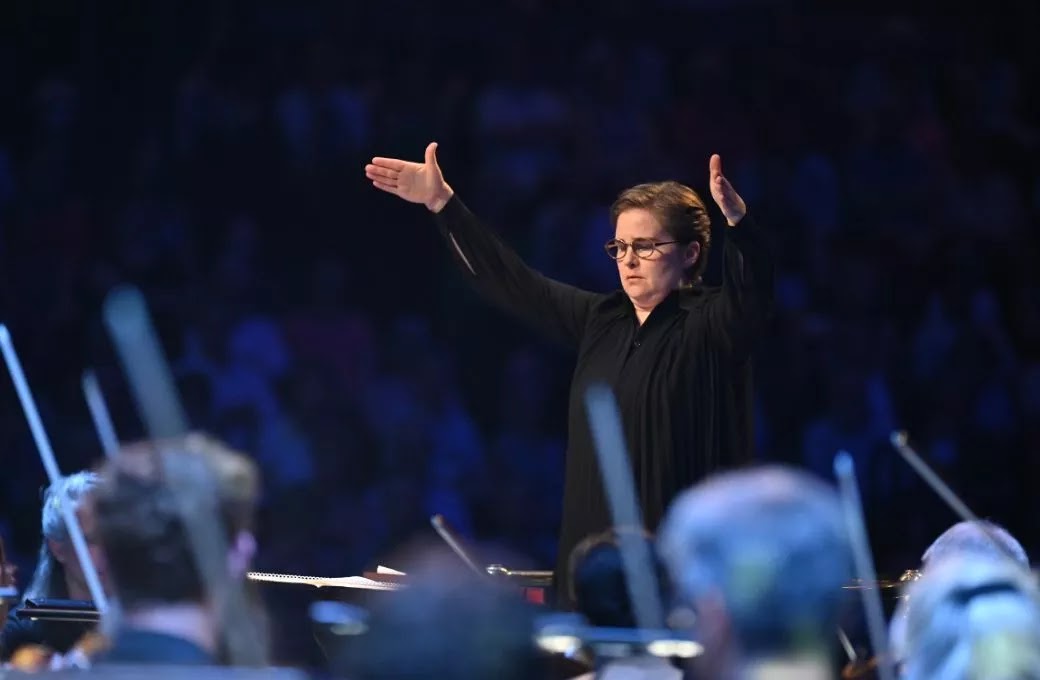
Beth Taylor, Edward Gardner & the London Philharmonic Orchestra
© Mark Allan Photography

Beth Taylor (mezzo-soprano)
Edward Gardner (conductor)

7.30pm, Wednesday 26 November 2025


Elgar, Edward (1857-1934): In the South (Alassio), Concert overture for orchestra, Op. 50
                                             Sea Pictures, Op. 50
                                             Sospiri for string orchestra and harp, Op. 70
                                             Enigma Variations on an Original Theme for Orchestra, Op. 36

In the South (Alassio):
'They started as they meant to go on, with a joyous rendition of In The South (Alassio) full of lush energy from the off'.

Edward Gardner conducting the London Philharmonic Orchestra
© Mark Allan Photography
Sea Pictures:
'... her rich dark mezzo tones captivating, with every word audible and expressively delivered, even at the lowest end of her range'.

'A superlative performance – surely a recording with this team should follow?'

Sospiri:
'Gardner and the LPO strings with harp kept things understated here ... as a result, it had all the more emotional impact'.

Edward Gardner & Beth Taylor with the London Philharmonic Orchestra
© Nick Boston
Enigma Variations:
'Gardner and the LPO gave us a reading full of energy and freshness. The big moments were there, but Gardner always kept things moving along, avoiding any wallowing'.

Read my full review on Bachtrack here.


Thursday, 25 September 2025

An impressive debut recording from Birmingham's chamber choir, The Elgar Scholars

The Elgar Scholars describe themselves as Birmingham’s newest pre-professional chamber choir, and is conducted by co-musical directors Jim Bate and Laura Bailie. Bate & Bailie are both graduates of The University of Birmingham’s choral conducting masters programme, and the singers are students and alumni from the university, the Royal Birmingham Conservatoire and elsewhere. As you would expect, therefore, they produce a sophisticated sound, with precise tuning and clear diction a given. What is more interesting perhaps on their short debut recording is the variety of contemporary styles across just eight tracks. 

One piece gives a nod towards their name, in John Cameron’s arrangement of Elgar’s ‘Nimrod’, as ‘Lux Aeterna’, but otherwise all the other pieces are by living composers. Starting with the Elgar, they take this at a good pace, avoiding any self-indulgence that can creep in, and they  keep their powder dry until the big climax, when the ringing sopranos really burst out of the texture, before retreating to deliver a touchingly fragile ending. There are two works here by ex-King’s Singer and composer Bob Chilcott (b.1955). Firstly, there is Even Such is Time, a setting of a Walter Raleigh text, with a falling repeated pattern that here leads towards a rich, full homophonic sound from the choir, and a beautifully pure-toned soprano solo line from Alice Martin. The other Chilcott piece comes from his Song of Harvest. Gratitude is a prayerful hymn, with a warm blend from the singers here. Judith Weir (b.1954) is represented here by Drop Down, Ye Heavens, From Above, her setting of the Rorate Coeli text, often set to plainsong for Advent matins. Weir starts with a bare sound of just two lines, then adds lines to the texture, building to a thicker homophonic texture, with a particularly richly dense chord on the word Fear. There is an eery wedding anthem, And I Will Betroth You, from Michael Zev Gordon (b.1963), once again relatively homophonic in texture, but with closely clashing parts requiring precision of tuning and balance from the singers, and they sustain the long-held chords with impressive steadiness. The album’s title, Finding Your Home, comes from Millicent B James’ work, which was commissioned by the National Youth Choir. James was a member of their Young Composer Scheme in 2023, and this piece demonstrates a highly impressive command of a variety of choral techniques, moving from jazzy close harmony into a more playful rhythmically driven style, with improvisatory solo lines and finger-clicking creating a joyful and richly textured celebration, and the singers clearly had fun with this one. 

But the two highlights here for me include Laura Mvula’s (b.1986) own choral arrangement of her song Sing To The Moon, originally composed with Steven James Brown who sadly passed away in 2024 for Mvula’s debut studio album in 2013. Mvula also studied composition at the Royal Birmingham Conservatoire, and this choral arrangement was performed by the BBC Singers at the Last Night of the Proms in 2019. The choruses have simpler, thicker harmony, with a glorious solo rising above from soprano Evelyn Byford, whilst the verses allow for more interesting textures from individual lines and falling figures from the sopranos. And my other highlight is Jonathan Dove’s (b.1959) In Beauty May I Walk. It was written as a present for Anthony Whitworth-Jones on leaving Glyndebourne Festival Opera, where Whitworth-Jones had been General Director and had commissioned various works by Dove, including his opera Flight. It uses anonymous Navajo text, translated by Jerome K Rothenberg, and Dove expertly combines chanting with repeating figures and layering of parts to create a haunting piece. Here The Elgar Scholars basses rise up slowly beneath the busier upper parts, their slow scale underpinning the build to the work’s climax, before falling away to a quiet, delicate conclusion. It is in these more complex works, the Dove, Mvula and James pieces in particular, that The Elgar Scholars demonstrate their assured command, and conductors Bailie and Bate have clearly worked hard with them to create a highly accomplished choir that I look forward to hearing more from.


Monday, 24 February 2025

Overtures & Dances - Impressive variety and virtuosity from the Mēla Guitar Quartet

The Mēla Guitar Quartet formed in 2015, graduates of the Guildhall School of Music & the Royal Academy of Music, and have established a reputation for interesting programming, combining clever arrangements (often their own) of works for other instruments, as well as commissioning new works. Following a change of line-up in 2023 (now comprising Matthew Robinson, George Tarlton, Michael Butten & Zahrah Hutton), they have now recorded a joyful album, entitled Overtures & Dances, including ingenious arrangements (by Tarlton) of two staples of the orchestral overture repertoire, Glinka’s Ruslan and Lyudmila (which opens the disc) and Humperdinck’s Overture to Hänsel und Gretel. The Glinka sets off at a wild pace, with no concessions made when it comes to the racing string scales, the guitars adopting a kind of mind-boggling hocketing technique, alternating semi-quavers between instruments, which quite frankly, sounds even more demanding! As well as all of the rapid virtuosity, they bring 
out the lyrical melodies, make use of harmonics for lighter textures, as well as drumming effects, and build to an impressive climax of orchestral dimensions. The Humperdinck opens with a more gentle, fairytale atmosphere, but once again, it is those impressive running scales that build up the drama. The guitars bring a music-box feel to the sound world, adding to the sense of fairytale, and the more rustic dance in the latter sections provides spirited dynamic to the more peaceful, delicate conclusion.

Tarlton also arranged the Deux Arabesques for piano by Debussy that appear here. The first gives the cascades of the piano a harp-like flow, and they achieve effective dynamic contrasts here too, as well as an impressive lyrical line. A slight change to the melodic line towards the end of the central section aside, this is otherwise a very effective arrangement, and the use of harmonics in the final cascade is a nice touch. The second Arabesque is playful and dances along, achieving a smoothness that is actually hard to achieve on the piano. The pace is steady and rhythmic, and once again, harmonics provide percussive contrast. Staying with French repertoire, Saint-Saëns’ Bacchanale from Samson et Delilah is up next, in an arrangement by former member of the quartet, Daniel Bovey. Following a dramatic opening, the dance gets going, with similar energy to the Glinka. The eastern-infused melodic line is effective in octaves, and there is drumming along the way to add to the drama. The mood is then calmed for Ravel’s Ma mère l’Oye (Mother Goose), arranged by Robinson, opening with Sleeping Beauty’s sparse Pavane. Petit Poucet ('Tom Thumb') follows, with relentless repeating scales and a wandering intensity. In Laideronnette, the strumming guitars are harp-like, with also more than a hint of the gamelan. Les entretiens de la Belle et de la Bête ('The Conversations of Beauty and the Beast' features a glorious glissando across all four instruments, and a de-tuned low E string to replace the contrabassoon of the orchestral scoring. The suite ends with Le Jardin Feerique ('The Fairy Garden', with gentle poise and courtly strumming building to a joyous conclusion, once again conjuring up a band of harps. Moving away from the French repertoire, we then have the Polka italienne by Rachmaninov, with harmonics now giving us dulcimer vibes. Initially the dance has halting rhythms, but then it starts to run away with itself, building to virtuosic craziness, before dying away into a darkly lugubrious finish. In contrast, Holst’s A Fugal Overture has bluesy lines, with complex rhythms and textures and a driving pace, before the mechanical, angular fugue takes hold. The third of Elgar’s 3 Characteristic Pieces, Contrasts: The Gavotte - AD 1700 & 1900 receives an arrangement by Hutton here, the delicate, courtly dance gradually transformed into something more playful and complex, with effective use of harmonics to thin the texture.

The disc ends with a highlight for me, former member Daniel Bovey’s arrangement of Joe Hisaishi’s (b.1950) My Neighbour Totoro Suite. The music is from a Japanese animated film from 1988, about two sisters who move to an old house in the countryside and meet the forest spirit, Totoro. The music is great fun, with an opening playful romp, and tapping rhythms. There’s a joyful, magical feel here, as well as moments of wistful atmosphere, building with a kind of ragtime, jazz energy, providing a great conclusion to this highly enjoyable collection. For a whole album of just four guitars playing, there is great variety of mood and texture here, as well as highly virtuosic display in those fast overtures. 


Various. 2025. Overtures & Dances. Mēla Guitar Quartet. Compact Disc and Download. trptk TTK 0145.

Wednesday, 27 March 2024

20th-century English quintets at Cadogan Hall: sensitivity and orchestral scale

Mark Bebbington & RPO Principals
© Jenny Robinson

Mark Bebbington (piano)
Principals of the Royal Philharmonic Orchestra
Tamás András (violin)
Andrew Storey (violin)
Abigail Fenna (viola)
Jonathan Ayling (cello)
Benjamin Cunningham (double bass)

3.30pm, Sunday 24 March 2024
Cadogan Hall, London


John Ireland (1879-1962): Phantasie Trio in A minor
 
Ralph Vaughan Williams (1872-1958): 
Piano Quintet in C minor
 
Edward Elgar (1857-1934): 
Quintet in Q minor for Piano and String Quartet, Op. 84


Ireland: 
'Jonathan Ayling’s opening lyrical cello melody was supported by gentle rippling from Bebbington, and violinist Tamás András responded with quiet delicacy'.

Vaughan Williams:
'The strings delivered warmth, with Bebbington soft-toned and sensitive throughout'.

'The free variations of the expansive finale gave all opportunities for fuller expression, and the string response to an emphatic statement from Bebbington midway was orchestral in magnitude'.

Elgar:
'The players followed András’ lead, with great swagger and bounce'.

'... with full-blooded passion from today’s players throughout'.

Read my full review on Bachtrack here

Tuesday, 31 October 2023

Lugansky and Petrenko inject new life into iconic Rachmaninov and Elgar

Nikolai Lugansky & the Royal Philharmonic Orchestra
© Andy Paradise

Vasily Petrenko (conductor)

7.30pm, Sunday 29 October 2023


Lera Auerbach (b.1973): Icarus

Sergei Rachmaninov (1873-1943): Piano Concerto No. 2 in C minor, Op. 18
Encore -
Rachmaninov: Prelude in G sharp minor, Op.32 no.12

Edward Elgar (1857-1934): Symphony No. 1 in A flat major, Op. 55

Vasily Petrenko, Nikolai Lugansky
& the Royal Philharmonic Orchestra
© Andy Paradise
Auerbach:
'Auerbach packs in the drama, opening with slapping basses and racing cellos, then propelling us through Icarus’ dramatic rise and ultimate fall'.

'... the star of the show ... was Lydia Kavina on theremin, its eery, otherworldly presence gaining increasing presence, building to its terrifying fall through several octaves'. 

Rachmaninov:
'... in the first movement his percussive projection cut through the thick orchestral textures, yet this never felt aggressive, just assuredly assertive'.

'Lugansky’s touch was particularly heartrending in the slow movement, supported by beautifully tender flute and clarinet solos'.


Vasily Petrenko conducts the RPO
© Andy Paradise

Elgar:
'... his grasp on its rich and lavish orchestration was evident right from the opening build to the noble theme’s first tutti rendition'.

'Petrenko took no prisoners with an incredibly quick second movement; the RPO ensemble was highly impressive here'.

Read my full review on Bachtrack here.

Tuesday, 28 February 2023

CD Reviews - February 2023

John Wilson is back with the Sinfonia of London with a great new disc to follow up on their acclaimed 2021 recording of English String Music. This time, alongside two stalwarts of the repertoire, Vaughan Williams’ (1872-1958) Fantasia on a Theme by Thomas Tallis, and Elgar’s (1857-1934) Introduction & Allegro for strings, are the sorely overlooked Concerto for String Orchestra by Herbert Howells (1892-1983), and a delightful gem, Late Swallows, by Frederick Delius (1862-1934). As with previous recordings, the Sinfonia of London string sound is rich, and the Chandos recording is equally full of depth. Wilson is precise and always clear as a bell, never allowing for any wallowing in the often thick textures of these works for strings. Vaughan Williams’ Fantasia has beautiful shimmering moments, but accents are strong, almost violent in places. Tempi are driven – Wilson never hangs about, avoiding the forementioned wallowing, so this is a less relaxed performance than some, but that brings out the precision and complexity of Vaughan Williams’ layered writing all the more. Wilson and the players give full weight when needed, but also exploit the contrasts between the three groupings – string quartet, and two orchestral ensembles, small and large. Their Elgar is similarly driven, right from the strident, energetic opening, yet the viola, immediately warm in contrast, has great emotional weight. This captures a key element of Wilson’s approach, always contrasting almost clinical precision and momentum with passion and emotional impact in the right places. Some recordings of this music achieve one or the other, but rarely both. The climaxes are quick – and the cold, spiky fugue builds to a phenomenal frenzy, with a thrilling race to the finish. Late Swallows is actually an arrangement by Eric Fenby (suggested by Barbirolli) of the slow movement from his String Quartet. It perhaps lacks the drama and contrasts of the other works here, but it is full of beautifully evocative swoops and dives, given lush expression here by the Sinfonia of London strings. Howells’ orchestral works have never achieved the same level of recognition as his choral works, which is a pity, as he clearly knew how to write for orchestral forces. He set out to write his Concerto for String Orchestra as a tribute to Elgar who had recently died, but he also then suffered the loss of his own nine-year-old son, and the resulting dedication of the work was to them both. He even said of the slow movement, ‘
it was inspired by the countryside between the Malverns and the Cotswolds, and by two people – one old and one young – who knew and loved that part of England’. Yet the opening movement is strident, even harsh, with bursts of energy throughout, contrasting with a plaintive, slower central section. That central slow movement is definitely full of soulful yearning, with the passion increasing to pleading cries in places. So here, as before, Wilson delivers the emotional impact when it’s required, whilst maintaining the overall sense of direction of the work. The final movement launches off, immediately strident and angular once again, yet this is also full of contrasts, with jazzy rhythms, lighter, more plaintive moments, and urgent chords bringing things to a sudden conclusion. As with the Elgar, which clearly inspired Howells, the solo viola features strongly throughout, successfully providing a thread tying the work together. This recording is worth attention purely for the Howells, but lively and energetic readings of the Elgar & Vaughan Williams, and the Delius rarity, make this another strong release all round for Wilson and the Sinfonia of London.


The ensemble ZRI take their name from Zum Roten Igel, the 19th century Vienna coffee house that was a hub for many composers, such as Brahms and Schubert, but also many folk and gypsy musicians of the time, creating a musical melting pot of influences and ideas. Here, in  Cellar Sessions, the five-piece ensemble, consisting of clarinet (Ben Harlan), violin (Max Baillie), cello (Matthew Sharp), accordion (Jon Banks) and santouri (a member of the dulcimer family) (Iris Pissaride), have embraced this idea of melding together classical repertoire with gypsy and folk material, but bringing that up to the present day, adding contemporary pop influences such as Donna Summer, Taylor Swift and Solange into the mix. This works remarkably well, with playful, dancing works such as Tokay by George Boulanger (1893-1958), and the swinging Horă din Budești by Aurel Gore (1928-1989), both Romanian violinists and arrangers, sitting alongside the ensemble’s take on classical works. They give a gloriously mysterious rendition of Schubert’s ethereal Andante from the Piano Trio No. 3, with a wonderful santouri introduction giving a nod to his nickname as the ‘Knight of the Cimbalom’, due to his fascination for Hungarian traditional music. From this introduction, Schubert’s slow movement emerges out of a gently pulsing rhythm, with burbling clarinet and sweet violin capturing the intensity of the original, and following some improvisatory exploration by the clarinet, low cello rumblings herald the return of the haunting sadness of the santouri. The Presto from Bach’s Violin Sonata No. 1 receives the ZRI treatment too, with the clarinet swinging the cross rhythms over gentle plucking from strings, building to some great rippling flourishes from the clarinet. Donna Summer’s I Feel Love opens with a bouncing accordion, but it’s the cello that sets up the iconic driving rhythm, whilst ethereal violin harmonics take on the melodic line. This all builds to a crazy clarinet riff, before a gradual fade. Taylor Swist’s Shake it Off is combined with a klezmer melody Lebedik un Freylach by Abe Schwartz (1881-1963), from a mournfully atmospheric beginning through to a racing, dancing conclusion. Matthew Sharp even gives us an expressive, cabaret-style baritone for Jay Gorney’s (1896-1990) Brother can you spare a dime?, with a shimmering accompaniment developing into swinging jazz. Brahms makes an indirect appearance, in the form of Isteni Csárdás by Miska Borzó (1800-1864), itself no doubt drawn from an older Hungarian tune, but better known to us now from Brahms’ Hungarian Dance No. 1, here full of the tune’s wildness and virtuosic energy in ZRI’s interpretation. They end with a delicate tango, Rote Rosen by Helmut Ritter (1907-1988), full of gentle nostalgia, before fading off into the distance. Overall, an extremely clever and inventive collection of repertoire, performed with joy and spirit throughout.


Greek-born pianist Alexandra Papastefanou studied in Moscow, Budapest and the US, and has had lessons from Alfred Brendel. She has performed all of Bach’s keyboard works, and recorded most of them too. Here she brings us a collection of transcriptions – so we’re immediately moving beyond the issue of performing his keyboard works on a modern piano, as here we have a trio sonata, chorales and cantatas, all in her own transcriptions, apart from Myra Hess’ famous arrangement of Jesus bleibet meine Freude (‘Jesu, joy of man’s desiring’), with which she ends her recording. Along the way, there are a couple of surprises too, with Papastefanou adding her own jazzy variation on top of her transcription of the chorale Allein Gott in der Höh sei Her, calling her addition appropriately Playing (with) Bach. The bouncy repeated figures here are effective, with the increasingly clashing harmonies providing an unusual counterpoint. We also get A Tribute to Bill Evans combined with An Wasserflussen Babylon (which also gives the album its title, Tears from Babylon). Here, she draws on Evans’ Peace Piece, with her own extemporisations entwined with the chorale melody in a particularly effective way, making this in fact the disc’s highlight for me. The Trio Sonata No. 5, BWV 529’s opening Allegro is clean, bright and lively, whilst the Largo that follows is tender and expressive. Papastefanou captures these contrasts throughout the recording, with joyful spirit for Sei Lob und Preis mit Ehren, carefully bringing out the chorale melody from within the busy moving textures, whilst using a softer, more expressive tone for the Aria, Meine Seufzer, meine Tränen. The plodding bass line for Gott hat alles wohlgemacht from BWV35 works well, as does the energetic Sinfonia from BWV18. Ending with Myra Hess’ transcription is a fitting tribute to all those that have gone before, transcribing and arranging Bach’s music, and Papastefanou’s rendition of Hess’ classic is captivating. Throughout this collection, Papastefanou captures the essence of Bach’s music, whilst taking us in some new and unexpected directions too. 


Bach, J. S./Papastefanou, A. Tears from Babylon: J. S. Bach Piano Transcriptions. Alexandra Papastefanou. Compact Disc. First Hand Records FHR141.

Thursday, 26 January 2023

Dazzling Tippett from Steven Osborne and the London Philharmonic

Edward Gardner (conductor)

7.30pm, Wednesday 25 January 2023


Samuel Coleridge-Taylor (1875-1912): Solemn Prelude, Op. 40

Michael Tippett (1905-1998): Piano Concerto

Keith Jarrett (b.1945)/Steven Osborne (b.1971): Vienna Concert, opening (improvisation)

Edward Elgar (1857-1934): Symphony No. 1 in A flat major, Op. 55


Coleridge-Taylor:
'The LPO and Edward Gardner gave a lusciously rich performance, the orchestra's impressive string sound in particular setting out their stall well for the Elgar later in the evening'.

Tippett:
'Steven Osborne was on dazzling form technically, but also expertly managed the complicated interplay with the orchestra'.

'Gardner kept a tight rein on proceedings too, controlling the dynamics of the richly textured, often spikily polyphonic orchestration'. 

Elgar:
'Gardner took the scurrying second movement at a pace, and the LPO responded with energy and precision'.

'Gardner allowed the detail to emerge, holding onto the building tension, giving the final return of the noble theme added power, bringing a fine performance to a triumphant conclusion'. 

Read my full review on Bachtrack here.

Friday, 12 August 2022

Prom 34: atmospheric Thorvaldsdottir and intimate Elgar from BBC Philharmonic

Eva Ollikainen
© Chris Christodoulou
Kian Soltani (cello)

Eva Ollikainen (conductor)

7.30pm, Thursday 11 August 2022


Anna Thorvaldsdottir (b.1977): ARCHORA


Edward Elgar (1857-1934): Cello Concerto in E minor, Op. 85


Encore: 

Trad., arr. Kian Soltani (b.1992): ‘Lovely Minka, I must away’


Jean Sibelius (1865-1957): Symphony No. 2 in D major, Op. 43


Anna Thorvaldsdottir & Eva Ollikainen
© Chris Christodoulou

Thorvaldsdottir:
'Ollikainen steered the BBC Philharmonic players through this dark landscape with a clear and expansive beat. Thorvaldsdottir uses the orchestra to create remarkably haunting atmospheres and textures'.


Elgar:

'Soltani's Elgar was strong, with command of the virtuosic demands a given and expressively singing tone in the slower moments'.


'Ollikainen succeeded in bringing each (tutti) back to allow for Soltani’s attention to detail to shine through'.


Kian Soltani
© Chris Christodoulou

Sibelius:
'Nothing was overplayed or forced, and there was thoughtful attention to detail throughout'.


'There were moments where Ollikainen drove proceedings with greater energy, such as the immediate pulsing energy of the opening, and encouraging intensity of response from the violins in the build to the big tune'.


Read my full review on Bachtrack here.

Monday, 23 November 2020

Defiant celebration and emotional depth from Kanneh-Mason, Gražinytė-Tyla and the CBSO

Mirga Gražinytė-Tyla, Sheku Kanneh-Mason & the CBSO
© CBSO
Sheku Kanneh-Mason
(cello)

Recorded 10 November 2020
(Video streamed online from 19 November 2020, available until 18 December 2020 here)

Symphony Hall, Birmingham


Jean Sibelius (1865-1957): Lemminkäinen Suite, Op. 22 No. 4, Lemminkäinen's Return

Sir Edward Elgar (1857-1934): Cello Concerto in E minor, Op. 85

Jean Sibelius (1865-1957): Lemminkäinen Suite, Op. 22 No. 2, The Swan of Tuonela

Ludwig van Beethoven (1770-1827): Leonore Overture No. 3, Op. 72b

Shake Kanneh-Mason
© CBSO
Sibelius:
'With expectant energy, Gražinytė-Tyla drove the players in rippling runs and the spiky melody, with bright brass pointing the joyful build to its glorious conclusion'.

Elgar:
'Kanneh-Mason ... commanded attention with his emphatic purity of tone from the opening chords'.

'Gražinytė-Tyla kept the orchestra on their toes as Kanneh-Mason skittered through with a deft touch'.

Rachael Pankhurst
© CBSO
Sibelius:
'The cor anglais (beautifully played with warmth and expression by Rachael Pankhurst) was the star here'.

Beethoven:
'Gražinytė-Tyla elicited razor sharp ensemble here in the rapid runs and syncopations, rising to a joyous conclusion'.

Read my full review on Bachtrack here.


Monday, 2 September 2019

'Dreaming and Singing' from fine Music Makers in a watery themed Prom - Prom 53

Sir Andrew Davis
© BBC/Chris Chrisodoulou
Stacey Tappan (soprano)
Dame Sarah Connolly (mezzo-soprano)
Anthony Gregory (tenor)

BBC Symphony Chorus
BBC Symphony Orchestra
Sir Andrew Davis (conductor)

Thursday 29 August 2019, 7pm

BBC Prom 53

Royal Albert Hall, London


Ralph Vaughan Williams (1872-1958): Fantasia on a Theme by Thomas Tallis

Hugh Wood (b.1932): Scenes from Comus

Sir Edward Elgar (1857-1934): The Music Makers, Op. 69


Dame Sarah Connolly & the BBCSO
© BBC/Chris Chrisodoulou
Vaughan Williams:
A 'richly warm and affectionate reading of this well-loved piece'.

Wood:
'Davis was positively swinging with the offbeats and frequent beat changes'.

Elgar:'
The BBC Symphony Chorus 'delivered the text with excellent precision, and flawless tuning throughout.

Connolly 'gave an impassioned and commanding performance here. ... her final lines ... brought a tear to many an eye'.


Read my full review on Bachtrack here.

Thursday, 15 August 2019

Martyn Brabbins celebrates his 60th in style - Prom 35

Composers of
Pictured Within: Birthday Variations for M. C. B.
with Martyn Brabbins
© BBC/Chris Christodoulou
Nadine Benjamin (soprano)
Idunnu Münch (mezzo-soprano)
William Morgan (tenor)
David Ireland (bass-baritone)

BBC Singers
ENO Chorus
BBC Scottish Symphony Orchestra
Martyn Brabbins (conductor)

Tuesday 13 August 2019, 7pm

BBC Prom 35

Royal Albert Hall, London


Martyn Brabbins
© BBC/Chris Christodoulou
Various: Pictured Within: Birthday Variations for M. C. B. (world premiere)

Ralph Vaughan Williams (1872-1958): Serenade to Music

Johannes Brahms (1833-1897): Schicksalslied (Song of Destiny), Op. 54

Edward Elgar (1857-1934): Variations on an Original Theme ('Enigma'), Op. 36


Pictures Within:
'A fun celebration ... in which Brabbins and the BBC SSO players clearly took great delight'.

'The set could well stand as a concert companion for the Elgar in the future'.

Vaughan Williams:
'The choral forces produced a beautifully warm blend, and their pianissimo first entry was highly effective'.

Elgar:
'A taut performance of Elgar’s Enigma Variations ... with no great surprises, ... just warmly and affectionately presented as they should be'.

Martyn Brabbins
© BBC/Chris Christodoulou


Read my full review on Bachtrack here.