Showing posts with label Sinfonia of London. Show all posts

Tuesday, 28 February 2023

CD Reviews - February 2023

John Wilson is back with the Sinfonia of London with a great new disc to follow up on their acclaimed 2021 recording of English String Music. This time, alongside two stalwarts of the repertoire, Vaughan Williams’ (1872-1958) Fantasia on a Theme by Thomas Tallis, and Elgar’s (1857-1934) Introduction & Allegro for strings, are the sorely overlooked Concerto for String Orchestra by Herbert Howells (1892-1983), and a delightful gem, Late Swallows, by Frederick Delius (1862-1934). As with previous recordings, the Sinfonia of London string sound is rich, and the Chandos recording is equally full of depth. Wilson is precise and always clear as a bell, never allowing for any wallowing in the often thick textures of these works for strings. Vaughan Williams’ Fantasia has beautiful shimmering moments, but accents are strong, almost violent in places. Tempi are driven – Wilson never hangs about, avoiding the forementioned wallowing, so this is a less relaxed performance than some, but that brings out the precision and complexity of Vaughan Williams’ layered writing all the more. Wilson and the players give full weight when needed, but also exploit the contrasts between the three groupings – string quartet, and two orchestral ensembles, small and large. Their Elgar is similarly driven, right from the strident, energetic opening, yet the viola, immediately warm in contrast, has great emotional weight. This captures a key element of Wilson’s approach, always contrasting almost clinical precision and momentum with passion and emotional impact in the right places. Some recordings of this music achieve one or the other, but rarely both. The climaxes are quick – and the cold, spiky fugue builds to a phenomenal frenzy, with a thrilling race to the finish. Late Swallows is actually an arrangement by Eric Fenby (suggested by Barbirolli) of the slow movement from his String Quartet. It perhaps lacks the drama and contrasts of the other works here, but it is full of beautifully evocative swoops and dives, given lush expression here by the Sinfonia of London strings. Howells’ orchestral works have never achieved the same level of recognition as his choral works, which is a pity, as he clearly knew how to write for orchestral forces. He set out to write his Concerto for String Orchestra as a tribute to Elgar who had recently died, but he also then suffered the loss of his own nine-year-old son, and the resulting dedication of the work was to them both. He even said of the slow movement, ‘
it was inspired by the countryside between the Malverns and the Cotswolds, and by two people – one old and one young – who knew and loved that part of England’. Yet the opening movement is strident, even harsh, with bursts of energy throughout, contrasting with a plaintive, slower central section. That central slow movement is definitely full of soulful yearning, with the passion increasing to pleading cries in places. So here, as before, Wilson delivers the emotional impact when it’s required, whilst maintaining the overall sense of direction of the work. The final movement launches off, immediately strident and angular once again, yet this is also full of contrasts, with jazzy rhythms, lighter, more plaintive moments, and urgent chords bringing things to a sudden conclusion. As with the Elgar, which clearly inspired Howells, the solo viola features strongly throughout, successfully providing a thread tying the work together. This recording is worth attention purely for the Howells, but lively and energetic readings of the Elgar & Vaughan Williams, and the Delius rarity, make this another strong release all round for Wilson and the Sinfonia of London.


The ensemble ZRI take their name from Zum Roten Igel, the 19th century Vienna coffee house that was a hub for many composers, such as Brahms and Schubert, but also many folk and gypsy musicians of the time, creating a musical melting pot of influences and ideas. Here, in  Cellar Sessions, the five-piece ensemble, consisting of clarinet (Ben Harlan), violin (Max Baillie), cello (Matthew Sharp), accordion (Jon Banks) and santouri (a member of the dulcimer family) (Iris Pissaride), have embraced this idea of melding together classical repertoire with gypsy and folk material, but bringing that up to the present day, adding contemporary pop influences such as Donna Summer, Taylor Swift and Solange into the mix. This works remarkably well, with playful, dancing works such as Tokay by George Boulanger (1893-1958), and the swinging Horă din Budești by Aurel Gore (1928-1989), both Romanian violinists and arrangers, sitting alongside the ensemble’s take on classical works. They give a gloriously mysterious rendition of Schubert’s ethereal Andante from the Piano Trio No. 3, with a wonderful santouri introduction giving a nod to his nickname as the ‘Knight of the Cimbalom’, due to his fascination for Hungarian traditional music. From this introduction, Schubert’s slow movement emerges out of a gently pulsing rhythm, with burbling clarinet and sweet violin capturing the intensity of the original, and following some improvisatory exploration by the clarinet, low cello rumblings herald the return of the haunting sadness of the santouri. The Presto from Bach’s Violin Sonata No. 1 receives the ZRI treatment too, with the clarinet swinging the cross rhythms over gentle plucking from strings, building to some great rippling flourishes from the clarinet. Donna Summer’s I Feel Love opens with a bouncing accordion, but it’s the cello that sets up the iconic driving rhythm, whilst ethereal violin harmonics take on the melodic line. This all builds to a crazy clarinet riff, before a gradual fade. Taylor Swist’s Shake it Off is combined with a klezmer melody Lebedik un Freylach by Abe Schwartz (1881-1963), from a mournfully atmospheric beginning through to a racing, dancing conclusion. Matthew Sharp even gives us an expressive, cabaret-style baritone for Jay Gorney’s (1896-1990) Brother can you spare a dime?, with a shimmering accompaniment developing into swinging jazz. Brahms makes an indirect appearance, in the form of Isteni Csárdás by Miska Borzó (1800-1864), itself no doubt drawn from an older Hungarian tune, but better known to us now from Brahms’ Hungarian Dance No. 1, here full of the tune’s wildness and virtuosic energy in ZRI’s interpretation. They end with a delicate tango, Rote Rosen by Helmut Ritter (1907-1988), full of gentle nostalgia, before fading off into the distance. Overall, an extremely clever and inventive collection of repertoire, performed with joy and spirit throughout.


Greek-born pianist Alexandra Papastefanou studied in Moscow, Budapest and the US, and has had lessons from Alfred Brendel. She has performed all of Bach’s keyboard works, and recorded most of them too. Here she brings us a collection of transcriptions – so we’re immediately moving beyond the issue of performing his keyboard works on a modern piano, as here we have a trio sonata, chorales and cantatas, all in her own transcriptions, apart from Myra Hess’ famous arrangement of Jesus bleibet meine Freude (‘Jesu, joy of man’s desiring’), with which she ends her recording. Along the way, there are a couple of surprises too, with Papastefanou adding her own jazzy variation on top of her transcription of the chorale Allein Gott in der Höh sei Her, calling her addition appropriately Playing (with) Bach. The bouncy repeated figures here are effective, with the increasingly clashing harmonies providing an unusual counterpoint. We also get A Tribute to Bill Evans combined with An Wasserflussen Babylon (which also gives the album its title, Tears from Babylon). Here, she draws on Evans’ Peace Piece, with her own extemporisations entwined with the chorale melody in a particularly effective way, making this in fact the disc’s highlight for me. The Trio Sonata No. 5, BWV 529’s opening Allegro is clean, bright and lively, whilst the Largo that follows is tender and expressive. Papastefanou captures these contrasts throughout the recording, with joyful spirit for Sei Lob und Preis mit Ehren, carefully bringing out the chorale melody from within the busy moving textures, whilst using a softer, more expressive tone for the Aria, Meine Seufzer, meine Tränen. The plodding bass line for Gott hat alles wohlgemacht from BWV35 works well, as does the energetic Sinfonia from BWV18. Ending with Myra Hess’ transcription is a fitting tribute to all those that have gone before, transcribing and arranging Bach’s music, and Papastefanou’s rendition of Hess’ classic is captivating. Throughout this collection, Papastefanou captures the essence of Bach’s music, whilst taking us in some new and unexpected directions too. 


Bach, J. S./Papastefanou, A. Tears from Babylon: J. S. Bach Piano Transcriptions. Alexandra Papastefanou. Compact Disc. First Hand Records FHR141.

Tuesday, 7 June 2022

CD Reviews - June 2022

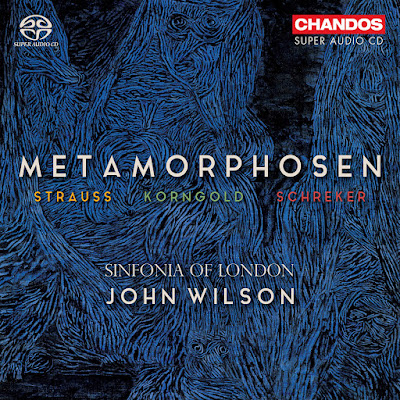
In 2018, conductor John Wilson relaunched the Sinfonia of London, a session orchestra with a long history, particularly in recording film music, and for their second recording with Chandos, they focus on German and Austrian composers, post World War II. Richard Strauss (1864-1949) composed his Metamorphosen, for 23 solo strings in 1945, and it is a heartfelt elegy and a musical realisation in many ways of the horrors that had been experienced in the preceding war. The Sinfonia of London strings here produce a deeply resonant and rich sound, and Chandos deserve credit for achieving precision in the balance, especially when all 23 lines are active. No detail is obscured, and Wilson steers the dynamic swells expertly too. In Strauss there are many climactic moments, and it can lose direction, but here there is a definite trajectory to the warmer major passionate centre, before the opening tragic lamenting material returns following a sudden violent stop. Yet despite the title, there is no metamorphosis into a positive new world – Strauss marks the end ‘In Memoriam’, and the subside into quiet darkness is achingly sad. The short Intermezzo for String Orchestra, Op. 8 by Franz Schreker (1878-1934) is an interesting work, with an opening reminiscent of Schoenberg’s Verklärte Nacht (written at around the same time), but moments of sweet, pastoral string writing too, and perhaps less overall bite. It is given a richly sensitive reading here, with Wilson’s attention to dynamic contrasts providing shape to its overt romanticism. The second half of the disc is given over to the Symphonische Serenade, op. 39 by Erich Korngold (1897-1957). This was composed just before Korngold returned to Austria from the US, during which time he had carved out a successful career in Hollywood, pretty much establishing the Hollywood movie soundworld of the time, and just after he had a heart attack which required him to step back from recording and conducting. Its opening movement shows an immediate shift from the more obvious ‘Hollywood’ sound, with some strident harmonies and tensely dramatic writing. The second movement Intermezzo has virtuosic pizzicato writing, and here the Sinfonia of London players excel, with tight ensemble and rhythmic energy, making the strange brief interjections of glassy bridge bowing and swoops stand out even more. The Lento religioso is heartfelt, but with a Mahlerian profundity that is arresting, and Wilson and the players give this sumptuous weight without any wallowing, and the repeated notes throb with insistent intensity. The violent outburst which interrupts the solace of the central solo passage is positively shocking here, and Wilson certainly extracts maximum drama from the score. The Finale sets off at a cracking pace, and is full of urgent energy. Wilson and the Sinfonia of London are highly impressive throughout these performances, bringing energy, precision and a glorious string sound to this rich repertoire.

Various. 2022. Metamorphosen - Strauss/Korngold/Schreker. Sinfonia of London, John Wilson. Hybrid Super Audio Compact Disc. Chandos CHSA 5292.
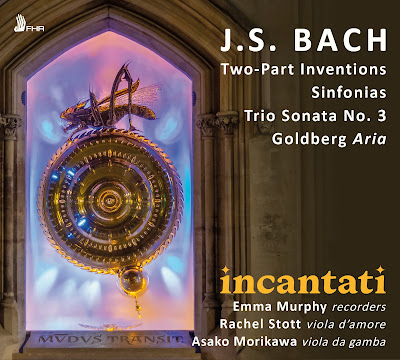
Now for Bach with a difference. The ensemble incantati, which consists of Emma Murphy (recorders), Rachel Stott (viola d’amore) and Asako Morikawa (viola da gamba), have collected together a selection of J. S Bach’s (1685-1750) keyboard works to perform in various combinations of instruments. Pianists will be familiar with the Two-Part Inventions and Sinfonias – basically pieces with two and three separate lines, with an educational intent, to develop playing the independent lines together. The same applies to his Trio Sonatas, or Organ Trios as they were actually written, which involve three parts – essentially two hands and the feet. In playing these with two or three separate instruments, immediately the individual lines come into their own, and no fluidity is lost through trying to negotiate playing them together on a keyboard. But it is in the different timbres of the instruments that add something new here. And that’s where the flexibility of Murphy’s different recorders and voice flutes is a bonus – so sometimes a warm tenor recorder is matched with the sonorous viola da gamba, or a brighter soprano recorder is paired with the slightly more brittle sound of the viola d’amore. They are also careful here in their selection, with the darker, more sombre pieces (eg. the Sinfonia No. 4, or the mournfully sighing No. 9) contrasted with the bright, lighter examples (Inventions Nos. 1 and 2, for example). There are also beautiful renditions of Bach’s chorale tune arrangements, such as the prayerfully lilting Allein Gott in der Höh sei Ehr, and the joyful, dancing Herr Jesu Christ, dich zu uns wend. They end their disc with the Trio Sonata No. 3, with more virtuosic lines for the alto recorder in its first movement, a lightly singing central movement, and a bright (if slightly stately for ‘vivace’) finale. This is then followed by a wonderfully graceful reading of the Aria from the Goldberg Variations, with the viola d’amore this time taking centre stage, and the tenor recorder and viola da gamba providing subtle inner and lower lines. A delightful collection, highly recommended.