Showing posts with label London Symphony Chorus. Show all posts

Friday, 26 August 2022

Prom 49: Glorious, tear-jerking Mahler 2 from Rattle and the London Symphony Orchestra at the Proms

Mahler's 'Resurrection' Symphony in the Royal Albert Hall
© BBC/Chris Christodoulou

Sir Simon Rattle conducts the London Symphony Orchestra
© BBC/Chris Christodoulou

Louise Alder (soprano)
Dame Sarah Connolly (mezzo-soprano)


Sir Simon Rattle (conductor)


7.00pm, Wednesday 24 August 2022


Harrison Birtwistle (1934-2022): Donum Simoni MMXVIII

Gustav Mahler 91860-1911): Symphony No. 2 in C minor, 'Resurrection'
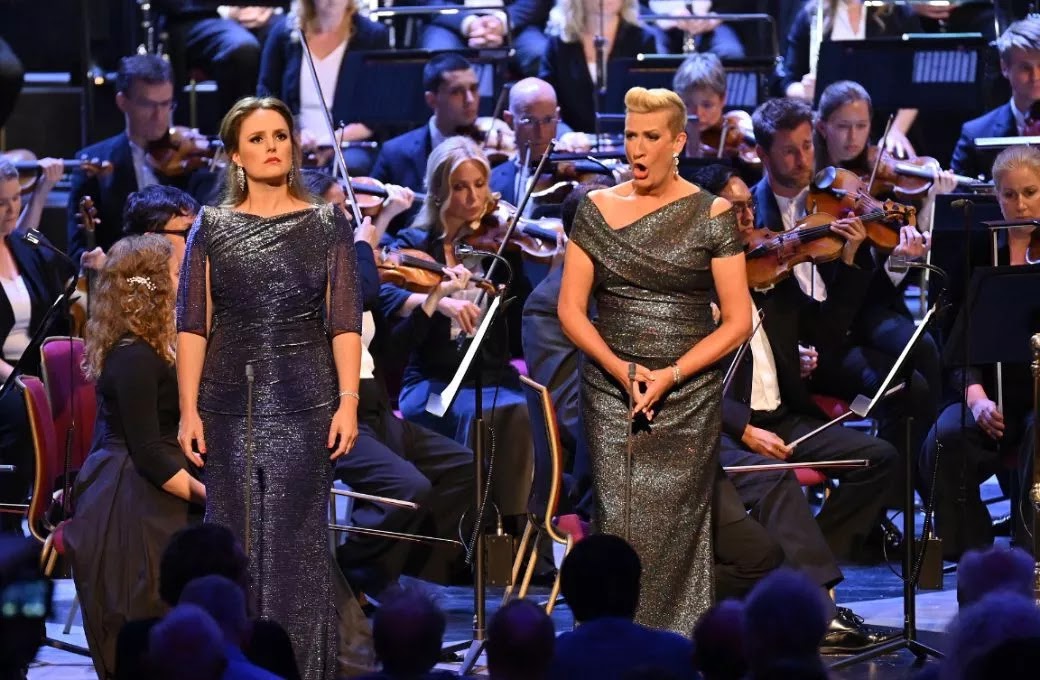
Louise Alder & Dame Sarah Connolly
© BBC/Chris Chrisodoulou
Birtwistle:
'In just three or four minutes, Birtwistle packs in some trademark features, with hefty rasps from trombones and shrill calls from the woodwind, as well as strident percussion effects'.

Mahler:
'Conducting from memory, Rattle immediately gave every sense of confidence and total command'. 

'Dame Sarah Connolly's opening line could not have been more captivating, full of pain and longing, and the rising phrases on 'Himmel' and 'leuchten' had a beautiful pleading intensity, all the more powerful for the understated control on show.

'Simon Halsey deserves credit for the fine preparation of both the London Symphony and CBSO Choruses here. From their first seated arrival with 'Aufersteh’n', fiendishly difficult to sing so quietly after sitting for over an hour, to their full-force explosion of sound in the closing sections, they demonstrated exemplary diction, control and tuning.'

'Soprano Louise Alder, at this point positioned side-stage up by the chorus upper voices, rose beautifully above them, and then joined Connolly on stage for their heartfelt banishments of pain and death'. 

'This ending never ceases to impress, but tonight’s tear-inducing, glorious statement of the power of life over death will be remembered for a long time to come'.

Read my full review on Bachtrack here.

Tuesday, 17 February 2015

Mahler to remember - Berliner Philharmoniker and Sir Simon Rattle's London residency concludes

© Monika Ritterhaus

Sir Simon Rattle and the Berlin Philharmoniker concluded their London residency with two performances of Mahler's Symphony No. 2, 'Resurrection', with soloists Kate Royal (soprano) and Magdalena Kožená (mezzo-soprano), the London Symphony Chorus and the City of Birmingham Symphony Chorus (Chorus Director: Simon Halsey).  The orchestra began the concert with Helmut Lachenmann's (b.1935) Tableau for orchestra.


Royal Festival Hall, Sunday 15 February 2015.


'We were rewarded with a performance to be remembered for some time to come.'

'The choral focus and precision was stunning, with every word still crystal clear, with total commitment and energy for their final climax.'
© Monika Ritterhaus

'A fitting conclusion to a triumphant residency from Sir Simon and the Berliner Philharmoniker.'


Read my full review here.

Friday, 1 March 2013

CD Reviews - March 2013


Brothers Paul and Huw Watkins have released the first volume of an exploration of British works for Cello and Piano.  Their first volume includes Sonatas by Hubert Parry (1848-1918), Frederick Delius (1862-1934), John Foulds (1880-1939) and a short piece, Hamabdil, by Granville Bantock (1868-1946).  The Parry is the earliest work, and it is clearly influenced by his hero, Brahms, and makes use of a four-note motif in the outer movements, with a particularly lyrical middle slow movement.  The Delius Sonata has just one movement, although it has three distinct sections.  Like much of Delius’ music, it has a seemless flow, and this can make his music difficult to shape.  However, the Watkins brothers manage to achieve a sense of direction in the melodic writing for cello and the often chordal piano accompaniment.  Bantock’s Hamabdil is a short setting of a Jewish hymn, and is a delightful miniature, with Paul Watkins relishing in the cadenza writing for the cello.  They close the disc with the most interesting work – Foulds’ expansive Sonata from 1905 (although it survives only in the revised version from 1927).  It is an extrovert, expansive work, with a curious mix of romanticism and more innovative techniques, such as whole tone scales, and quarter tones.  The slightly queasy-making use of quarter tone double-stopping in the slow movement, over chilly open octaves in the piano is particularly striking, and very effective.  Overall, enjoyable performances of four varied works, all previously unknown to me.  I await Volume 2 with interest.


Briefly, check out two re-releases of music by Zoltán Kodály (1882-1967).  The recordings date from the late sixties to seventies, and one disc include the Háry János Suite, the Dances of Galánta, and ‘The Peacock Variations’ (sung by London Symphony Chorus), whilst the other is a two disc set, with Psalmus Hungaricus, Missa Brevis, Pange Lingua, Psam 114, the Hymn of Zrinyi and Laudes Organi, all sung here by Brighton Festival Chorus (before my time singing with them, but many current members took part in the recordings).  István Kertész conducts the London Symphony Orchestra on the first disc, and in Psalmus Hungaricus – this recording was described by the Penguin Guide as ‘splendidly vibrant’ and ‘outstanding’ (March et al, 2003, p678), and BFC’s founding conductor, László Heltay conducts the other works.  The second set is filled with Sir Georg Solti conducting the Budapest Festival Orchestra in his final recording, of Bartók’s Cantata Profana.  So a couple of great budget price discs, covering the key choral works of Kodály, with excellent performances from Brighton’s own Chorus – see here for a chance to hear us this month. 


March, I. et al. (Eds.) The Penguin Guide to Compact Discs & DVDs 2003/4 Edition. 2003. Penguin Books, London.


(Edited versions of these reviews first appeared in GScene magazine, March 2013)