Showing posts with label Mahler. Show all posts

Tuesday, 21 October 2025

Playful Coleridge-Taylor contrasting with dramatic Mahler from the Brighton Philharmonic Orchestra

Elena Urioste
 © Chris Gloag

Elena Urioste (violin)

Alice Farnham (conductor)
Ruth Rogers (leader)

2.45pm, Sunday 19 October 2025


Coleridge-Taylor, Samuel (1875-1912): Violin Concerto in G minor, Op. 80

Encore:
Arlen, Harold (1905-1986): Over the Rainbow (?arr. Poster, Tom (b.1981))

Mahler, Gustav (1860-1911): Symphony No. 5


For their latest programme, ‘The Romantics’, the Brighton Philharmonic Orchestra presented two highly contrasting works, with Mahler’s mighty Symphony No. 5 following the lighter offering of Samuel Coleridge-Taylor’s Violin Concerto in G minor, Op. 80. Ben Gernon was originally scheduled to conduct the concert but was replaced by Alice Farnham, whose combination of precise direction and energy made for a highly engaging afternoon’s programme. Of course it shouldn’t be worthy of note, but it’s great to see an all-female roster (for the second time this season) of conductor, soloist (Elena Urioste) and leader (Ruth Rogers) – with Music Director Joanna MacGregor the overall driving force. 

Elena Urioste
© Nick Boston

Violinist Elena Urioste was born in the US, and has an established solo career, performing with orchestras around the world. She is also a committed chamber music, with her Chamber Music by the Sea festival in Maryland celebtrating its tenth anniversary this year. She also co-founded with her partner, Tom Poster, the Kaleidoscope Chamber Collective, frequent performers at the Wigmore Hall and at the most recent Coffee Concert at Brighton Corn Exchange. She first performed Samuel Coleridge-Taylor’s Violin Concerto with Chineke! in 2019, recorded it with them in 2022, and has become a strong advocate for the somewhat neglected work. It’s an open-hearted piece, full of lyrical invention and plenty of opportunity for a virtuoso soloist to shine. Born in Croydon, of mixed Sierra Leonean and English heritage, Coleridge-Taylor originally intended to use spirituals for the melodic material of his Violin Concerto, but wasn’t happy with his attempts, deciding instead to use his own thematic ideas. Of course, Dvořák’s take on ‘American’ music also must have had an influence to bear here too, but the resulting work has a great sense of fun and individual style, which Urioste communicated here with great enthusiasm. 

Following the brassy stately opening from the orchestra, Urioste launched with a flourish into the first melodic idea, and from there, delivered each episodic entry with panache, at one point dancing her line over the accompanying pizzicato strings, and elsewhere injecting just enough bite to point up her dotted rhythms over the full orchestra. That dotted rhythm featured highly in her impressive cadenza, leading to a dramatic conclusion from the orchestra. The second movement is unashamedly lyrical, and the BPO strings set up just the right kind of muted accompaniment to allow Urioste to sing the silky lines above them. Orchestral ensemble was kept tight by Farnham through the ebb and flow of the rubatos whilst Urioste’s tender solos roamed effortlessly. The sprightly finale is once again packed with thematic invention, and Urioste and Farnham drove on through with playful energy (accompanied by frequent audible foot-tapping from Urioste). Virtuosic downward scale passages and skittering runs were aplenty, and weighty tuttis from the orchestra made for a brightly dramatic conclusion. In stark contrast, Urioste gave a simple yet highly tender rendition of Over the Rainbow by Harold Arlen (arranged I believe by Tom Poster), with gentle double-stopping providing some harmony, but the emphasis being on the beauty of the melodic line, delighting the Brighton audience.


Alice Farnham & the Brighton Philharmonic Orchestra
© Nick Boston
In contrast to the light-hearted ease of the Coleridge-Taylor, Mahler’s Symphony No. 5 was of course a completely different matter. The funereal opening movement immediately takes things in a darker direction, and the challenge for the orchestra is equally weightier. There is a great deal of pressure on many soloists from the orchestra, chiefly the trumpet and horn, and on the whole, the BPO acquitted themselves very well. It has to be said, however, that the overall strike rate today of brass splits was relatively high, which was a pity. The first movement’s woodwind dance had finesse, with some wild car-chase strings to follow, and Farnham steered the orchestra through with great clarity, although the latter part of the movement lost a little forward momentum. The screaming opening of the second movement had great drive, and the concluding brass chorale gleamed brightly, although the central marching section could have taken a bit more bite. The Scherzo had lilt and swagger, although at times a little too precisely measured, and once again, it was the woodwinds that shone the most, with the pecking bassoon and delicately precise oboe proving most noteworthy. The Adagietto was beautifully shaped by Farnham, with warm and tender playing from the strings, and sumptuous playing from harpist Alex Rider. The finale raised the mood, with precise horn and woodwind solos leading to the cellos deftly setting off the playful fugal section that followed. The orchestra appeared more in their element now, and the brass climaxes, swaying strings and woodwind interjections were knitted together with momentum by Farnham, with the final accelerando racing to a spectacular finish. So if not the most precise Mahler 5 at every point, Farnham and the BPO certainly delivered a performance with high energy and many great moments. 

Wednesday, 11 September 2024

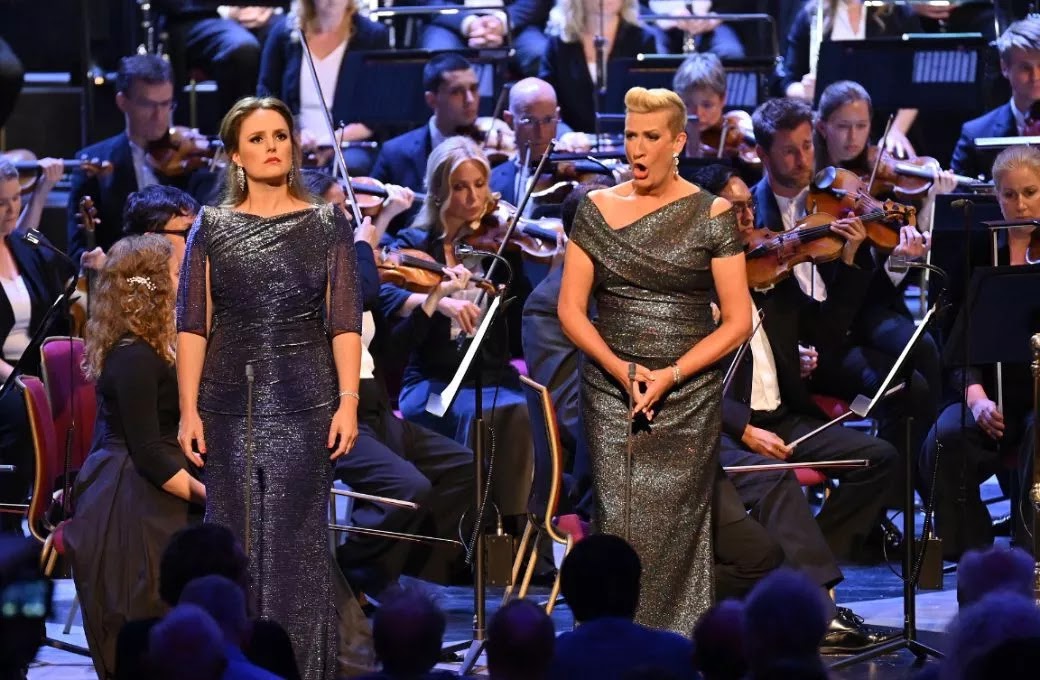
Rattle and the Bavarian RSO offer a glimmer of hope in epic Mahler 6

Sir Simon Rattle conducts the
Bavarian Radio Symphony Orchestra
© BBC/Chris Christodoulou

Sir Simon Rattle (conductor)

8pm, Friday 6 September 2024


Gustav Mahler (1860-1911): Symphony No. 6 in A minor (1903-4, rev. 1906)


The Bavarian Radio Symphony Orchestra percussionists
© BBC/Chris Christodoulou

'With short phrases thrown around the orchestra, detail can easily get lost, or lack connection. Yet Rattle (without score) led from one to the other, and just watching him alone delivered complete coherency'.  

'... alone at the top of the staging was a large, beehive-like wooden box on legs. At the appointed moment, the percussionist rose from his seat below, solemnly walked up the steps, picked up the huge mallet, and then scared the living daylights out of the audience in the choir stalls behind, hitting the box with such force it jumped around on the stage. Thankfully it didn’t fall to bits, and no swarm of bees emerged'.

'In the Scherzo, Rattle contrasted the violent, twisted march with the pecking, petulant woodwind, but also brought out the laughing violas alongside the shrill E flat clarinet at the movement’s end'. 

The Bavarian Radio Symphony Orchestra woodwinds
© BBC/Chris Christodoulou

'From the dreamlike opening with weirdly twanging, muted harp effects and more offstage cowbells, to the galloping brass and trilling birdlike woodwinds, the BRSO demonstrated their unquestionable prowess and ability to produce stunning orchestral colour'.

'In the finale, Rattle and the BRSO excelled'.

Read my full review on Bachtrack here.


Sir Simon Rattle & the Bavarian Radio Symphony Orchestra
© Nick Boston


Thursday, 21 September 2023

Vladimir Jurowski and the Bayerisches Staatsorchester make it all look so easy

Louise Alder (soprano)
Vladimir Jurowski (conductor)

7.30pm, Tuesday 19 September, 2023


Yefim Bronfman & the Bayersiches Staatsorchester
© Mark Allan/Barbican
Richard Wagner (1813-1883): Prelude to Tristan und Isolde

Robert Schumann (1810-1856): Piano Concerto in A minor, Op. 54

Encore:

Frédéric Chopin (1810-1849) – Nocturne in D flat major, Op. 27 No. 2

Gustav Mahler (1860-1911): Symphony No. 4 in G major

Encore:

Mahler: Suite aus den Orchesterwerken (Bach, Johann Sebastian), 4. Air

(from Suite No. 3 in D major, BWV 1068)


Wagner:
'From the opening bars ... Jurowski commanded silence in the portentous rests, with knife-edge precision from the strings, leading up to ‘that’ chord; the strings were indeed the stars of the show'. 

Louis Alder & the Bayerisches Staatsorchester
© Mark Allan/Barbican
Schumann:
'Yefim Bronfman delivered effortlessly clean Schumann'.

'it was his delicacy and tenderness in the ‘Clara’ second subject of the opening movement, and his fairy-like embellishments at the top of the keyboard in the finale that stood out'.

Mahler:
'Jurowski brought out every little detail, but it never felt that he was stressing the point'.

'Louise Alder set the mood perfectly, with intense communication of the text ... Alder’s rich tone and intensity of expression lifted this way beyond the straightforward'.

Read my full review on Bachtrack here.

Friday, 26 August 2022

Prom 49: Glorious, tear-jerking Mahler 2 from Rattle and the London Symphony Orchestra at the Proms

Mahler's 'Resurrection' Symphony in the Royal Albert Hall
© BBC/Chris Christodoulou

Sir Simon Rattle conducts the London Symphony Orchestra
© BBC/Chris Christodoulou

Louise Alder (soprano)
Dame Sarah Connolly (mezzo-soprano)


Sir Simon Rattle (conductor)


7.00pm, Wednesday 24 August 2022


Harrison Birtwistle (1934-2022): Donum Simoni MMXVIII

Gustav Mahler 91860-1911): Symphony No. 2 in C minor, 'Resurrection'

Louise Alder & Dame Sarah Connolly
© BBC/Chris Chrisodoulou
Birtwistle:
'In just three or four minutes, Birtwistle packs in some trademark features, with hefty rasps from trombones and shrill calls from the woodwind, as well as strident percussion effects'.

Mahler:
'Conducting from memory, Rattle immediately gave every sense of confidence and total command'. 

'Dame Sarah Connolly's opening line could not have been more captivating, full of pain and longing, and the rising phrases on 'Himmel' and 'leuchten' had a beautiful pleading intensity, all the more powerful for the understated control on show.

'Simon Halsey deserves credit for the fine preparation of both the London Symphony and CBSO Choruses here. From their first seated arrival with 'Aufersteh’n', fiendishly difficult to sing so quietly after sitting for over an hour, to their full-force explosion of sound in the closing sections, they demonstrated exemplary diction, control and tuning.'

'Soprano Louise Alder, at this point positioned side-stage up by the chorus upper voices, rose beautifully above them, and then joined Connolly on stage for their heartfelt banishments of pain and death'. 

'This ending never ceases to impress, but tonight’s tear-inducing, glorious statement of the power of life over death will be remembered for a long time to come'.

Read my full review on Bachtrack here.

Monday, 5 June 2017

Stimulating programming and powerful performances from Lawrence Power, the Philharmonia and Gustavo Gimeno

Gustavo Gimeno (© Marco Borggreve)

Gustavo Gimeno (conductor)
Lawrence Power (viola)

Philharmonia Orchestra

Thursday 1 June 2017

Royal Festival Hall, London


Ligeti: Concerto Românesc

Salonen: Pentatonic Etude for Solo Viola

Bartók: Viola Concerto, Sz 120

Mahler: Symphony No. 1 in D major, 'Titan'

Ligeti: 'Gimeno elicited energy and spark from the Philharmonia players, as well as many commanding solos'.


Salonen: 'Power communicated with great conviction, proving a strong advocate for this striking miniature'.

Bartók: 'Power maintained the level of intensity (...) communicating constantly with Gimeno and the orchestral players'.


Mahler: A 'tightly controlled performance, with moments of great delicacy as well as power'.


Read my full review on Backtrack here.


Wednesday, 12 April 2017

CD Reviews - April 2017


Alexander Scriabin (1872-1915) was born just one year before fellow pianist-composer, Rachmaninov, with whom he also studied at the Moscow Conservatory.  Of course Rachmaninov outlived Scriabin by many years, but also Scriabin’s music quickly went in a much more dissonant and individual direction than the ostensibly more accessible and tonal music of his contemporary.  Scriabin was fascinated by synesthesia (where people ‘see’ sounds as colours, for example).  Whilst it is unlikely that he was actually synesthetic himself, it had a strong influence on his harmonic theory, together with a fascination with mysticism and theosophy.  Consequently, his music can be hard to make immediate sense of, but then as his ten Piano Sonatas demonstrate, once you join his soundworld, there is much to reward your attention.  Peter Donohoe remarkably performs all ten sonatas in a single concert (well over two hours of music).  There is a lot to be said for hearing all ten in sequence, as they amply demonstrate the composer’s progression through the 21 years of their composition, and the building complexity of his style draws you in.  In the first four sonatas, he alternated between a four-movement structure and his more favoured two-movement form of a slow/fast combination.  From the fifth sonata onwards, he used a single movement, although often still following that slow/fast pattern.  The first sonata was written when he was 20, when he had damaged his right hand from over-practising virtuosic works, and thought it was the end of his performing career.  It is moody and dark, with a funeral march as its finale, already looking forward from its Chopinesque roots.  A freer second sonata, inspired by his first sight of the sea in Latvia, is followed by the deeper, soul-searching third, with its chromatic lines and turbulent mood.  The Wagnerian harmonies of the fourth are almost jazz-like and improvisatory in places, and the fifth has an incredibly passionate climax, with hammering chords.  By the sixth sonata, conventional tonality is almost gone, and the mysterious harmonies are deeply unsettling – even Scriabin found it ‘frightening’ and wouldn’t play it in public.  The ‘White Mass’ nickname of the seventh builds on the combination of weighty textures, contrasted with extensive use of rippling trills.  The eighth is more anxious than overtly turbulent, which Donohoe brings out well, with some almost skittish, impetuous passages, before disappearing away to nothing. The ninth, ‘Black Mass’, is full of ‘satanic’ tri-tones and chromatic scales, whereas the final sonata, which he described as his ‘sonata of insects’, is full of light and radiance.  This two-disc set is rounded off by one of Scriabin’s last works from the year before his death.  ‘Vers la Flamme’ is his representation of rising heat, growing from nothing to brilliance, with the heat of the sun eventually destroying the world.  So, a mammoth range here, and Donohoe takes us on a wild journey through these highly individual works.  The weight of his playing, particularly in the rapturous seventh, as well as his anxious filigree in the eighth, and the full-on romantic flourishes of the fourth and fifth amply demonstrate his phenomenal range.  The virtuosic command on show here is almost forgotten as the depth of his performances of these dark and complex works engulfs you. 


German mezzo-soprano Gerhild Romberger, together with pianist Alfredo Perl, has recorded three of Gustav Mahler’s (1860-1911) most well-known song cycles.  Most of the songs present here are better known in their orchestrated versions, so it is good to hear them in this form.  One might assume the piano versions came first, but in fact some were written after the orchestrated versions.  Here we have the Rückert-Lieder, the Kindertotenlieder (also with texts by Friedrich Rückert), and the Lieder eines fahrenden Gesellen (‘Songs of a Wayfarer’).  Romberger has a rich mezzo voice, well suited for Mahler, and can regularly be heard in performances of the symphonies, appearing several times at the Proms.  Her full tones are demonstrated in ‘Blicke mir nicht in die Lieder’ from the Rückert-Lieder, yet in the first of this set, ‘Liebst du um Schönheit’, his private piece for Alma and the only one he didn’t orchestrate himself, the tender lifts to the high notes have great poise.  Romberger gives a heartfelt performance of ‘Ich bin der Welt abhanden gekommen’, although perhaps a little over controlled for this desperate plea.  The ‘Lieder eines fahrenden Gesellen’ have strong links with the first symphony, the rustic ‘Ging heut morgen…’ and the melancholic ‘Die zwei blauen Augen’ both appearing there.  However, it is in the third song here, ‘Ich hab’ ein glühend Messer’, that Romberger gives full vent, with wild anguish and high drama.  In the heartfelt Kindertotenlieder, which draw on some of the 428 poems Rückert wrote following the death of his two children, Romberger again shows great control in the rising lines of ‘Nun seh’ ich wohl’, and pianist Perl has the opportunity to shine in the first song of the cycle.  Overall, this is a commanding set, and Romberger and Perl present a strong argument for these pared down versions of Mahler’s finest songs.


The Doric String Quartet has released their second CD of String Quartets by Franz Schubert (1797-1828).  Following on from the success of the first, they remain in the later reaches of Schubert’s string quartet output, pairing the wonderful ‘Quartettsatz’, D703, a single movement of his projected but unfinished twelfth quartet, with his final String Quartet in G major, D887.  In the Quartettsatz, the Dorics open with glassy determination, giving this miniature masterpiece great clarity and energy.  The final String Quartet in contrast comes it at over fifty minutes, and is a mighty challenge.  Again, the Dorics attack this with high energy, intensity and precision throughout.  There is high drama here, and despite the G major key, Schubert shifts between major and minor right at the start, highlighting the conflicting moods that run throughout the work.  The Dorics give the frequent tremolandi an edge of anxiety, and the slow movement is dark and mournful.  It is only in the Trio of the Scherzo that follows that there is any sense of calm, and the players relish the successive duet writing here.  But the finale dashes all this to one side, and in its relentless race to the finish, the players never lose attention to detail, whilst maintaining impressive intensity and energy to the last.  Catch them in the Brighton Festival, playing Haydn, Brahms & Adams (26 May).

Schubert, F. 2017. String Quartet in G major, String Quartet in C minor 'Quartettsatz'. 

(Edited versions of these reviews first appeared in GScene, April 2017)