Showing posts with label London Symphony Orchestra. Show all posts

Sunday, 6 April 2025

Convincing MacMillan from Benedetti contrasts with Noseda's full-on Shostakovich

Nicola Benedetti & the London Symphony Orchestra
© LSO/Mark Allan

Gianandrea Noseda (conductor)

7pm, Thursday 3 April 2025


Dmitri Shostakovich (1906-1975): Festive Overture, Op. 96
James MacMillan (b.1959): Violin Concerto No. 2
Shostakovich: Symphony No. 12 in D minor, Op. 112, 'The Year 1917'

Festive Overture:
'Noseda took the LSO through a tight and spirited rendition, with strong articulation from the strings in particular'.

Gianandrea Noseda conducts the London Symphony Orchestra
© LSO/Mark Allan
MacMillan:
'There’s a particularly aggressive central solo, where Benedetti didn’t hold back on, producing lots of extra ‘noise’ from the bow and wood of the instrument, and she also mesmerised with rapid minimalist repetitions, as well as rising trills at the opening'.

'... towards the end MacMillan’s master stroke, a series of duets between the soloist and different instruments, started playfully with the double bass and ended with a sweet duet with the leader'.

Symphony No. 12:
'There was a relentlessness to the sheer intensity and volume here, but Noseda and the orchestra kept us with them by fully exploiting the moments of ‘downtime’, few and far between though they are'.

'That full-on finish, a feat of stamina for all involved, was indeed electric, but within that, Noseda still managed to shape some of the final surges, almost running forward to the edge of the podium and back'. 

Read my review on Bachtrack here.


Saturday, 22 June 2024

Evocative Beamish and commanding Prokofiev from Noseda and the LSO

Sally Beamish, Martin Fröst, Janine Jansen & Gianandrea Noseda
© Mark Allan
Janine Jansen (violin)
Martin Fröst (clarinet)
Gianandrea Noseda (conductor)

7pm, Thursday 20 June 2024


Ludwig van Beethoven (1770-1827): Overture: Leonore No. 3, Op. 72b

Sally Beamish (b.1956)Distans: Double Concerto for Violin & Clarinet

Sergei Prokofiev (1891-1953): Symphony No. 7 in C sharp minor, Op. 131


Martin Fröst, Janine Janse & Gianandrea Noseda
© Mark Allan

Beethoven:

'Lively woodwind and precise skittering strings demonstrated the LSO’s expert ensemble'.


Beamish:

'Following more virtuosic skirmishes from the highly mobile and animated soloists, and droning strings evoking the nyckelharpa, complex, jerky rhythms abounded, with Noseda keeping a tight rein'. 


'The highly expansive second movement conjured up open landscape, distance and longing, with birdlike flourishes from the soloists and bell-like percussion'.


Gianandrea Noseda conducts the LSO
© Mark Allan


Prokofiev:

'Noseda had a strong command throughout here, and from the opening angular violin theme, with cellos responding in kind, through to woodwind solos in the third movement’s relentless melodic line, orchestral precision was impressive'.


'... an emphatically commanding performance from Noseda and the LSO to end a highly engaging concert'.


Read my full review on Bachtrack here.


Saturday, 20 April 2024

Classical Music at the Brighton Festival 2024

Antonio Pappano
Brighton Festival is soon upon us, and as ever, there is a great line-up of classical music on offer. Opening the Festival, new Chief Conductor, Sir Antonio Pappano brings the London Symphony Orchestra to the Dome Concert Hall to play Rachmaninov’s Symphony No. 2. They open with Barber’s Adagio for Strings, and are joined by pianist Bertrand Chamayou for Ravel’s Piano Concerto in G major (Saturday 4 May, 7pm).


Harpsichordist Mahan Esfahani is joined by Britten Sinfonia soloists for a concert of Bach at Glyndebourne, performing two Keyboard Concertos, and the Brandenburg Concertos Nos 2 & 5 (Sunday 3 May, 3pm). Slipping through the net of the printed brochure, a late addition to the Festival is the wonderful Baroque ensemble, Solomon’s Knot, performing Scarlatti, Bach and Handel’s Dixit Dominus (Thursday 9 May, 8pm, Corn Exchange).


12 Ensemble
12 Ensemble will perform Strauss’ Metamorphosen alongside an immersive holographic visual experience created by Ben Ditto. A new work by Edmund Finnis drawing on Byrd, and an instrumental aria by Oliver Leith from his opera about Kurt Cobain’s suicide will sit alongside Claude Vivier’s Zipangu (Thursday 16 May, 8pm, Corn Exchange). Then The Heath Quartet will be in the glorious Music Room at the Royal Pavilion to play Haydn, Korngold, Lyadov and Henriëtte Bosmans (Wednesday 22 May, 8pm).


Ed Hughes' new opera, States of Innocence, based on John Milton’s Paradise Lost, will be premiered at the Corn Exchange, with cast including Sir John Tomlinson. Texts are adapted from Milton by Peter Cant, and Ian Winters provides video projection design (Sunday 19 May, 6.30pm & 8.45pm). 


Danielle de Niese
Soprano Danielle de Niese, lead in this summer’s Glyndebourne production of The Merry Widow, comes to the Corn Exchange to share an evening of song by Debussy, Gershwin, Sondheim and James MacMillan (Monday 20 May, 7.30pm). And contralto Hilary Summers and pianist Andrew West take a humerous swipe at opera in What’s So Great About Opera? (Wednesday 8 May, 6pm, Studio Theatre). 


The Brighton Festival Youth Choir, conducted by Juliette Pochin, perform Cecilia McDowall’s cantata, The Girl from Aleppo (Saturday 11 May, 6pm, All Saints, Hove). For more on this piece, I reviewed the National Children’s Choir of Great Britain’s recording of it back in 2020 here. They are followed the same evening by the Brighton Festival Chorus, performing the UK premiere of Kim André Arnesen’s The Stranger, weaving together refugee poems and multi-faith texts emphasising our common humanity (Saturday 11 May, 8.30pm, All Saints). Meanwhile, Brighton and East Sussex Youth Orchestra bring us Rimsky-Korsakov’s Scheherazade, with storyteller Alia Alzougbi retelling some of the tales of the 1001 nights. Former BESYO trumpeter, Alan Thomas returns to join the orchestra to perform Artunian’s Trumpet Concerto (Monday 13 May, 7.30pm).


Apollo's Cabinet
Lunchtime concerts return to the Dome complex. In the newly refurbished Studio Theatre, Pianist Hao Zi Yoh plays Haydn, Ravel, Rachmaninov & Albéniz, as well as a piece by Malaysian pianist composer, Chong Lim Ng (Tuesday 7 May, 1pm), then counter-tenor Hugh Cutting and mezzo-soprano Rebecca Leggett, with George Ireland on piano, perform words and music by Butterworth, Belloc, Vaughan Williams and Virginia Woolf (Wednesday 8 May, 1pm). BREMF Live! artists, Apollo’s Cabinet explore the travels of Charles Burney, with music by Telemann & Schmelzer (Thursday 9 May, 1pm), then the Elmore Quartet play Webern and Brahms (Friday 10 May, 1pm). There are two more pianists – first Lithuanian Ignas Maknickas plays Schumann, Bortkiewicz, Chopin and Charles Vine (Wednesday 15 May, 1pm), then over to the Corn Exchange for Japanese pianist, Shunta Morimoto, playing Schubert, Bach, Chopin and Schumann (Friday 22 May, 1pm). In between, the Fibonacci Quartet play Mozart & Mendelssohn (Friday 17 May, 1pm) and the ever-popular Glyndebourne Jerwood Young Artists perform a range of favourites – this year, two sopranos and two tenors (Monday 20 May, 1pm). 


Details of all concerts, venues and tickets here.

Friday, 26 August 2022

Prom 49: Glorious, tear-jerking Mahler 2 from Rattle and the London Symphony Orchestra at the Proms

Mahler's 'Resurrection' Symphony in the Royal Albert Hall
© BBC/Chris Christodoulou

Sir Simon Rattle conducts the London Symphony Orchestra
© BBC/Chris Christodoulou

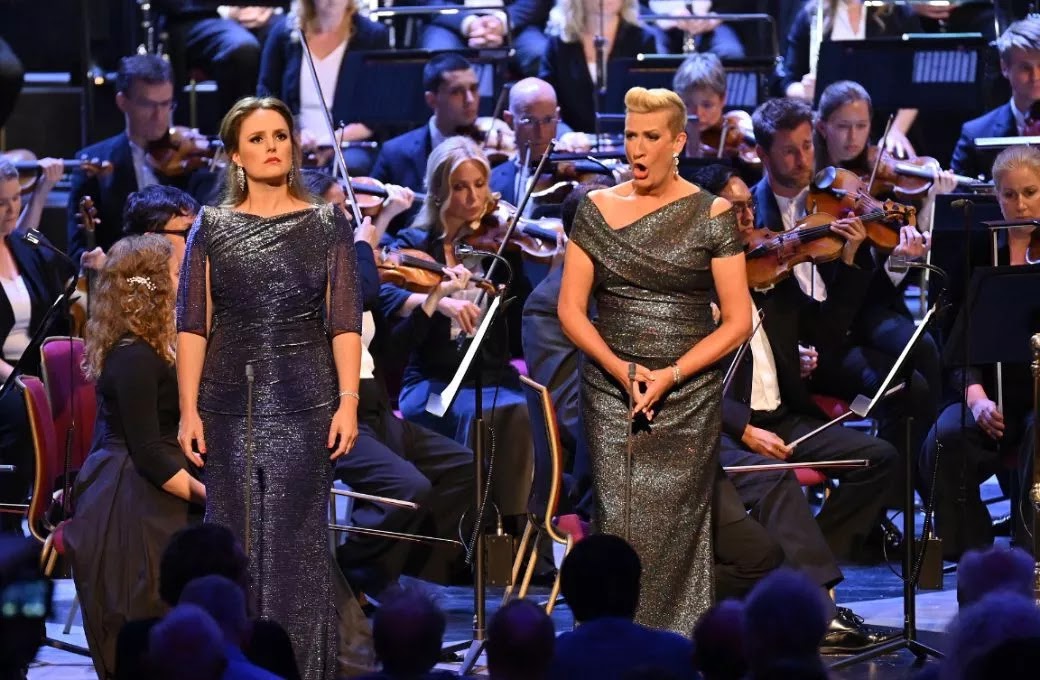
Louise Alder (soprano)
Dame Sarah Connolly (mezzo-soprano)


Sir Simon Rattle (conductor)


7.00pm, Wednesday 24 August 2022


Harrison Birtwistle (1934-2022): Donum Simoni MMXVIII

Gustav Mahler 91860-1911): Symphony No. 2 in C minor, 'Resurrection'

Louise Alder & Dame Sarah Connolly
© BBC/Chris Chrisodoulou
Birtwistle:
'In just three or four minutes, Birtwistle packs in some trademark features, with hefty rasps from trombones and shrill calls from the woodwind, as well as strident percussion effects'.

Mahler:
'Conducting from memory, Rattle immediately gave every sense of confidence and total command'. 

'Dame Sarah Connolly's opening line could not have been more captivating, full of pain and longing, and the rising phrases on 'Himmel' and 'leuchten' had a beautiful pleading intensity, all the more powerful for the understated control on show.

'Simon Halsey deserves credit for the fine preparation of both the London Symphony and CBSO Choruses here. From their first seated arrival with 'Aufersteh’n', fiendishly difficult to sing so quietly after sitting for over an hour, to their full-force explosion of sound in the closing sections, they demonstrated exemplary diction, control and tuning.'

'Soprano Louise Alder, at this point positioned side-stage up by the chorus upper voices, rose beautifully above them, and then joined Connolly on stage for their heartfelt banishments of pain and death'. 

'This ending never ceases to impress, but tonight’s tear-inducing, glorious statement of the power of life over death will be remembered for a long time to come'.

Read my full review on Bachtrack here.

Friday, 9 April 2021

Style, vibrancy and vitality from John Wilson and the LSO

John Wilson (conductor)

Streamed Thursday 8 April 2021, 7pm at MarqueeTV
(available free for 7 days, then on demand through subscription)
Recorded 11 March 2021


Richard Rodney Bennett (1936-2012): Partita

Maurice Ravel (1875-1937): Valses nobles et sentimentales

George Gershwin (1898-1937), arr. Robert Russell Bennett (1894-1981): Porgy and Bess: A Symphonic Picture

John Wilson & the LSO
© London Symphony Orchestra
Bennett:
'A great opening to this concert showcasing Wilson’s tight, detailed approach and the LSO’s commitment to precision and excellence'.

Ravel:
'Wilson and the LSO players relished in the silky textures and surging waves, with delicate precision in the many solo wind passages'.

Gershwin:
'Wilson showed his command, steering the LSO through the frequent mood changes, and handling the contrasting rhythms and tempi shifts without letting the joins show'.

'The Finale was infectiously joyous, with bright brass and fulsome strings. An uplifting conclusion to an evening full of warmth, fun and vitality'.

Read my full review on Bachtrack here.

Friday, 22 January 2021

Darkly intense Berg from Kavakos, with uplifting Schubert from Rattle and the LSO

Leonidas Kavakos
© London Symphony Orchestra
Leonidas Kavakos
(violin)
Sir Simon Rattle (conductor)

Streamed Thursday 21 January 2021 at Marquee TV
(available free for 7 days, then on demand through subscription)
Recorded Thursday 7 January 2021


Alban Berg (1885-1935): Violin Concerto 'To the Memory of an Angel'

Franz Schubert (1797-1828): Symphony No. 9 in C major D944, 'The Great'

Sir Simon Rattle & the LSO
© London Symphony Orchestra
Berg:
'His incisive virtuosity brought a moving intensity'. 

'Kavakos’ effortless cadenza passages, with a tolling solo line combined with fiendish left hand pizzicato, was captured well by close-up camerawork and his lament, joined by the bassoons, was heartrending'.


Juliana Koch
© London Symphony Orchestra
Schubert:
'Rattle’s Andante (often taken too slowly) had energy, yet it didn’t feel rushed'.


'Through the endless stream of Schubert’s ideas, Rattle maintained the momentum, driving through with the racing strings to blazing trumpets and a glorious finish'.

Read my full review on Bachtrack here.

Saturday, 21 September 2019

Uplifting Romantic giants from Ax, Rattle and the LSO

Emanuel Ax, Sir Simon Rattle
& the LSO
© Kevin Leighton
Emanuel Ax (piano)
London Symphony Orchestra
Sir Simon Rattle (conductor) 

Wednesday 18 September 2019, 7pm

Barbican Hall, London


Johannes Brahms (1833-1897): Piano Concerto No. 2 in B flat major, Op. 83

Encore:
Robert Schumann (1810-1856): Fantasiestücke, Op. 73 No. 1

Sergei Rachmaninov (1873-1943): Symphony No. 2 in E minor, Op. 27


Emanuel Ax
© Kevin Leighton
'Ax and Rattle ensured that the balance between piano and orchestra were always controlled'.

'The warm, silky sound of Tim Hugh’s solo cello, combined with Ax’s delicacy ... made for an exquisite slow movement'.

'Rattle never allowed the surges of romantic passion here to get too carried away ... so that the impact of the brief passionate climax when it finally arrived was all the more powerful'.

'Rattle and the LSO, along with Ax, succeeded here in making an evening of such weighty masterpieces feel airy, uncluttered and suitably uplifting, a true pleasure to experience'.

Read my full review on Bachtrack here.

Thursday, 20 September 2018

Something special in the air: Rattle and the LSO in energetic Sibelius 5

© Mark Allan/Barbican

Janine Jansen (violin)

Sir Simon Rattle (conductor)

London Symphony Orchestra

Wednesday 19 September, 2018

Barbican Hall, London


Janáček: Sinfonietta, Op. 60

Szymanowski: Violin Concerto No.1 Op. 35

Sibelius: Symphony No. 5 in E flat major, Op. 82

'A fine example of live performance in every sense, and it was evident that ... the orchestra was having a ball'. 

'Janine Jansen, from the violin’s first solo entry, was in command of this tricky piece', with 'impressive focus and intensity of tone'.

'Rattle and the LSO ... gave this a freshness and energetic spirit such that one was made to listen anew throughout'.

'A highly exciting whirlwind of a rendition'.

Read my full review on Bachtrack here.


Thursday, 8 June 2017

Brighton Festival 2017


Tuesday, 14 July 2015

CD reviews - July 2015

Canadian pianist Louis Lortie has reached the fourth volume of his recordings of Chopin’s piano works, and for this latest release he again uses Nocturnes to vary the programme of the disc’s main genre focus, in this case the Waltzes.  He also doesn’t present the waltzes in chronological or numerical order, but favours a more logical order in terms of key relationships, so that the disc makes for a pleasurable programme for the listener.  Of all his genres, the Waltzes might initially appear to be the least profound – in fact Chopin only thought eight were worthy of publishing as proper ‘works’ in his lifetime.  Included here however are eleven further Waltzes published posthumously – of these, one (B150, which opens the disc) is considered spurious, and a further one (B46) is now considered to be probably by one of Chopin’s students. Lortie’s performances here emphasise the dance qualities of these short miniatures, of which only a couple top five minutes, and most are around two minutes long. He has a lightness of touch, even in the more virtuosic moments, such as in Op. 70 No. 1, never letting the rapid figurations get bogged down in any way. He uses rubato (a pulling about of the tempo) appropriately but never indulgently, and the tempi of the faster examples (such as the famous Minute Waltz’, Op. 64 No. 1, and the Grande Valse Brillante, Op. 18) are perfectly judged.  However, the downside of this focus on the dance means that one or two of the slower Waltzes feel slightly rushed – the darker A minor Waltz, Op. 34 No. 2, marked ‘lento’, for example, needs a bit more time to emphasise the mournful, mysterious outer sections.  Yet there are moments where the poignancy and delicacy of Chopin at his most deceptively simple really shine through. The five Nocturnes on offer here, towards the end of the programme, pick up on the darker atmosphere, particularly in Op. 32 No. 1, whose simple lyrical opening leads through darker moods to a strange, dramatic recitative ending.  The disc ends in a brighter mood, however, with the lilting ballad-like Op. 37 No. 2. A most interesting presentation of the Waltzes, with Lortie once again showing himself to be a thoughtful and insightful performer.


British conductor Sir Andrew Davis lives in Chicago where he conducts the Lyric Opera, but he must spend a lot of time in the air, as he also conducts the Toronto Symphony Orchestra, the BBC SO and the Melbourne Symphony Orchestra, and it is with the last of these that he has released a live recording of an all-Strauss programme.  The disc opens with a lively performance of the swashbuckling tone poem, Don Juan. They performed this when they visited the Proms in London in 2014.  It was well-received then, and Davis certainly brings out the detail of this imaginatively (and challengingly for most instruments) scored piece here, letting the music tell the story, making this a great disc opener.  This is followed by Strauss’ sublime Four Last Songs, with soprano Erin Wall.  Her voice is beautifully rich without being too heavy or dark, and September is particularly enchanting here. The rest of the disc is given over to Also Sprach Zaruthustra, his most ambitious tone poem.  Despite the somewhat episodic writing here, the work has symphonic proportions, and Davis shows that he fully understands the architecture, giving perfect sense to the frequent changes of mood.  The orchestra are on fine form, and as in the Don Juan, they rise to the challenges of Strauss’ writing. The final sequence of alternating wind and strings quiet chords are perfectly placed – all the more impressive in a live recording.  As the first of a promised Strauss cycle of recordings, this certainly bodes well.


Chandos have gathered together their recordings of Sir Malcolm Arnold’s (1921-2006) nine Symphonies in a box set re-release.  The recordings include the first six symphonies performed by the London Symphony Orchestra, conducted by the late Richard Hickox, and the final three from the BBC Philharmonic under Rumon Gamba.  Arnold’s music was somewhat unfairly dismissed by many in his lifetime, with many not able to separate his more substantial and ‘serious’ output from his more popular works, particularly his extensive filmscore output.  Yet the symphonies, which span most of his career from 1949 when the Symphony No. 1 was composed, right through to 1986 when he finished the Symphony No. 9. The early symphonies show influences of Sibelius and Mahler, yet very soon Arnold develops his own particular style, and the symphonies become progressively darker, and more disturbing, somewhat reflecting Arnold’s own difficult mental health.  It is perhaps not surprising that the Symphony No. 5, the most disturbing, labelled by one critic as ‘a study in disintegration’, was apparently Arnold’s favourite. His mental health deteriorated significantly in the early eighties, and he pretty much stopped composing altogether from 1982 to 1986, and it was only thanks to the help of his companion and carer, Anthony Day, that he was able to regain his creative inspiration to compose the Symphony No. 9. It is a particularly desolate creation, and it struggled to receive a first performance, owing partly to the delay in its completion, but also to its stark, bare scoring.  Yet it is a work of remarkable if uncomfortable intensity, and in many ways makes perfect sense in the context of the progression through the symphonies, which makes this box set particularly powerful.  The recordings are exemplary throughout, with the LSO under Hickox perhaps achieving a tad more intensity than Gamba and the BBC Phil – it would have been great to hear Hickox perform the ninth. This is an important digitally remastered collection, and hopefully will add further to the belated reappraisal of this troubled and misunderstood composer.


(Edited versions of some of these reviews first appeared in GScene, July 2015)