Showing posts with label Messaien. Show all posts

Tuesday, 15 April 2025

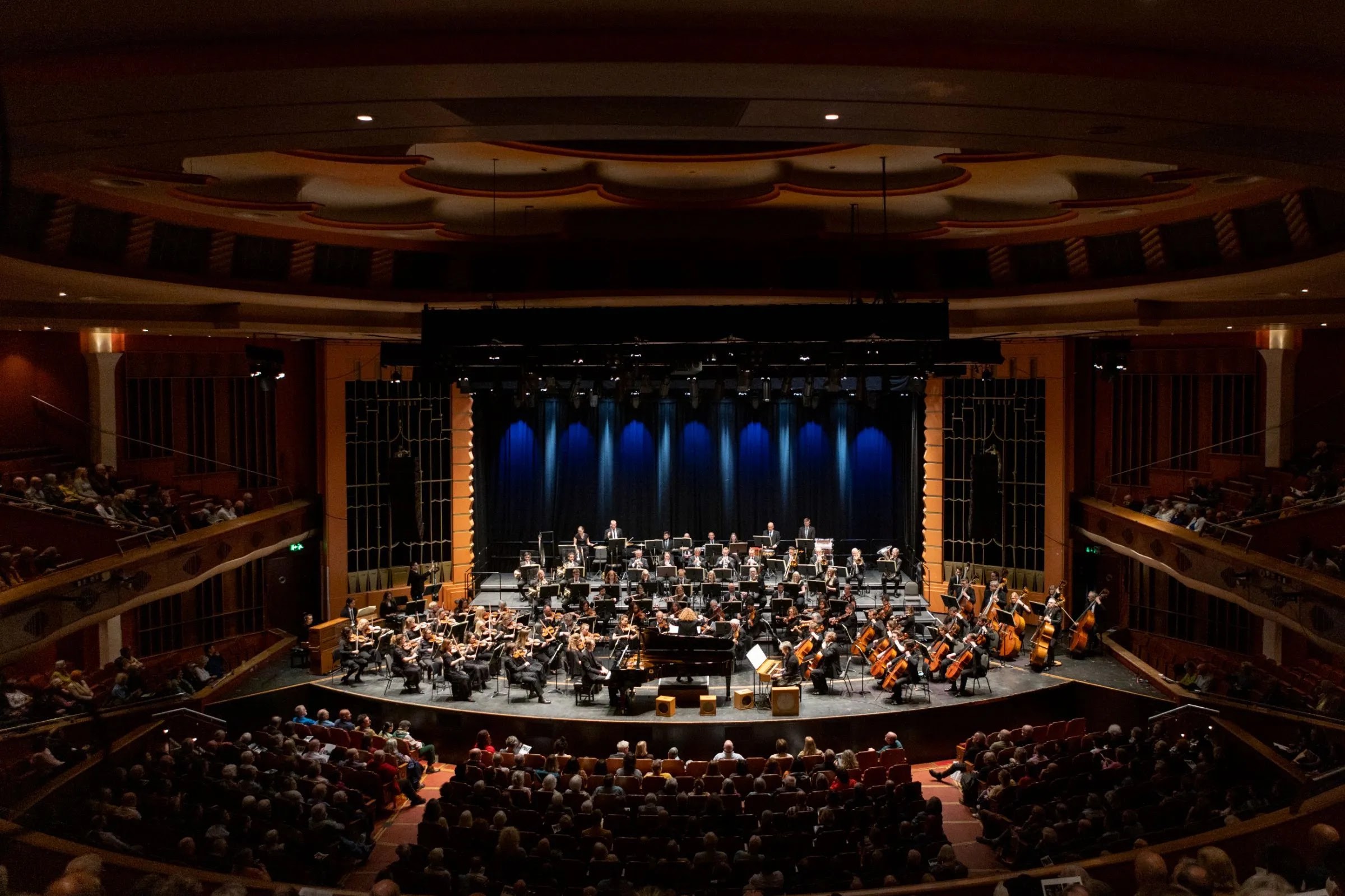
A golden Turangalîla-Symphonie to celebrate the Brighton Philharmonic's centenary

The Brighton Philharmonic Orchestra
© Frances Marshall

Joanna MacGregor (conductor)
Cynthia Millar (ondes martenot)
Ruth Rogers (leader)

2.45pm, Sunday 13 April 2025

★★★★

Olivier Messaien (1908-1992): Turangalîla-Symphonie


'The percussion section (today some nine players strong, in addition to celesta and keyed glockenspiel players) has featured prominently throughout the season; they gave an assured and confident response to Messaien’s heavy demands'.

'Here the orchestra delivered a truly massive sound, and although not every onset of the huge tutti chords was perfectly clean, they ended with lush waves of warmth and celebration'. 

Joanna MacGregor conducts the Brighton Philharmonic Orchestra
© Frances Marshall
'Havlat was astonishing in the various piano cadenzas, thundering through the virtuosic flourishes in the fifth movement especially'.

'Millar was a constant secure presence, with the eery slides and otherworldly melodies emerging from the ondes Martenot'. 

'This was a triumph of ambition and commitment, and MacGregor, Millar, Havlat and all the BPO players deserve high praise for pulling off this vast endeavour to end their centenary season'.

Read my full review on Bachtrack here.

Wednesday, 3 July 2024

Brighton Philharmonic Orchestra celebrate their 100th birthday with an exciting new 2024-25 season

Brighton Philharmonic Orchestra have launched a typically ambitious and exciting 100th season, building up to their official centenary in 2025. With Joanna MacGregor at the helm, the orchestra will also hopefully be building further on the strides they’ve made in the last few years both in terms of expanded repertoire and drawing in new audiences. Remarkably, MacGregor is only the fourth Music Director/Conductor of the orchestra, which began in 1925 as The Symphonic String Players, then became the Southern Philharmonic, before taking their current name in 1958. Their founder Herbert Menges conducted the orchestra for 47 years, followed by John Carewe and then Barry Wordsworth, before MacGregor took the baton in 2019.


Jess Gillan
© Robin Clewley
What’s on offer in this season? Well, there are some big-name classical music stars, including saxophonist Jess Gillam, percussionist Evelyn Glennie and conductor/percussionist Colin Currie, and conductors Sian Edwards and Geoffrey Paterson from recent seasons also return. But it is the ambition of the repertoire that stands out. Two giants bookend the season, with Stravinsky’s The Rite of Spring to open and Messiaen’s monumental Turangalîla Symphony to end as the BPO’s Centenary Gala concert in April.


Ruby Hughes

So, in a little more detail, alongside The Rite of Spring, Dutch pianist Aidan Mikdad will perform Tchaikovsky’s Piano Concerto No. 1 at the season’s opening concert (2.45pm, Sunday 22 September, Brighton Dome), with MacGregor at the podium. Then Alpesh Chauhan conducts what promises to be a great programme, with Jess Gillam performing Glazunov’s Concerto for Saxophone, and soprano Ruby Hughes joining the orchestra for Górecki’s Symphony of Sorrowful Songs. Ruby Hughes sang some Britten and Weill songs with Joanna MacGregor at the BPO season launch, and I look forward to hearing her pure, bright soprano voice in the soaring lines of the Górecki (2.45pm, Sunday 13 October, Brighton Dome).


Joanna MacGregor
© Pal Hansen
In November, the Brighton Philharmonic Strings move over to the Corn Exchange and take up the Saturday night slot, which has proved successful in recent years, particularly bringing in different audiences. In a film inspired programme, The Madness/Lightness of Being, they will perform music by Hermann, Schnittke and Ukrainian composer Valentin Silvestrov’s Silent Music for Strings. Joanna MacGregor conducts, plays piano and the concert also includes her arrangements of music by Piazzolla, including Oblivion and Libertango (7.30pm, Saturday 16 November, Brighton Corn Exchange).


Dame Evelyn Glennie
© Philip Rathmer/Brigitte
December brings Dame Evelyn Glennie, to perform James MacMillan’s Veni, Veni, Emmanuel, and conductor Geoffrey Paterson conducts the orchestra in Peter Maxwell Davies' glorious An Orkney Wedding, with Sunrise (complete with bagpiper!) and Rimsky-Korsakov’s Scheherezade (2.45pm, Sunday 1 December, Brighton Dome). The BPO Brass Quintet will also perform alongside MacGregor in their popular version of Charles Dickens’ A Christmas Carol, directed by Richard Williams. They are joined by Alistair McGowan as narrator, following his performance of The Soldier’s Tale with the orchestra last year (6pm & 8pm, Saturday 14 December, St George’s, Kemptown). 


Gwilym Simcock
To welcome in 2025, the orchestra are joined by the Gwilym Simcock Trio for Blue Notes, a jazz-infused programme of music by Duke Ellington and Wayne Shorter, as well as music by Gwilym Simcock and a solo set from the trio (7.30pm, Saturday 25 January, Brighton Dome). Then conductor Ben Gernon conducts Elgar’s Enigma Variations, followed by Walton’s Belshazzar’s Feast, with the Brighton Festival Chorus and baritone Cody Quattlebaum (2.45pm, Sunday 9 February, Brighton Dome).


Colin Currie
© Andy Catlin
Another highlight of the season promises to be a celebration of the music of Steve Reich, culminating in his Reich/Richter, a shining, vibrant piece written to accompany Gerhard Richter’s abstract film Moving Picture (946-3). There is also music from Terry Riley, Yoko Ono, Lou Harrison and John Cage. Colin Currie conducts, and also plays claves (tuned wooden sticks) in Reich’s iconic and mesmerising Music for Pieces of Wood (7.30pm, Sunday 23 March, Brighton Dome). 


Sian Edwards
And then for that final Centenary Gala. Messaien’s Turangalîla Symphony is truly mammoth, requiring a huge orchestra, and encompasses so many influences in its epic exploration of love, life and death, including birdsong, gamelan and the other-worldly ondes martenot, played by Cynthia Millar. There’s also a demanding solo piano part, which Joanna MacGregor will perform, with Sian Edwards conducting (2.45pm, Sunday 13 April, Brighton Dome). Messiaen described the work as ‘a love song: a hymn to joy’ – a suitably joyful way, then, for the BPO to celebrate 100 years of music making in Brighton.


Tickets on sale now, and check out their LoveMusic scheme, with late release of best available seats, and £1 tickets for children and teenagers. Details on the BPO website here, tickets sold through Brighton Dome here.


Thursday, 29 August 2019

CD Reviews - August 2019

Pianist Jean-Efflam Bavouzet has turned his attention to the piano music of Robert Schumann (1810-1856), and he presents first the Grande Sonate No. 3, which was a revised version of Schumann’s earlier Concert sans orchestre.  As both names suggest, this is a grand statement, right from the opening flourish of the first movement, which unleashes an almost unruly cascade of ideas. The second movement Scherzo with its running scales and slightly uncertain rhythmic pulse leads to a set of variations on an Andantino de Clara Wieck, and this work stems from the period when Clara’s father was keeping the couple apart.  The variations not only play with the theme but its four part structure, and the result has a much more rhapsodic feel than a conventional set of theme and variations.  The capricious finale bursts through, full of drama, and propelled forward to the very end. Bavouzet somehow makes sense of the somewhat rambling form, bringing together into a coherent arc the disparate ideas, without allowing any of the frequent dramatic outbursts to upset the overall trajectory.  In the Faschingsschwank aus Wien that follow, a five movement collection of festive, or carnival scenes, Bavouzet is at times playful and joyous, particularly in the opening movement’s succession of dances, with the mischievous inclusion of bars of La Marseillaise, banned in Vienna at the time of composition, and at other times accentuating the intimate and passionate, in the Romanze and Intermezzo respectively.  His finale is suitably exuberant and euphoric.  The Drei Fantasiestücke are darker and more disturbed, with surging C minor waves in the first, and the outwardly hefty march of the third disguising its more wistful centre.  Similiarly, the central fantasy surrounds a darkly elusive section with seemingly song-like calm.  Bavouzet is alert to these contrasts throughout.  Finally, the Gesänge der Frühe (Songs of Dawn), which again combine an introspection and sadness, as in the opening hymn-like movement, with more confident, assertive and at times extremely agitated music, such as in the cascading fourth movement.  But a sense of calm, albeit with deep sadness, is arrived at eventually in the ‘Amen’ cadence at the conclusion of the final movement.  Again, Bavouzet is sensitive to the inherent contradictions here, and never allows Schumann’s more bombastic moments to be over-stated – the sadness and beauty is never far beneath the surface here.  A great Schumann programme, and hopefully there’s more to come.


Young Canadian cellist Cameron Crozman, having studied at the Conservatoire de Paris, has understandably chosen an all-French line up for his first recording.  He is joined by pianist Philip Chiu, and the two substantial works on offer here are the Sonatas for Cello and Piano by Poulenc (1899-1963) and Debussy (1862-1918). Poulenc’s Sonata, despite being sketched when the composer was demobbed in 1940 and completed just after the end of the war, it is a characteristically quirky piece, full of Poulenc’s sprightly wit. Crozman contrasts the playfulness of the first movement with the more lyrical, songlike second movement (the Cavatine that gives the disc its title) with a slightly shrill tone for the former and a richer, warmer sound for the latter.  In the Cavatine, the lyrical melody is preceded by a chorale-like piano introduction, played with warmth here by Chiu.  The scherzo-like Ballabile that follows is full of spirit, and Crozman dances through the movement with a light touch, leading to the sprightly finale. The Debussy Sonata is a different animal altogether.  Whilst it too has moments of wit, it is a weightier affair, with  heavy piano opening leading to a improvisatory cello display, and the mysterious, mostly pizzicato Sérenade, with low piano rumblings, that follows is somewhat unsettling.  The Spanish-tinged finale lifts the mood somewhat, but it still has an emphatic insistence that hints at darker emotions, unlike the Poulenc perhaps showing its time of composition, just before the First World War, more transparently. Crozman and Chiu’s reading brings out the darkness in Debussy’s harmonies and textures, yet Crozman is also totally on top of the considerable technical challenges here, with tricky harmonics, left-hand pizzicato and flautando bowing (over the fingerboard) that produces a fluty, glassy timbre.  Placing these two substantial works first in his programme means that the Koechlin (1867-1950) Chansons bretonnes that follow inevitably feel slight by comparison, but that does these modal-infused miniatures an injustice.  In the early 1930s, Koechlin wrote a collection of 20 short pieces inspired by Breton folksongs, Crozman has selected six here. They have mournful, simple melodies on the whole, allowing Crozman to show off a warmly lyrical tone, particularly in the sombre lament, ‘Notre-Dame du Folgoat’, yet he maintains a lightness of touch in ‘Iannik Skolan’.  This selection is followed by a set of Variations de concert by Jean Françaix (1912-1997) from 1950, with a bouncy, offbeat theme receiving a variety of treatments, with rapid gallops and a whirling waltz contrasting with a lilting, lyrical rendition, and a pizzicato variation with pecking piano accompaniment, all building to a whirling presto finish.  A great showpiece, and Crozman delivers its technical demands with ease. Somewhat unexpected as a finale to the disc is the movement for cello and piano from Messiaen’s (1908-1992) Quatuor pour la fin du Temps (Quartet for the end of Time), composed and premiered (with Messiaen on the piano) in a concentration camp in 1941. Louange à l’Éternité de Jésus has a longing, desperate cello melody playing out over pulsing, insistent piano chords, and Crozman’s plaintive tone, over Chiu’s soft yet ever present chords, dying away peacefully to nothing at the end makes for a poignant end to this impressive survey of varied French music for cello. 


And now for a great chamber music recording, taken from a live performance at Turner Sims, University of Southampton in 2017, when clarinetist Emma Johnson was joined by the Carducci String Quartet, Chris West (double bass), Philip Gibbon (bassoon) and Peter Francombe (horn). The centrepiece of their programme was Beethoven’s Septet, Op. 20, a relatively early work, and a great success at its first performance in 1800.  It is a work clearly modelled on the Mozartian Serenades or Divertimenti, but Beethoven, of course, develops the genre, not least in his chosen septet scoring. On the whole, the clarinet and/or first violin take the leading roles, but he also makes frequent less obvious groupings from within the seven instruments at his disposal, so there is plenty for all players to get their teeth into.  Johnson et al’s performance here is lively and spirited throughout, and given this is a live recording, there are remarkably few unclean moments. In general the balance is good, although when Beethoven unusually puts the double bass, horn and bassoon altogether at the end of the first movement, the sound is a little muddy.  Johnson is beautifully lyrical in the Adagio, answered with equal warmth by Matthew Denton (violin).  Francombe on horn in the star of the Scherzo, with its jumping, hopping rhythms, and Emma Denton on cello gets her star moment in the lyrical, lilting Trio.  The sound gets a little rustic in the lively final Presto, which might be polished up in a studio recording, but admirably communicates the spirit of the live performance.  They precede the Septet with an Introduction, Theme and Variations for clarinet and string quartet, attributed to Carl Maria von Weber, but in fact now thought to be by Joseph Küffner (1776-1856).  This is a beautifully summery work, with a bright joyful theme for the clarinet over a rippling, light string accompaniment.  The variations ratchet up the virtuosity for the clarinet, and the pace quickens for the final dash to the conclusion.  Johnson is bright and agile throughout here.  They end with two ‘bonbons’ – Johnson’s own arrangements for all eight players of Frülinsstimmen and Perpetuum Mobile, by Johann Strauss II. The former is a piece of fun, the waltz tunes performed with warmth and gusto, and then Johnson’s arrangement of the latter passes the interest around the players, including delightful exchanges between the clarinet and bassoon, and then violin and double bass.  A crowdpleasing conclusion to their concert, no doubt, and to this delightful disc too.


(Edited versions of these reviews first appeared in GScene, August 2019)