Showing posts with label Schumann. Show all posts

Tuesday, 23 January 2024

Energetic Scottish Symphony lifts a weighty evening of the Schumanns and Mendelssohns


Natalia Ponomarchuk
© Alina Harmash


Alexander Melnikov (piano)

London Philharmonic Orchestra

Natalia Ponomarchuk (conductor)


7.30pm, Saturday 20 January 2024


Fanny Hensel, née Mendelssohn (1805-1847): Overture in C major

Clara Schumann (1819-1896): Piano Concerto in A minor, Op. 7

Robert Schumann (1810-1856): Introduction and Allegro for piano and orchestra, Op. 134

Felix Mendelssohn (1809-1847): Symphonhy No. 3 in A minor (Scottish)


Fanny Hensel:

'The LPO's violins responded to the horn’s quiet opening with lyricism, although their pick-up following the introduction was a little imprecise'.


Clara Schumann:

'Melnikov was most at home in the lyrically rhapsodic slow movement, joined by guest principal cellist, Waynne Kwon, beautifully complementing Melnikov’s lyricism with warmth and depth'.


Robert Schumann:

'Melnikov’s chromatic scales swirled and the orchestra surged appropriately in response. He was assured in the delicate intricate passagework, but occasionally, in the more bombastic moments, attention to detail was surprisingly matter of fact, with more than a few imprecisions creeping in'.


Felix Mendelssohn:

'Here the LPO winds came into their own, with a flowing clarinet opening and fizzing articulation from them all, complemented well by the joyful string filigree passages'.


'Once at full pelt, Ponomarchuk elicited rich and expressive drama. The finale had immediate attack, and the fugal sections here were tight. Clarinet and bassoon gave a delightfully expressive duet, and then the transformed ‘Holyrood’ delivered stately grandeur, with glorious horns to finish'. 


Read my full review on Bachtrack here.

Thursday, 21 September 2023

Vladimir Jurowski and the Bayerisches Staatsorchester make it all look so easy

Louise Alder (soprano)
Vladimir Jurowski (conductor)

7.30pm, Tuesday 19 September, 2023


Yefim Bronfman & the Bayersiches Staatsorchester
© Mark Allan/Barbican
Richard Wagner (1813-1883): Prelude to Tristan und Isolde

Robert Schumann (1810-1856): Piano Concerto in A minor, Op. 54

Encore:

Frédéric Chopin (1810-1849) – Nocturne in D flat major, Op. 27 No. 2

Gustav Mahler (1860-1911): Symphony No. 4 in G major

Encore:

Mahler: Suite aus den Orchesterwerken (Bach, Johann Sebastian), 4. Air

(from Suite No. 3 in D major, BWV 1068)


Wagner:
'From the opening bars ... Jurowski commanded silence in the portentous rests, with knife-edge precision from the strings, leading up to ‘that’ chord; the strings were indeed the stars of the show'. 

Louis Alder & the Bayerisches Staatsorchester
© Mark Allan/Barbican
Schumann:
'Yefim Bronfman delivered effortlessly clean Schumann'.

'it was his delicacy and tenderness in the ‘Clara’ second subject of the opening movement, and his fairy-like embellishments at the top of the keyboard in the finale that stood out'.

Mahler:
'Jurowski brought out every little detail, but it never felt that he was stressing the point'.

'Louise Alder set the mood perfectly, with intense communication of the text ... Alder’s rich tone and intensity of expression lifted this way beyond the straightforward'.

Read my full review on Bachtrack here.

Tuesday, 14 February 2023

Emotionally compelling Lenau settings from Gerhaher and Huber at Wigmore Hall

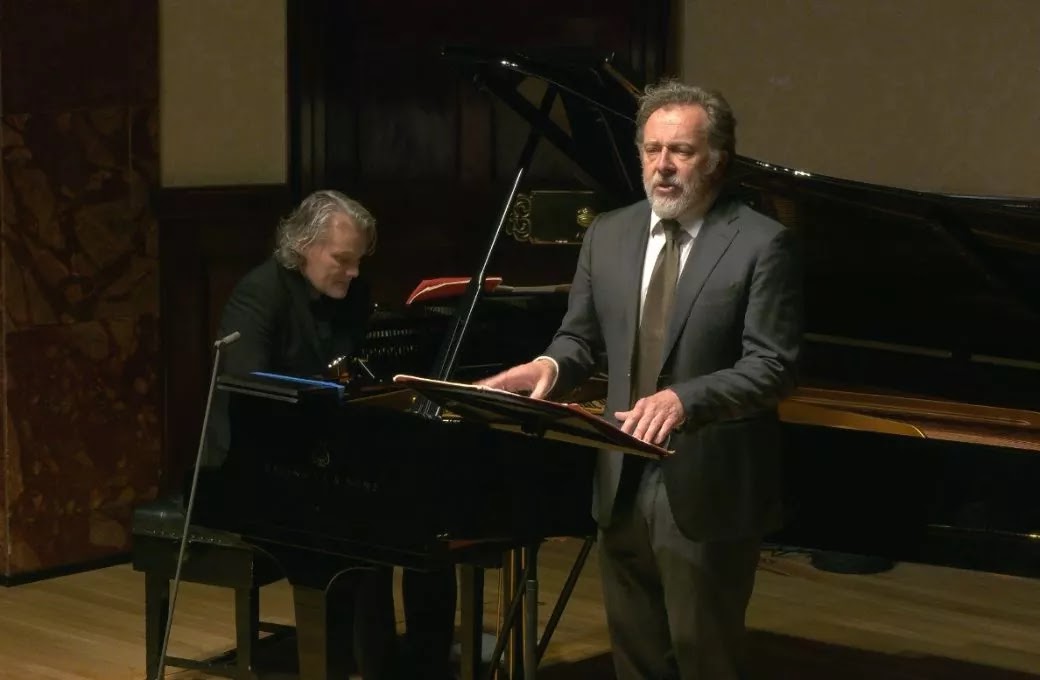
Christian Gerhaher & Gerold Huber
© Wigmore Hall Trust

Christian Gerhaher
(baritone)
Gerold Huber (piano)

7.30pm, Sunday 12 February 2023

Wigmore Hall, London


Heinz Holliger (b.1939): Elis: Verkündigung des Todes, Todesangst und Gnade, Himmelfahrt

Hugo Wolf (1860-1903): Abendbilder

Heinz Holliger: Lunea: Wirf o Thor, Die Jahre flogen, Die Himmelsschlange, Ich will, Weit, Dein Blick, Transsubstantiatio, Der Mensch, Ich habe, Serenum, Der Eisenhammer, Ein Tropfen, Verächtlich, Man grüsst, Der Schwimmer, Mein Widerhall, Der Frühling, Der schwarze Schleier, Der Zweifel, Der Himmel, Der Mond, Die Wüstenwanderer, Einklang (Nachwort)

Robert Schumann (1810-1856): 4 Husarenlieder, Op. 117: Der Husar, trara!, Der leidige Frieden, Den grünen Zeigern, Da liegt der Feinde gestreckte Schar, 

Othmar Schoeck (1886-1957): Elegie, Op. 36: An den Wind, Herbstgefühl, Verlorenes Glück, Das Mondlicht, Herbstentschluss, Welke Rose

Robert Schumann: 6 Gedichte von N Lenau und Requiem, Op. 90: Lied eines Schmiedes, Meine Rose, Kommen und Schieden, Die Seine, Einsamkeit, Der schwere Abend, Requiem

Encore:
Othmar Shock: Elegie, Op. 36: Zweifelnder Wunsch

Christian Gerhaher
© Wigmore Hall Trust
Holliger:
'Gerhaher ... immediately drew us into the dark, introspective world that would pervade the programme to come. Huber’s glassy, ethereal playing, with layered pedalling also set a darkly atmospheric scene'.   

'Gerhaher delivered the twistingly tormented, leaping lines with remarkable, chilling clarity, with striking stillness on stage, oblivious to Huber’s frequent forays into the piano’s interior'.

Schoeck:
'Gerhaher gave us pleading, icy tones, and the final journey of Herbstentschluss dripped with sadness, before the heartbreaking Welke Rose, Huber’s soft-toned accompaniment in the distance'.

Schumann:
'But it was with the Sechs Gedichte von N Lenau that Gerhaher truly tugged the heartstrings. Words were exquisitely pointed in Meine Rose, with a wishful blossoming on “freudig”. Despite some gloriously ringing tone at the top of his range, he returned to oppressive darkness for Einsamkeit'.

Read my full review on Bachtrack here.

Watch the concert streamed by the Wigmore Hall here.


Friday, 6 May 2022

Roderick Williams & Paul Cibis capture the passion of youth with energetic immediacy at Kings Place

Roderick Williams
(© Benjamin Ealovega)

Paul Cibis (piano)

7.30pm, Thursday 5 May, 2022

Kings Place, London


Franz Schubert (1797-1828): Die schöne Müllerin, Op. 25: Das Wandern

George Butterworth (1885-1916): Six Songs from A Shropshire Lad

Rebecca Clarke (1886-1979): 8 o’clock

                                                Aufblick

Robert Schumann (1810-1856): Album für die Jugend, Op. 68 No. 21

                                                   Liederkreis, Op. 24, Nos. 1-3

Rebecca Clarke: Stimme im Dunkeln

Robert Schumann: Album für die Jugend, Op. 68 Nos. 8 & 16

                               Liederkreis, Op. 24, Nos. 4-5

Franz Schubert: Die schöne Müllerin, Op. 25: Wohin? & Halt


Interval


Franz Schubert: Die schöne Müllerin, Op. 25: Am Feierabend, Der Neugierige & Ungeduld

Ralph Vaughan Williams (1872-1958): Songs of Travel: The Vagabond

Charles Wilfred Orr (1893-1976): A Shropshire Lad: Along the field

Frédéric Chopin (1810-1849): Prelude, Op. 28 No. 10

Ralph Vaughan Williams: Songs of Travel: Roadside Fire, Whither must I wander? & Bright is the Ring of Words

Charles Wilfred Orr: A Shropshire Lad: When I watch the living meet

Frederic Chopin: Prelude, Op. 28 No. 23

Charles Wilfred Orr: A Shropshire Lad: The Lent Lily

Franz Schubert: Die schöne Müllerin, Op. 25: Die liebe Farbe, Die böse Farbe, Der Müller und der Bach


Encore: 

Ralph Vaughan Williams: The House of Life, No. 2: Silent Noon 


'Most striking was Williams’ immediacy of communication, often singing as if speaking conversationally'.


'Williams’ control at the higher end of his register was also impressive, with particular lightness on the opening note of Loveliest of trees'.


'Williams’ Schubert had energy and impatience, with a bright twinkle for Das Wandern, and expertly voiced different characters in Der Neugierige'.


'Williams’ ability to shift the emotions as quickly as they turn in these songs is what made this recital so captivating throughout'.


'Cibis also deserves credit for the range of his playing, both in the varied accompaniments and in his solo pieces'.


Read my full review on Bachtrack here.

Wednesday, 5 May 2021

Spring has Sprung: a taste of live concerts to come from Paul McCreesh and the RNS

Paul McCreesh (conductor)

7.30pm Friday 30 April 2021
Streamed live at sagegateshead.com

Sage One, Gateshead


Frederick Delius (1862-1934): On Hearing the First Cuckoo in Spring

Thea Musgrave (b.1928) (arr. by Martyn Brabbins (b.1959)): Green

Ralph Vaughan Williams (1872-1958): The Lark Ascending

Robert Schumann (1810-1856): Symphony No. 1 in B flat major, Op. 38, 'Spring'

Maria Włoszczowska
© Royal Northern Sinfonia
Delius:
'The clarinet’s cuckoo was not overstated, emerging naturally from the textures, and the string sound was warm without excess weight'.

Musgrave:
'From a glassy, atmospheric opening to the frenzied intense climax, the RNS string players were in their element, with strong solo work and powerful contrasts between the lyrical and the harsher effects'.

Vaughan Williams:
'Włoszczowska’s playing ... was easy and relaxed, and the winding figures rising to the first high melodic statement were natural and effortless, with a singing, pure tone at the top'.

Royal Northern Sinfonia
© Royal Northern Sinfonia
Schumann:
'The Finale was the strongest movement here, with dancing energy, (and) precise articulation and detail from the strings'.

'“Spring in full bloom” ..., with bright brass and an emphatic finish'.   

Read my full review on Bachtrack here.

Friday, 9 April 2021

CD Reviews - April 2021

Arnold Schoenberg (1874-1951) originally composed Verklärte Nacht (‘Transfigured Night’) for string sextet, but he later orchestrated the work, and it has become one of his most performed works.  Unlike his later music, it is tonal, although highly chromatic, with a late Romantic stamp, and a strong Wagnerian flavour. The poem by Dehmel which inspired the work is about a woman who walks with her lover in a moonlit forest, and confesses she is pregnant by another man.  Her lover ultimately forgives her, and the intensity of their love and the beauty of the moonlight brings them together.  On this latest recording, Edward Gardner and the BBC Symphony Orchestra have cleverly explored some lesser-known works from the same period, notably Oskar Fried’s (1871-1941) setting of Verklärte Nacht, Op. 9, for mezzo-soprano, tenor and orchestra (with Christine Rice and Stuart Skelton the soloists here). Fried’s setting is lush and atmospheric, with warm narrative duets contrasting with more emotionally charged solos from both characters. Rice and Skelton are beautifully matched, and Skelton shimmers at the top of his range on ‘Glanz’ (glow). It is perhaps a little more obvious than Schoenberg’s intense instrumental interpretation, which here receives a wonderfully mysterious and atmospheric reading, contrasting the full weight of strings at the climactic moment, with an incredibly light touch for the lilting night music and glassy solos. The disc begins with another surprise – Fieber (Fever) by Franz Lehár (1870-1948), for tenor and orchestra. This is a highly episodic piece – perhaps understandable when expressing the delirium of an injured soldier in hospital, flitting between calling for the nurse, thinking of his girlfriend, remembering battle and even an image of his mother, before finally succumbing to death. Skelton is bold and emphatic, yet also captures the sense of confusion and anguish here. We get fragments of romantic waltzes, and even a snippet of the Radetzky March, all lusciously orchestrated. Skelton returns in the four Lieder des Abschieds, Op. 14 (Songs of Farewell) by Erich Korngold (1897-1957). Full of yearning, with texts including ‘Sterbelied’ (Upon Dying), a German translation of a Christina Rossetti poem, the songs employ frequent yearning vocal leaps, and Skelton’s placing is impeccably tender. The second song is more urgent and dramatic, whilst the third and fourth have more of a gentle rocking feel. Korngold’s orchestration is rich and sumptuous, and here as throughout, Gardner and the BBCSO are on top form.  

Various, 2021. Verklärte Nacht: Schoenberg, Fried, Lehar, Korngold. Christine Rice, Stuart Skelton, BBC Symphony Orchestra, Edward Gardner. Hybrid Super Audio Compact Disc. Chandos. CHSA 5243.

Greek-born pianist Alexandra Papastefanou studied in Moscow, Budapest and the US, and has had lesson from Alfred Brendel. She has performed all of Bach’s keyboard works, and to date, her recordings have also focussed on Bach, as well as her own compositions. Now she turns to Robert Schumann (1810-1856), and in a two disc set, she covers all the works for piano written in 1839. The following year, 1940, is known as his ‘Year of Song’, in which he wrote over 160 vocal works, including 135 solo songs. It was also the year he finally married Clara, after the extended and embittered battles with her father. Whilst not as prolific a year, 1839 did generate a considerable number of works for the piano, and in many ways, they reflect the turbulent time of that year before he was finally able to marry the love of his life. Papastefanou has coined the term ‘Year of Piano’ for her survey of this output. Papastefanou plays with clarity and avoids overindulgence in the more romantic, expressive passages. So the Humoreske, Op. 20 is suitably boisterous and playful to begin with, yet the stuttering rhythms of the second section have a subtle unease, followed by darker, expressive then tender and lilting third and fourth sections. Schumann said when writing this ‘I have been sitting at the piano, composing and writing, laughing and crying all at once’, and there are certainly a lot of moods to capture here. The same might be said of the 4 Nachstücke, Op. 23, with a slightly pacy, agitated funeral procession, and swirling, darkly turbulent night revelry. Papastefanou takes some freedom with the tempi in the Arabeske, Op. 18, yet could perhaps take a little more time in the expressive recitative-like moments, but the rippling repeating rhythms have a real flow. The Faschingsschwank aus Wien, Op. 26 (Carnival Jest from Vienna), is fascinating, with its embedded reference to the Marseillaise, at that time banned in Vienna, and lively dances, rippling textures and central sad Romanze. Again, Schumann’s moods change from moment to moment, yet Papastefanou makes sense of these transitions, making coherent sense of the contrasts. The 3 Romanzen, Op. 28 are darker than one might expect from the title, and a sense of anxiety pervades. The middle Romanze has moments of calm, but the third is jumpy and mercurial. There are a number of shorter pieces filling out this two disc collection, some part of larger collections published later, but here for the year of their composition. They merit their inclusion, however, and the dark smouldering Praeludium from Bunte Blätter, Op. 99 and the delicately dancing Phantasiestück from Albumblätter, Op. 124 are given sensitive readings here. A fascinating collection of lesser-performed works here, and Papastefanou performs throughout with virtuosic command and sensitivity to the constantly changing moods. 


Schumann, R. 2021. Schumann 1839: Year of Piano. Alexandra Papastefanou. Compact Discs (2). First Hand Records. FHR 112.


(Edited versions of these reviews first appeared in Scene, April 2021)

Saturday, 21 September 2019

Uplifting Romantic giants from Ax, Rattle and the LSO

Emanuel Ax, Sir Simon Rattle
& the LSO
© Kevin Leighton
Emanuel Ax (piano)
London Symphony Orchestra
Sir Simon Rattle (conductor) 

Wednesday 18 September 2019, 7pm

Barbican Hall, London


Johannes Brahms (1833-1897): Piano Concerto No. 2 in B flat major, Op. 83

Encore:
Robert Schumann (1810-1856): Fantasiestücke, Op. 73 No. 1

Sergei Rachmaninov (1873-1943): Symphony No. 2 in E minor, Op. 27


Emanuel Ax
© Kevin Leighton
'Ax and Rattle ensured that the balance between piano and orchestra were always controlled'.

'The warm, silky sound of Tim Hugh’s solo cello, combined with Ax’s delicacy ... made for an exquisite slow movement'.

'Rattle never allowed the surges of romantic passion here to get too carried away ... so that the impact of the brief passionate climax when it finally arrived was all the more powerful'.

'Rattle and the LSO, along with Ax, succeeded here in making an evening of such weighty masterpieces feel airy, uncluttered and suitably uplifting, a true pleasure to experience'.

Read my full review on Bachtrack here.

Thursday, 29 August 2019

CD Reviews - August 2019

Pianist Jean-Efflam Bavouzet has turned his attention to the piano music of Robert Schumann (1810-1856), and he presents first the Grande Sonate No. 3, which was a revised version of Schumann’s earlier Concert sans orchestre.  As both names suggest, this is a grand statement, right from the opening flourish of the first movement, which unleashes an almost unruly cascade of ideas. The second movement Scherzo with its running scales and slightly uncertain rhythmic pulse leads to a set of variations on an Andantino de Clara Wieck, and this work stems from the period when Clara’s father was keeping the couple apart.  The variations not only play with the theme but its four part structure, and the result has a much more rhapsodic feel than a conventional set of theme and variations.  The capricious finale bursts through, full of drama, and propelled forward to the very end. Bavouzet somehow makes sense of the somewhat rambling form, bringing together into a coherent arc the disparate ideas, without allowing any of the frequent dramatic outbursts to upset the overall trajectory.  In the Faschingsschwank aus Wien that follow, a five movement collection of festive, or carnival scenes, Bavouzet is at times playful and joyous, particularly in the opening movement’s succession of dances, with the mischievous inclusion of bars of La Marseillaise, banned in Vienna at the time of composition, and at other times accentuating the intimate and passionate, in the Romanze and Intermezzo respectively.  His finale is suitably exuberant and euphoric.  The Drei Fantasiestücke are darker and more disturbed, with surging C minor waves in the first, and the outwardly hefty march of the third disguising its more wistful centre.  Similiarly, the central fantasy surrounds a darkly elusive section with seemingly song-like calm.  Bavouzet is alert to these contrasts throughout.  Finally, the Gesänge der Frühe (Songs of Dawn), which again combine an introspection and sadness, as in the opening hymn-like movement, with more confident, assertive and at times extremely agitated music, such as in the cascading fourth movement.  But a sense of calm, albeit with deep sadness, is arrived at eventually in the ‘Amen’ cadence at the conclusion of the final movement.  Again, Bavouzet is sensitive to the inherent contradictions here, and never allows Schumann’s more bombastic moments to be over-stated – the sadness and beauty is never far beneath the surface here.  A great Schumann programme, and hopefully there’s more to come.


Young Canadian cellist Cameron Crozman, having studied at the Conservatoire de Paris, has understandably chosen an all-French line up for his first recording.  He is joined by pianist Philip Chiu, and the two substantial works on offer here are the Sonatas for Cello and Piano by Poulenc (1899-1963) and Debussy (1862-1918). Poulenc’s Sonata, despite being sketched when the composer was demobbed in 1940 and completed just after the end of the war, it is a characteristically quirky piece, full of Poulenc’s sprightly wit. Crozman contrasts the playfulness of the first movement with the more lyrical, songlike second movement (the Cavatine that gives the disc its title) with a slightly shrill tone for the former and a richer, warmer sound for the latter.  In the Cavatine, the lyrical melody is preceded by a chorale-like piano introduction, played with warmth here by Chiu.  The scherzo-like Ballabile that follows is full of spirit, and Crozman dances through the movement with a light touch, leading to the sprightly finale. The Debussy Sonata is a different animal altogether.  Whilst it too has moments of wit, it is a weightier affair, with  heavy piano opening leading to a improvisatory cello display, and the mysterious, mostly pizzicato Sérenade, with low piano rumblings, that follows is somewhat unsettling.  The Spanish-tinged finale lifts the mood somewhat, but it still has an emphatic insistence that hints at darker emotions, unlike the Poulenc perhaps showing its time of composition, just before the First World War, more transparently. Crozman and Chiu’s reading brings out the darkness in Debussy’s harmonies and textures, yet Crozman is also totally on top of the considerable technical challenges here, with tricky harmonics, left-hand pizzicato and flautando bowing (over the fingerboard) that produces a fluty, glassy timbre.  Placing these two substantial works first in his programme means that the Koechlin (1867-1950) Chansons bretonnes that follow inevitably feel slight by comparison, but that does these modal-infused miniatures an injustice.  In the early 1930s, Koechlin wrote a collection of 20 short pieces inspired by Breton folksongs, Crozman has selected six here. They have mournful, simple melodies on the whole, allowing Crozman to show off a warmly lyrical tone, particularly in the sombre lament, ‘Notre-Dame du Folgoat’, yet he maintains a lightness of touch in ‘Iannik Skolan’.  This selection is followed by a set of Variations de concert by Jean Françaix (1912-1997) from 1950, with a bouncy, offbeat theme receiving a variety of treatments, with rapid gallops and a whirling waltz contrasting with a lilting, lyrical rendition, and a pizzicato variation with pecking piano accompaniment, all building to a whirling presto finish.  A great showpiece, and Crozman delivers its technical demands with ease. Somewhat unexpected as a finale to the disc is the movement for cello and piano from Messiaen’s (1908-1992) Quatuor pour la fin du Temps (Quartet for the end of Time), composed and premiered (with Messiaen on the piano) in a concentration camp in 1941. Louange à l’Éternité de Jésus has a longing, desperate cello melody playing out over pulsing, insistent piano chords, and Crozman’s plaintive tone, over Chiu’s soft yet ever present chords, dying away peacefully to nothing at the end makes for a poignant end to this impressive survey of varied French music for cello. 


And now for a great chamber music recording, taken from a live performance at Turner Sims, University of Southampton in 2017, when clarinetist Emma Johnson was joined by the Carducci String Quartet, Chris West (double bass), Philip Gibbon (bassoon) and Peter Francombe (horn). The centrepiece of their programme was Beethoven’s Septet, Op. 20, a relatively early work, and a great success at its first performance in 1800.  It is a work clearly modelled on the Mozartian Serenades or Divertimenti, but Beethoven, of course, develops the genre, not least in his chosen septet scoring. On the whole, the clarinet and/or first violin take the leading roles, but he also makes frequent less obvious groupings from within the seven instruments at his disposal, so there is plenty for all players to get their teeth into.  Johnson et al’s performance here is lively and spirited throughout, and given this is a live recording, there are remarkably few unclean moments. In general the balance is good, although when Beethoven unusually puts the double bass, horn and bassoon altogether at the end of the first movement, the sound is a little muddy.  Johnson is beautifully lyrical in the Adagio, answered with equal warmth by Matthew Denton (violin).  Francombe on horn in the star of the Scherzo, with its jumping, hopping rhythms, and Emma Denton on cello gets her star moment in the lyrical, lilting Trio.  The sound gets a little rustic in the lively final Presto, which might be polished up in a studio recording, but admirably communicates the spirit of the live performance.  They precede the Septet with an Introduction, Theme and Variations for clarinet and string quartet, attributed to Carl Maria von Weber, but in fact now thought to be by Joseph Küffner (1776-1856).  This is a beautifully summery work, with a bright joyful theme for the clarinet over a rippling, light string accompaniment.  The variations ratchet up the virtuosity for the clarinet, and the pace quickens for the final dash to the conclusion.  Johnson is bright and agile throughout here.  They end with two ‘bonbons’ – Johnson’s own arrangements for all eight players of Frülinsstimmen and Perpetuum Mobile, by Johann Strauss II. The former is a piece of fun, the waltz tunes performed with warmth and gusto, and then Johnson’s arrangement of the latter passes the interest around the players, including delightful exchanges between the clarinet and bassoon, and then violin and double bass.  A crowdpleasing conclusion to their concert, no doubt, and to this delightful disc too.


(Edited versions of these reviews first appeared in GScene, August 2019)

The Amatis Piano Trio celebrate Clara Schumann with warmth and delicacy - Proms at ... Cadogan Hall 6

Amatis Piano Trio
© Allard Photo

Amatis Piano Trio:
Lea Hausmann (violin)
Samuel Shepherd (cello)
Mengjie Han (piano)

Monday 26 August, 1pm

Proms at ... Cadogan Hall 6
Cadogan Hall, London


Robert Schumann (1810-1856): 
Adagio and Allegro, Op. 70

Clara Schumann (1819-1896): 
Three Romances, Op. 22
Piano Trio in G minor, Op. 17

R Schumann:
'They began the Adagio with a brave pianissimo, the cello slowly warming into a sweet tone, matched by soft warmth from the piano'.

C Schumann:
Three Romances:
'Haussmann (violin) played here with a soft tone ... with well-judged dynamic phrasing throughout'.

Piano Trio:
'The close communication between the three players was evident'.

'The trio had great fun with the finale, with its folk-like playfulness'.


Read my full review on Bachtrack here.

Thursday, 19 July 2018

Engaging invention from Shaw and joyous Schumann - Proms at ... Cadogan Hall 1

© Sophie Zhai

Calidore String Quartet
Javier Perianes (piano)

Monday 16 July, 2018

Proms at ... Cadogan Hall 1

Cadogan Hall, London


Caroline Shaw (b.1982):
First Essay, 'Nimrod'
Second Essay, 'Echo'
Third Essay, 'Ruby'

Robert Schumann (1810-1856):
Piano Quintet in E flat major, Op. 44

Shaw: 
'There are many musical ideas here, and Shaw moves seamlessly from one to the next'.

'The Calidores gave us highly polished and convincing performances here, providing a strong platform for Shaw’s imaginative writing'.

Schumann:
'Right from the joyous opening onwards, the Calidores, now joined by ... Javier Perianes, grabbed hold of the energy in this music and flew with it'.

'The Calidores and Perianes communicated the splendour of Schumann’s creativity here, bringing proceedings to a joyous conclusion'.

Read my full review on Bachtrack here.