Showing posts with label Brighton. Show all posts

Tuesday, 15 April 2025

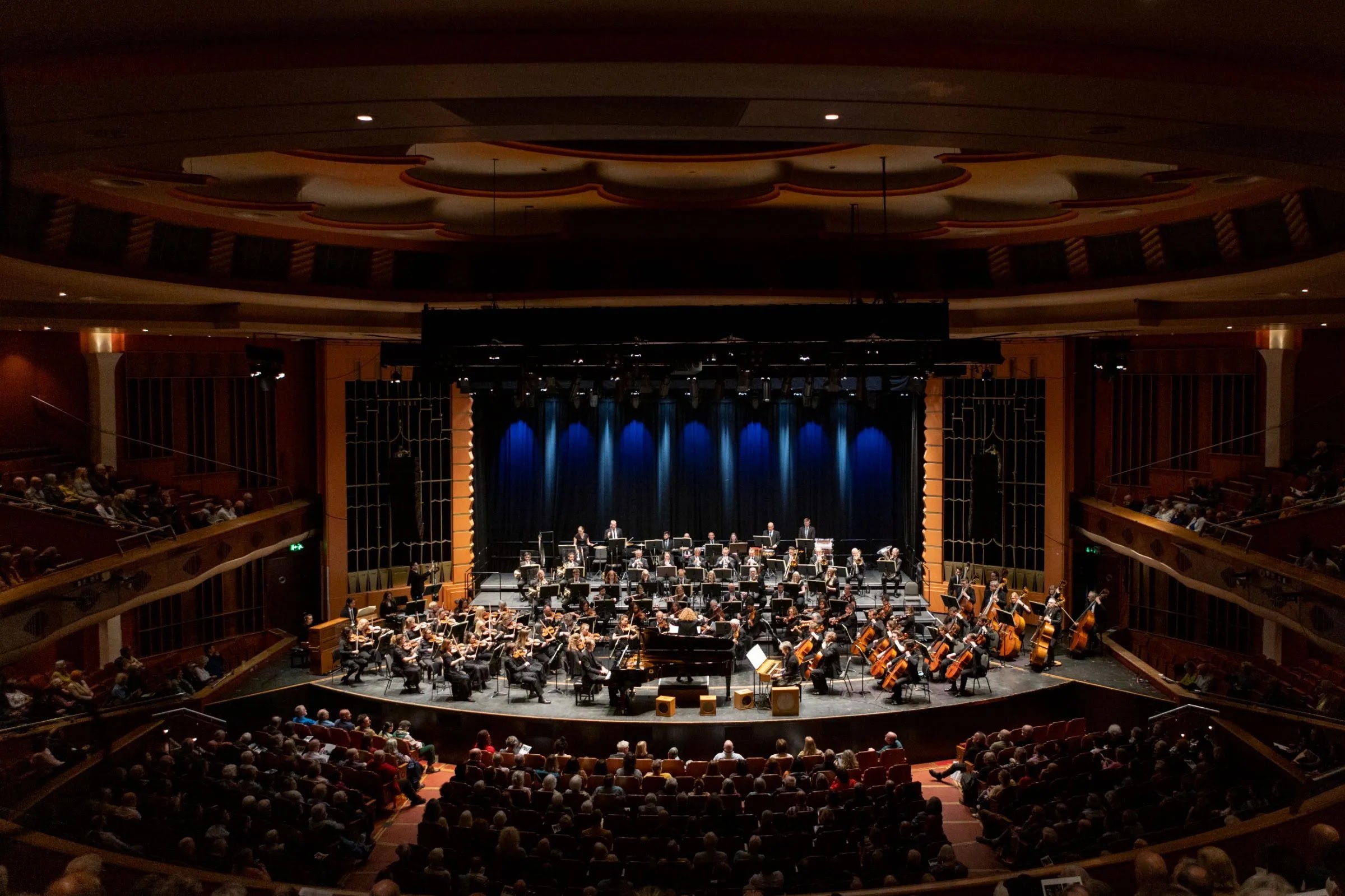
A golden Turangalîla-Symphonie to celebrate the Brighton Philharmonic's centenary

The Brighton Philharmonic Orchestra
© Frances Marshall

Joanna MacGregor (conductor)
Cynthia Millar (ondes martenot)
Ruth Rogers (leader)

2.45pm, Sunday 13 April 2025

★★★★

Olivier Messaien (1908-1992): Turangalîla-Symphonie


'The percussion section (today some nine players strong, in addition to celesta and keyed glockenspiel players) has featured prominently throughout the season; they gave an assured and confident response to Messaien’s heavy demands'.

'Here the orchestra delivered a truly massive sound, and although not every onset of the huge tutti chords was perfectly clean, they ended with lush waves of warmth and celebration'. 

Joanna MacGregor conducts the Brighton Philharmonic Orchestra
© Frances Marshall
'Havlat was astonishing in the various piano cadenzas, thundering through the virtuosic flourishes in the fifth movement especially'.

'Millar was a constant secure presence, with the eery slides and otherworldly melodies emerging from the ondes Martenot'. 

'This was a triumph of ambition and commitment, and MacGregor, Millar, Havlat and all the BPO players deserve high praise for pulling off this vast endeavour to end their centenary season'.

Read my full review on Bachtrack here.

Wednesday, 26 March 2025

The Brighton Philharmonic Orchestra scale new heights with Colin Currie at the helm in a celebration of Steve Reich

Steve Reich
Colin Currie (conductor, percussion)
Ruth Rogers (leader)

7.30pm, Sunday 23 March 2025

★★★★

Steve Reich (b.1936): Music for Pieces of Wood
Lou Harrison (1917-2003) & John Cage (1912-1992): Double Music
Terry Riley (b.1935): Half Wolf Dances Mad in Moonlight, from Salome Dances for Peace
Yoko Ono (b.1933): Pieces for Orchestra
Reich: Runner
Reich/Gerhard Richter (b.1932): Moving Picture (936-3)
(Director: Corinna Belz (b.1955))


I’ve been following most of Brighton Philharmonic Orchestra’s 100th season, enjoying their ever more adventurous and interesting programming, and their latest offering, a concert centring on the music of Steve Reich (b.1936) saw them reach new heights of excellence. With conductor and percussionist Colin Currie at the helm, chamber-sized BPO forces tackled some highly challenging repertoire, and the percussion section in particular, who have already shown themselves to be a key part of the BPO’s development over the last few years, rose to the occasion. 


So to begin with, Currie joined the four percussionists for Reich’s popular and mesmerising Music for Pieces of Wood, and this 9 minute piece, consisting of five players with tuned claves (pairs of wooden sticks), knocking out constantly crossing and phasing rhythms. There’s a pattern that began with just two players (Donna-Maria Landowksi & Meadow Brooks) setting the base rhythms – and they need particular commendation for the stamina of maintaining this throughout the whole piece. They were joined by Currie, then Cameron Gorman, and finally Chris Brannick, building up the complex, hypnotic rhythms. The pattern is repeated three times, so going back to two players, and building up again, before the whole thing comes to an abrupt stop. The almost full Dome audience was completely drawn into their tight and intense performance, making for a great start to the evening.


From centre stage, attention then shifted to the far right, and an array of bells, brake drums, sistra, gongs, tam-tams and even a thunder sheet, to which the four BPO percussionists moved to perform Double Music by Lou Harrison (1917-2003) and John Cage (1912-1992). With the brake drums laid out in an array on the floor, and other instruments circling them, the four players crouched down and drew us into the gamelan-inspired soundworld, beginning with a ringing from a Tibetan bowl, and building to a resonant mix of sounds, the metallic tuned brake drums against the rattling sistra and rumbling tam-tams and gongs. One couldn’t always tell exactly what was producing which sounds – there was some use of the sides of the gongs or tam-tams to produce yet more different timbres. Harrison & Cage composed two of the four sections each independently, but the result creates a unified soundworld, ending with the instruments’ long final resonance hanging in the air. 


Colin Currie
Next it was the turn of strings, and a quartet led by BPO leader, Ruth Rogers, with Nikki Gleed, Caroline Harrison & Peter Adams. They were conducted here by Joanna MacGregor – once the piece was underway, it was clear that this was a necessity. Terry Riley’s Half Wolf Dances Mad in Moonlight from his Salome Dances for Peace is a frenetic mash-up of rhythmic energy, with the players often at odds with each other. There are moments of more congruent movement, but they are brief, and MacGregor’s ongoing beat was essential for keeping the players on track. They performed with commitment and confidence, and whilst there were moments that felt on the very edge of control, they stayed together and united for the more stable conclusion, with drones underpinning eastern-infused melodic lines and confident use of harmonics, slides and glassy tones as they died away to nothing.


The percussionists returned for Yoko Ono’s (b.1933) Pieces for Orchestra, joined by MacGregor on the piano. Her playing involved lots of plucking and scraping inside the piano, with some watery work on the keyboard later on. The percussionists began unwinding rolls of tape, then moved from instruments to tapping and beating the floor, the speakers, seemingly anything on the stage. There was bowing and scraping on the sides of glockenspiels or vibraphones and elsewhere, and the players moved around their area of the stage slowly. The overall soundscape was surprisingly effective, although once the percussionists had then slowly exited, with Joanna MacGregor left shuffling a deck of cards, it wasn’t entirely clear what it amounted to in the end.  


There was a little stage resetting before the final piece of the first half – Steve Reich’s Runner. The musical forces were set out symmetrically, with a string quartet, a wind trio, a piano and a vibraphone all doubled, all joined by a single double bass. Currie was back to conduct, and from the start, rich, rhythmic textures quickly built up, with rocking pianos joined by strings then woodwind and the percussion, the antiphonal effect of the two ‘choirs’ being used to great effect. The rhythmic energy swirled as the rhythms phased, coming together and pulling apart in waves. Currie kept a tight rein on proceedings, and ensemble was tight for the sudden big tutti accented chords. Only once did it feel the rhythms were in danger of falling out of line, but more big chords reestablished the sense of control, and Currie kept the energy at a high level throughout, bringing the evening’s first half to a strong conclusion.  


Colin Currie and members of the
Brighton Philharmonic Orchestra
© Nick Boston

And then to the most substantial work of the evening, Reich’s collaboration with artist Gerhard Richter and director Corinna Belz, Moving Picture (936-3). Reich’s music accompanies Richter’s abstract film, which starts with rippling parallel coloured lines filling the screen. Gradually, bands emerge and then open and expand, creating increasingly complex images in a kaleidoscope fashion, and by the central section, the effect is rather like a Rorschach test, as one can start to see faces, dancers, pagodas, dragons, angels, etc – perhaps best not to overanalyse here in case I reveal too much about myself… The process is then reversed, ultimately returning to the single rippling lines which opened proceedings. Reich’s music takes a similar trajectory, starting out by doubling the rhythmic patterns as the lines on the screen increase in complexity. Over the work’s forty minutes, however, the structure of the music is somewhat overshadowed by the hypnotic nature of the visuals, relegating the music to more of an accompaniment role, perhaps, but Currie shaped the progress of the score, with variation in dynamics and emphasis of strident clashes and suspensions as the piece reached its climax. Whilst musically not as exciting as Runner, the overall effect of the music and film was nonetheless highly effective, and the whole performance brought the evening to a suitably impressive end. 


Once again, Joanna MacGregor and all involved deserve to be congratulated for pushing expectations of what Brighton Philharmonic Orchestra has to offer to a new level. With just Messaien’s mighty Turangilîla Symphony to go to conclude their 100th season (details here), it will be exciting to see where MacGregor takes them into their next century. 
Wednesday, 18 September 2024


Programme


Josquin des Prez (c.1450–1521) - Kyrie from Missa Pange lingua 

Thomas Tallis (c.1505-1585) - In manus tuas 

William Byrd (1539/40–1623) - Haec dies 

Robert Parsons (c.1535-1572) - Ave Maria 

Giovanni Palestrina (c.1525-1594) - Sicut cervus 

Tomás Luis de Victoria( c.1548-1611) - O quam gloriosum 


More details here.

Saturday, 20 April 2024

Classical Music at the Brighton Festival 2024

Antonio Pappano
Brighton Festival is soon upon us, and as ever, there is a great line-up of classical music on offer. Opening the Festival, new Chief Conductor, Sir Antonio Pappano brings the London Symphony Orchestra to the Dome Concert Hall to play Rachmaninov’s Symphony No. 2. They open with Barber’s Adagio for Strings, and are joined by pianist Bertrand Chamayou for Ravel’s Piano Concerto in G major (Saturday 4 May, 7pm).


Harpsichordist Mahan Esfahani is joined by Britten Sinfonia soloists for a concert of Bach at Glyndebourne, performing two Keyboard Concertos, and the Brandenburg Concertos Nos 2 & 5 (Sunday 3 May, 3pm). Slipping through the net of the printed brochure, a late addition to the Festival is the wonderful Baroque ensemble, Solomon’s Knot, performing Scarlatti, Bach and Handel’s Dixit Dominus (Thursday 9 May, 8pm, Corn Exchange).


12 Ensemble
12 Ensemble will perform Strauss’ Metamorphosen alongside an immersive holographic visual experience created by Ben Ditto. A new work by Edmund Finnis drawing on Byrd, and an instrumental aria by Oliver Leith from his opera about Kurt Cobain’s suicide will sit alongside Claude Vivier’s Zipangu (Thursday 16 May, 8pm, Corn Exchange). Then The Heath Quartet will be in the glorious Music Room at the Royal Pavilion to play Haydn, Korngold, Lyadov and Henriëtte Bosmans (Wednesday 22 May, 8pm).


Ed Hughes' new opera, States of Innocence, based on John Milton’s Paradise Lost, will be premiered at the Corn Exchange, with cast including Sir John Tomlinson. Texts are adapted from Milton by Peter Cant, and Ian Winters provides video projection design (Sunday 19 May, 6.30pm & 8.45pm). 


Danielle de Niese
Soprano Danielle de Niese, lead in this summer’s Glyndebourne production of The Merry Widow, comes to the Corn Exchange to share an evening of song by Debussy, Gershwin, Sondheim and James MacMillan (Monday 20 May, 7.30pm). And contralto Hilary Summers and pianist Andrew West take a humerous swipe at opera in What’s So Great About Opera? (Wednesday 8 May, 6pm, Studio Theatre). 


The Brighton Festival Youth Choir, conducted by Juliette Pochin, perform Cecilia McDowall’s cantata, The Girl from Aleppo (Saturday 11 May, 6pm, All Saints, Hove). For more on this piece, I reviewed the National Children’s Choir of Great Britain’s recording of it back in 2020 here. They are followed the same evening by the Brighton Festival Chorus, performing the UK premiere of Kim André Arnesen’s The Stranger, weaving together refugee poems and multi-faith texts emphasising our common humanity (Saturday 11 May, 8.30pm, All Saints). Meanwhile, Brighton and East Sussex Youth Orchestra bring us Rimsky-Korsakov’s Scheherazade, with storyteller Alia Alzougbi retelling some of the tales of the 1001 nights. Former BESYO trumpeter, Alan Thomas returns to join the orchestra to perform Artunian’s Trumpet Concerto (Monday 13 May, 7.30pm).


Apollo's Cabinet
Lunchtime concerts return to the Dome complex. In the newly refurbished Studio Theatre, Pianist Hao Zi Yoh plays Haydn, Ravel, Rachmaninov & Albéniz, as well as a piece by Malaysian pianist composer, Chong Lim Ng (Tuesday 7 May, 1pm), then counter-tenor Hugh Cutting and mezzo-soprano Rebecca Leggett, with George Ireland on piano, perform words and music by Butterworth, Belloc, Vaughan Williams and Virginia Woolf (Wednesday 8 May, 1pm). BREMF Live! artists, Apollo’s Cabinet explore the travels of Charles Burney, with music by Telemann & Schmelzer (Thursday 9 May, 1pm), then the Elmore Quartet play Webern and Brahms (Friday 10 May, 1pm). There are two more pianists – first Lithuanian Ignas Maknickas plays Schumann, Bortkiewicz, Chopin and Charles Vine (Wednesday 15 May, 1pm), then over to the Corn Exchange for Japanese pianist, Shunta Morimoto, playing Schubert, Bach, Chopin and Schumann (Friday 22 May, 1pm). In between, the Fibonacci Quartet play Mozart & Mendelssohn (Friday 17 May, 1pm) and the ever-popular Glyndebourne Jerwood Young Artists perform a range of favourites – this year, two sopranos and two tenors (Monday 20 May, 1pm). 


Details of all concerts, venues and tickets here.

Tuesday, 5 July 2022

Brighton16 - Towards Expressionism - Saturday 9 July

Brighton16 will be singing music by Rheinberger, Brahms, Smyth, Bruckner, Reger, Schoenberg, and Strauss' 16-part anthem, Der Abend.

7pm, Saturday 9 July, St Michael & All Angels Church, Brighton

Entrance free


Friday, 29 September 2017

Brighton Early Music Festival 2017 - Preview


The theme for this year’s Brighton Early Music Festival is ‘Roots’, with the aim of discovering the tangled origins of what today we call classical music.  To that end, and building on the success a couple of years ago of their first major foray into opera, this year includes new productions of not one but two operas.  Monteverdi’s Orfeo was among the earliest of operas as we know the form today, and BREMF’s production, directed by Thomas Guthrie, with musical direction from BREMF Co-Director Deborah Roberts, will include a wonderful young cast of emerging soloists, together with the Monteverdi String Band and the English Cornett & Sackbut Ensemble (8, 11 & 12 November, The Old Market). 

The second opera, Rameau’s Pygmalion comes from the other end of the Baroque period, and has been brought to life by BREMF Early Music Live scheme alumni, the Ensemble Molière.  Karolina Sofulak’s staging uses animated film and simplified texts, taking the action into the streets of 21st century Paris (28, 29 October, Sallis Benney Theatre).  The Ensemble Molière also manage to squeeze in a concert of ‘Dance Sweets’, examples of French baroque dance music, between two performances of the opera (29 October, Sallis Benney Theatre).
Musica Poetica
Alongside opera, the other developing form explored this year is the oratorio, with Carissimi’s Jephte, often seen as the first great example, receiving a performance by Musica Poetica, alongside motets and cantatas by de Wert, Cozzolani, Caccini and Frescobaldi (4 November, St George’s Church).  Then concluding the festival is an early Christmas present, Bach’s wonderful Christmas Oratorio, perfo rmed by the festival’s own BREMF Singers & Players, directed by John Hancorn (12 November, St Martin’s Church, Lewes Rd).

Calcutta
Taking the ‘Roots’ theme further afield, the Ensemble Tempus Fugit present an intriguing evening, ‘Calcutta’, which explores the collision of English music by Purcell and Locke with Indian song and dance in late 18th century Calcutta.  With music performed by both Indian and western classical singers and instrumentalists, this promises to be a fascinating mix of musical worlds (5 November, St Bartholomew’s).

Musica Secreta & Celestial Sirens
The BREMF Consort of Voices, together with the Laycock Scholars, explore the journey from plainsong and ancient chant melodies to the masterpieces of polyphony, including a performance of Tallis’ wonderful 40-part motet, Spem in alium (28 October, St Bartholomew’s).  And following on from their groundbreaking recording earlier this year (check out my review in March’s GScene), Musica Secreta and the Celestial Sirens bring us music from the great convent choirs of Ferrara, with music by Josquin, Gombert and works probably composed by Lucretia Borgia’s daughter, Leonora d’Este (3 November, St Paul’s Church).

L'Avventura London & Old Blind Dogs
The Consone Quartet explore the roots of the classical string quartet (28 October, St Paul’s), whilst the acclaimed English folk duo, The Askew Sisters investigate the links between expressions of nature in folk and early music (2 November, Ropetackle Arts Centre, Shoreham-by-Sea).  Two ensembles, L’Avventura London & Old Blind Dogs bring Orpheus Caledonius, the first publication of traditional Scottish songs and their melodies, to life, joined by the BREMF Community Choir (27 October, St George’s).  And it’s back to Scotland, as Ensemble Hesperi delve into the world of Scottish baroque music and the connections with folk music (4 November, Friends' Meeting House).  Then the Chelys Viol Consort unravel the origins of renaissance melodies, re-used and borrowed by composers through history (10 November, St George’s). 

The Telling
So where to next?  Well, retiring BREMF Co-Director, Clare Norburn’s ensemble The Telling are in Spain, looking at the collaboration of Christian, Muslim and Jewish musicians at the 13th century court of Alfonso el Sabio, followed by the later exiling of Jews (9 November, St Paul’s).  Back to Italy, there’s more Monteverdi, and music from contemporaries, exploring the vocal and instrumental sonata, with Gawain Glenton (cornetto), Oliver Webber (violin) and Claire Williams (harpsichord) (11 November, The Old Market).  And for younger audiences (and others) the Little Baroque Company tell the tale of The Pigeon and the Albatross, with music by Telemann, Handel, Vivaldi and Biber (11 November, Komedia and South Portslade Community Centre). 

The Gesualdo Six
BREMF Live! showcases this year’s crop of Early Music Live scheme ensembles.  The Gesualdo Six male vocal ensemble has already begun to attract widespread attention, and are not to be missed.  They are joined by recorder duo Flauti d’echo, chamber ensembles Istante and Improviso, and Rumorum, who perform songs from medieval Germany.  These showcases offer a great opportunity to these young ensembles, and give audiences the chance to catch them at the start of their careers (4 November, St Paul’s).  And at the BREMF Clubnight, you can hear highlights from the showcase in a more informal setting (4 November, The RoseHill Arts Hub).

OAE Tots
And if you’re quick of the mark, there are a few pre-festival events worth checking out.  The Orchestra of the Age of Enlightenment bring one of their innovate interactive ‘ OAE Tots’ concerts, ‘The Apple Tree’ to Brighton – ideal for 2-5 year olds but younger children also welcome (7 October, Friends’ Meeting House).  With choral workshops on Monteverdi (14 October, St Martin’s Church) and the Chorales from Bach’s Christmas Oratorio (15 October, St Paul’s), and a Lute workshop led by Toby Carr (22 October, The Rose Hill Arts Hub), there are lots of opportunities for you to join in too.  And if you want to hear more, with talks, performance tasters and discussion on the Roots theme, don’t miss the BREMF introduction and preview Day, ‘Exploring the Roots of Western Music’ (21 October, Brighton Unitarian Church).

As ever, BREMF have managed to pack an awful lot into just a few weeks, and have managed to present a programme of incredible variety, whilst also giving the festival a coherent theme throughout.  With such an eclectic mix, there is surely something here for everyone.

For details, times and tickets, visit www.bremf.org.uk.  Tickets are also available from the Brighton Dome Ticket Office (01273 709709).