Showing posts with label Ruth Rogers. Show all posts

Tuesday, 29 September 2026

Brighton Philharmonic Orchestra, Brighton Dome's newly crowned resident orchestra, open their season with a bang

Khrystyna Mykhailichenko
& the Brighton Philharmonic Orchestra
© Frances Marshall
Khrystyna Mykhailichenko (piano)
Joanna MacGregor (conductor)
Ruth Rogers (leader)

2.45pm, Sunday 27 September 2026

★★★★

Gershwin, George (1898-1937): Cuban Overture
Rachmaninov, Sergei (1873-1943): Rhapsody on a Theme of Paganini, Op. 43
Piazzolla, Astor (1921-1992): Estaciones Porteñas, No. 3 - Primavera Porteña (arr. Desyatnikov, Leonid (b.1955))
Janáček, Leoš (1854-1928): Sinfonietta

Joanna MacGregor
© Frances Marshall
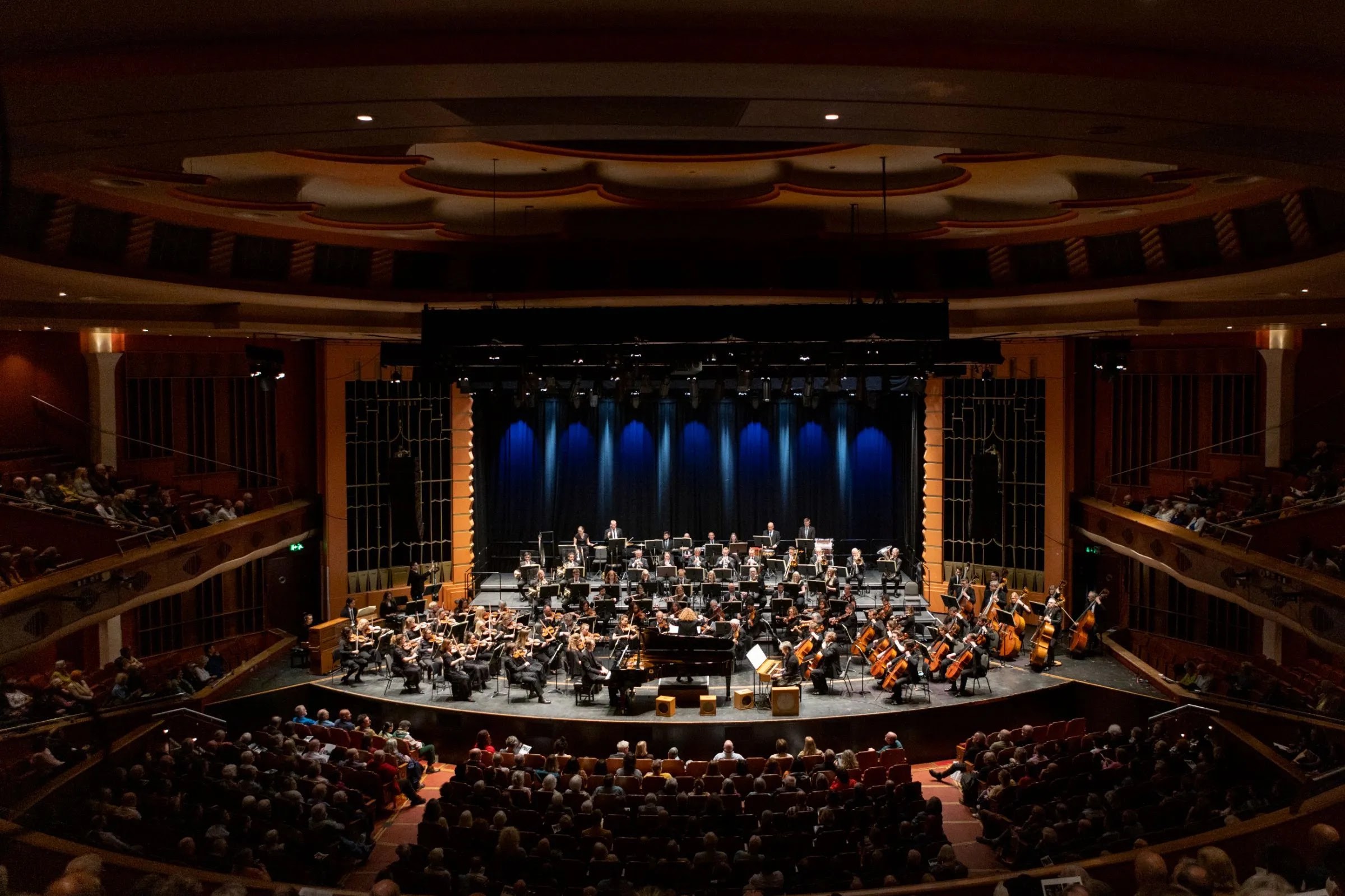
Hot on the heels of the announcement that Brighton Philharmonic Orchestra is to become the resident orchestra at Brighton Dome, the orchestra launched its new season in style with another exciting programme. As ever, Music Director, and today’s conductor, Joanna MacGregor put together a programme that managed to showcase different sections of the orchestra, as well as featuring not one but two soloists. So the brass section were the stars of the show in Janáček’s dazzling Sinfonietta, whilst the percussionists had their moment in the opener, Gershwin’s cinematic Cuban Overture, with the strings taking centre stage for the Piazzolla. 

Gershwin’s lively Cuban Overture opened proceedings, with its quartet of Cuban percussion instruments at the side of the stage behind the violins, with more percussion at the back. It took the orchestra a little while to settle into the rhythms, but once up and running, they had fun with it. There’s a lot going on, not just the percussion quartet, but frequent cross rhythms for the woodwinds, as well as solo moments for cor anglais, a slinky clarinet, and a duet for oboe and cor anglais. Given the busyness, balance wasn’t always ideal, so some detail was obscured, but all in all, this was a joyful opener, the Tom and Jerry style strings and the brassy buildup back to the opening music bringing it all to a playful conclusion, all steered with a bounce from MacGregor.  


Ukrainian-born pianist Khrystyna Mykhailichenko, pupil of MacGregor’s, then gave a confident and exciting rendition of Rachmaninov’s Rhapsody on a Theme of Paganini, all the more impressive as it was her first live performance of the work. She rippled effortlessly through the rapid motion of the faster variations, yet was sensitive and expressive in the big romantic D flat variation. The orchestral support was on the whole sound, although there were moments of less than unanimous tuning amongst the reeds and horns – all in all, woodwind blend could have been better. The strings produced a rich sound, however, and their response to the big romantic tune was suitably warm, and the woodwinds’ pickup after Mykhailichenko’s thundering double octaves was solid. MacGregor was alert to both soloist and orchestra throughout, making for a strong performance here. Given the connection, here’s hoping Mykhailichenko returns to Brighton soon.


Emily Trubshaw and the BPO strings
© Frances Marshall
Astor Piazzolla’s Estaciones Porteñas (Four Seasons of Buenos Aires) is a wonderfully evocative work, originally written for Piazzolla’s quintet, with the composer on bandoneon. Russian composer Leonid Desyatnikov arranged the set of four pieces for Latvian violinist, Gidon Kramer, scoring it for solo violin and string ensemble, and bringing the link to Vivaldi’s Four Seasons more to the fore, with little quotes from the earlier masterpiece. Today, the solo violinist was Emily Trubshaw, a member of the BPO’s Spring Forwards scheme (along with nine other young players in the orchestra today), which offers orchestral experience and mentoring to exceptional young players at the start of their careers. With the BPO string section standing, they performed Primavera Porteña (Spring in Buenos Aires) from the set, without conductor. They began with the ensemble’s leader, Ruth Rogers setting the rhythm, quickly joined by offbeat scratches from the leader of the second violins, Julia Loucks. Viola and cello followed, before Trubshaw took up the dancing tango line with panache. Her silky slow solo line in the central section was equally infectious, with throbbing double bass stabbing out the beat below. As the opening music returned, the strings luxuriated in their sweeps, and Rogers jammed with cross rhythms against Trubshaw’s melody. More virtuosic riffs from Trubshaw, led to a pause, with quick cheeky snippets of the Vivaldi to finish. A fun opener to the second half – it would be great for Trubshaw to return to give us the full set of Estaciones Porteñas sometime.


And finally, the Janáček. His Sinfonietta was written for the Sokol Festival in Prague, promoting Czech culture and sport, and it is packed full of fairytale and folk influences, as well as the blazing fanfare that opens and closes the work. The brass reinforcements arrived on stage and stood for their glorious fanfare, no fewer than nine trumpets and two bass trumpets, delivering the striking opening with precision and confidence. We were then given rattling woodwinds, muted trombones and dancing strings in The Castle, followed by rich, sliding strings in The Queen’s Monastery, this movement concluding with virtuosic horn whinnies. The Street Leading to the Castle is dominated by another brassy theme (for those of a certain age forever linked to Crown Court), and this was again delivered with energy, with winding violins, raspy muted horns and bells. The Town Hall, Brno creates a dazzling townscape, and all the dancing and activity built up to the brass standing once again for the return of their fanfare, their majestic confidence bringing this successful season opener to a blazing conclusion.

Tuesday, 31 March 2026

Johnston's Tavener the highlight for the Brighton Philharmonic Orchestra with MacGregor

Guy Johnston
© Frances Marshall

Ruth Rogers (violin)
Joanna MacGregor (conductor)

2.45pm, Sunday 29 March 2026

★★★★


Vaughan Williams, Ralph (1872-1958): Fantasia on a Theme by Thomas Tallis
Vivaldi, Antonio (1678-1741): Le quattro stagioni, Concerto No. 1 in E major, Op. 8, RV269 'La primavera' (excerpts)
                                                                               Concerto No. 4 in F minor, Op. 8, RV297 'L'inverno' (excerpts)
Richter, Max (b.1966): Recomposed by Max Richter: Vivaldi - The Four Seasons (excerpts)

Ruth Rogers, Joanna MacGregor
& the Brighton Philharmonic Orchestra
© Nick Boston

Vaughan Williams:
'.... was a great place to start, allowing the BPO strings to demonstrate warm tone and strong ensemble'.

Vivaldi/Richter:
this was a highly enjoyable rendition, with Rogers leading with spirit, dancing to the offbeat rhythms in Richter’s obsessive take on Spring.
Vivaldi had the last word, and the BPO strings positively fizzed

Guy Johnston, Joanna MacGregor
& the Brighton Philharmonic Orchestra
© Nick Boston

Tavener:
'The star of the show proved to be cellist Guy Johnston, with an intensely focussed performance'.

'Johnston’s variety of tone ... was astonishing'. 

'A wonderful performance from Johnston, but also raising MacGregor and the BPO strings’ game to a new level'.

Read my full review on Bachtrack here.

Monday, 10 November 2025

The Brighton Philharmonic Orchestra strings excel, with expressive Britten from Padmore & Watkins, and exciting MacMillan from MacGregor

Joanna MacGregor & the BPO strings
© Frances Marshall

Mark Padmore (tenor)
Joanna MacGregor (piano/conductor)
Ruth Rogers (leader)

7.30pm, Saturday 8 November 2025


★★★★


Ruth Rogers leading the BPO strings
© Frances Marshall

Britten, Benjamin (1913-1976): Young Apollo, Op. 16
Purcell, Henry (1659-1695): Chacony in G minor Z.730, (arr. Britten, Benjamin)
Britten, Benjamin: Serenade for Tenor, Horn and Strings, Op. 31
Dowland, John (1563-1626): Mr Dowland's Midnight (arr. MacGregor, Joanna (b.1959))
MacMillan, James (b.1959): Piano Concerto No. 2


The Brighton Philharmonic Orchestra continued their successful season with a programme that allowed their string section to shine, and shine they did. With some of the richest string playing I’ve heard from them, they relished the warm Corn Exchange acoustic, and also showed their tight ensemble in some of the more complex rhythmic music this evening. And what a great programme, with the music of three English composers – Britten, Purcell and Downland – joining the great Scottish composer, James MacMillan.


So they began with Britten’s Young Apollo, with Music Director Joanna MacGregor at the keyboard. It’s a vibrant, energetic piece, composed in 1939 when the 26-year-old Britten was in New York, yet he withdrew it soon after its premiere, without saying why, and it wasn’t performed again until 1979, after his death. It’s hard to know why, as its bright, radiant energy certainly captures images of ‘the new dazzling Sun-god’, as Britten described Apollo, inspired by Keats’ Hyperion. MacGregor launched in with an incisive start, and the glassy string slides and scales against the virtuosic piano scales were full of vitality. The vibrant solo string quartet contrasted well with the full, luscious string sound, and the ensemble of the accelerating chords at the finish was spot on. 


Mark Padmore, Alexei Watkins and the BPO
© Frances Marshal

Next up the strings were left to their own devices, with leader Ruth Rogers directing from the front desk in Britten’s arrangement of Purcell’s Chacony. Here their lush sound came to the fore, but also their ability to keep their precision alive when playing quietly. Just when the repeated variations that form the chaconne felt like they were becoming borderline aggressive, they dropped back to produce a more sensitive, quieter sound, and the slowing up of the quiet ending was well timed.


They were then joined by their Principal Horn player, Alexei Watkins and tenor Mark Padmore for Britten’s masterpiece, the Serenade for Tenor, Horn and Strings. A cycle of eight short songs setting varied texts including Tennyson, Blake and Keats, it is bookended by a Prologue and Epilogue for the solo horn. Watkins’ opening Prologue, which exploits hand-stopping to produce natural, other-worldly harmonics, was secure and controlled, with an earthy rasp to the sound in places, and the off-stage Epilogue at the end was atmospherically eery. Padmore’s expressive communication of the texts was faultless, so no need to consult the texts in the programme here. His tone was equally expressive, with moments of tender fragility , such as in Pastoral, as well as evocative word-painting, as in Nocturne’s repeated ‘dying’, and the playfully decorative ‘excellently’ in Hymn to Diana. Occasionally, expressive projection was favoured over centring of intonation, such as on the repeated ‘lulling’ or at the highest end of the range, but communication of the dark moods and evocative texts had undeniable clarity throughout. Watkins’ fanfares in Nocturne, and shifts in and out of mute in the mournful Elegy were impressive, and he demonstrated considerable power in Dirge. MacGregor directed the strings with clarity and energy, with a gleaming, glassy sound in Nocturne, and strong articulation in Dirge. 


Joanna MacGregor’s arrangements of three short Dowland pieces provided a delightful opening to the concert’s second half, with solo violins and viola joining the double bass and cello pizzicato line in Forlorn Hope Fancy, soon to be joined by running lines from the piano, the arrangement cleverly building to a richly textured conclusion. In Mr Dowland’s Midnight, MacGregor uses the pizzicato double basses again, this time layered with jazzy piano chords and then string surges. A muted quartet of two cellos, viola and violin features, with noodling from the piano on top. The final Can She Excuse for strings alone provided a lively rhythmic contrast to end the set. 


Joanna MacGregor (snare drum and piano)
© Frances Marshall

James McMillan’s Piano Concerto No. 2, which ended the evening’s concert, was a revelation to me, an exciting piece full of humour and playfulness but also complexity and diversity of moods. There’s the McMillan trademark use of Scottish tunes, and the Ceilidh that always seems to go off the rails. When MacGregor has conducted the full orchestra from the piano in the past, it hasn’t always proved totally successful, particularly in larger scale concerto works. However, here, the smaller forces of just strings needed less controlling, especially with Rogers’ strong leadership. Joanna still managed some left hand conducting whilst playing the solo part in the right hand, however, and everything felt extremely tight and energetic throughout. The opening movement, Cumnock Fair, is full of cartoon-like, playful renditions of various 18th century tunes, and there is plenty of opportunity for the strings to have fun. At one point, the violins’ drunken melody gets louder and slightly out of hand, and the BPO violins judged and controlled this well. Melodies collided as the piano tried to pick out the quote of music from Donizetti’s Lucia di Lammermoor’s famous Mad Scene, which repeatedly went off the rails (in a good, Ravel’s La Valse kind of way), before the sliding strings came over all atmospherically Celtic. As the chaos develops into full on Ceilidh in the final movement, there was enthusiastic foot stamping and whoops from the players, with slaps and slides, and the solo piano ringing out on top. Joanna even switched to beating rhythm on the snare drum before sliding down into the depths of the keyboard, and then still trying to assert the Lucia music. Rising piano flourishes built with a stomping string reel, bringing everything to a sudden raucous conclusion. 


Once again, MacGregor’s lively and imaginative programming, as well as insightful direction throughout, allowed the BPO players to rise to new heights. And great to see the Corn Exchange pretty much sold out for this.  

Tuesday, 21 October 2025

Playful Coleridge-Taylor contrasting with dramatic Mahler from the Brighton Philharmonic Orchestra

Elena Urioste
 © Chris Gloag

Elena Urioste (violin)

Alice Farnham (conductor)
Ruth Rogers (leader)

2.45pm, Sunday 19 October 2025

★★★★

Coleridge-Taylor, Samuel (1875-1912): Violin Concerto in G minor, Op. 80

Encore:
Arlen, Harold (1905-1986): Over the Rainbow (?arr. Poster, Tom (b.1981))

Mahler, Gustav (1860-1911): Symphony No. 5


For their latest programme, ‘The Romantics’, the Brighton Philharmonic Orchestra presented two highly contrasting works, with Mahler’s mighty Symphony No. 5 following the lighter offering of Samuel Coleridge-Taylor’s Violin Concerto in G minor, Op. 80. Ben Gernon was originally scheduled to conduct the concert but was replaced by Alice Farnham, whose combination of precise direction and energy made for a highly engaging afternoon’s programme. Of course it shouldn’t be worthy of note, but it’s great to see an all-female roster (for the second time this season) of conductor, soloist (Elena Urioste) and leader (Ruth Rogers) – with Music Director Joanna MacGregor the overall driving force. 

Elena Urioste
© Nick Boston

Violinist Elena Urioste was born in the US, and has an established solo career, performing with orchestras around the world. She is also a committed chamber music, with her Chamber Music by the Sea festival in Maryland celebtrating its tenth anniversary this year. She also co-founded with her partner, Tom Poster, the Kaleidoscope Chamber Collective, frequent performers at the Wigmore Hall and at the most recent Coffee Concert at Brighton Corn Exchange. She first performed Samuel Coleridge-Taylor’s Violin Concerto with Chineke! in 2019, recorded it with them in 2022, and has become a strong advocate for the somewhat neglected work. It’s an open-hearted piece, full of lyrical invention and plenty of opportunity for a virtuoso soloist to shine. Born in Croydon, of mixed Sierra Leonean and English heritage, Coleridge-Taylor originally intended to use spirituals for the melodic material of his Violin Concerto, but wasn’t happy with his attempts, deciding instead to use his own thematic ideas. Of course, Dvořák’s take on ‘American’ music also must have had an influence to bear here too, but the resulting work has a great sense of fun and individual style, which Urioste communicated here with great enthusiasm. 

Following the brassy stately opening from the orchestra, Urioste launched with a flourish into the first melodic idea, and from there, delivered each episodic entry with panache, at one point dancing her line over the accompanying pizzicato strings, and elsewhere injecting just enough bite to point up her dotted rhythms over the full orchestra. That dotted rhythm featured highly in her impressive cadenza, leading to a dramatic conclusion from the orchestra. The second movement is unashamedly lyrical, and the BPO strings set up just the right kind of muted accompaniment to allow Urioste to sing the silky lines above them. Orchestral ensemble was kept tight by Farnham through the ebb and flow of the rubatos whilst Urioste’s tender solos roamed effortlessly. The sprightly finale is once again packed with thematic invention, and Urioste and Farnham drove on through with playful energy (accompanied by frequent audible foot-tapping from Urioste). Virtuosic downward scale passages and skittering runs were aplenty, and weighty tuttis from the orchestra made for a brightly dramatic conclusion. In stark contrast, Urioste gave a simple yet highly tender rendition of Over the Rainbow by Harold Arlen (arranged I believe by Tom Poster), with gentle double-stopping providing some harmony, but the emphasis being on the beauty of the melodic line, delighting the Brighton audience.


Alice Farnham & the Brighton Philharmonic Orchestra
© Nick Boston
In contrast to the light-hearted ease of the Coleridge-Taylor, Mahler’s Symphony No. 5 was of course a completely different matter. The funereal opening movement immediately takes things in a darker direction, and the challenge for the orchestra is equally weightier. There is a great deal of pressure on many soloists from the orchestra, chiefly the trumpet and horn, and on the whole, the BPO acquitted themselves very well. It has to be said, however, that the overall strike rate today of brass splits was relatively high, which was a pity. The first movement’s woodwind dance had finesse, with some wild car-chase strings to follow, and Farnham steered the orchestra through with great clarity, although the latter part of the movement lost a little forward momentum. The screaming opening of the second movement had great drive, and the concluding brass chorale gleamed brightly, although the central marching section could have taken a bit more bite. The Scherzo had lilt and swagger, although at times a little too precisely measured, and once again, it was the woodwinds that shone the most, with the pecking bassoon and delicately precise oboe proving most noteworthy. The Adagietto was beautifully shaped by Farnham, with warm and tender playing from the strings, and sumptuous playing from harpist Alex Rider. The finale raised the mood, with precise horn and woodwind solos leading to the cellos deftly setting off the playful fugal section that followed. The orchestra appeared more in their element now, and the brass climaxes, swaying strings and woodwind interjections were knitted together with momentum by Farnham, with the final accelerando racing to a spectacular finish. So if not the most precise Mahler 5 at every point, Farnham and the BPO certainly delivered a performance with high energy and many great moments. 

Tuesday, 30 September 2025

'A New World' - Brighton Philharmonic Orchestra kicks off their 101st season in style

Junyan Chen

Junyan Chen (piano)
Joanna MacGregor (conductor)
Ruth Rogers (leader)

2.45pm, Sunday 28 September

★★★★


Rachmaninov, Sergei (1873-1943): Piano Concerto No. 3 in D minor, Op. 30
Encore: 
Gershwin, George (1898-1937): The Man I Love, arr. by ?
Ravel, Maurice (1875-1937): La Valse, poème chorégraphique pour orchestre
Bartók, Béla (1881-1945): Suite from The Miraculous Mandarin, Sz.73

Joanna MacGregor
After a cracking 100th season, the Brighton Philharmonic Orchestra are back for their 101st (my season preview is here),and there’s no sign of Joanna MacGregor letting up on the imaginative programming we’ve now come to expect. So whilst there was a big hitting concerto for the first concert of the new season, they went for Rachmaninov’s Piano Concerto No. 3 – popular of course, but not as well-known as the second. And rather than the usual overture-concerto-symphony sandwich, the Rachmaninov opened the concert, bold and up front, with Shanghai-born pianist Junyan Chen at the keyboard. A former pupil of MacGregor’s, Chen has performed with the BPO previously, and last year won not one but three prizes at the Leeds International Piano Competition, including the Silver Medal.

Right from the steadily rolling opening of the Rachmaninov, it was clear that Chen was in control here, setting the pace with incision and steering progress through the frequent rubatos at the ends of phrases. The orchestra were a little slower to get going, with a somewhat muted response, and MacGregor’s occasionally uncertain beat meant that in solo-free passages there were a few hesitant cadences. Woodwind solos were strong, however, with a particularly fine moment from the bassoon alone with the piano. Flute, oboe, clarinet and horn all got a chance towards the end of the movement, and all acquitted themselves well. The muted strings in the slow movement could have still had a little more weight in their sound, but their ensemble was tight, giving secure support to Chen’s swirling romantic solo. The movement’s conclusion was authoritative and arresting, with the finale following at a healthily steady pace. Once again, Chen drove the tempos, and apart from the odd uncertain pickup, the orchestra followed obediently. Chen demonstrated some particularly seductive, slinky playing here, with impressively virtuosic solo passages, and a glorious surge to the finish, here matched with a rich, full sound from the full orchestra. She then treated the appreciative Brighton audience to a sensual arrangement of Gershwin’s The Man I Love 
(possibly Art Tatum’s arrangement?), with its seductive outer thick chords beautifully contrasted with the brief vamping central section. Definitely a pianist to watch, and hopefully we’ll be treated to a return visit in Brighton sometime soon.
 
Junyan Chen & the Brighton Philharmonic Orchestra
© Nick Boston
Ravel’s La Valse is a wonderfully anarchic unravelling of the Viennese Waltz, originally intended as a ballet for Diaghilev. He turned it down, souring their relationship for good, even though Diaghilev acknowledged it as a musical masterpiece. As well as a reflection on the dying world of the waltz, was it also a comment on political decay in Europe, post-World War I? Well Ravel said not, but it is hard not to read some sense of the end of an era into his wildly evocative picture of the opulent ballrooms of Vienna gradually swirling out of control into chaos. MacGregor and the BPO gave us a suitably dark opening, with slithering glissandi from the violas and an ominous cor anglais solo. MacGregor steered through the frequent rubatos and Viennese holdups, although these felt occasional a little mechanical rather than fully felt. As things built to the inevitable climax, timing unravelled ever so slightly, and the seasick surges from the orchestra needed even more, but MacGregor punched through to a suitably wild finish. 
 
Joanna MacGregor & the Brighton Philharmonic Orchestra
© Nick Boston
Then came the most intriguing programming choice of the afternoon. Bartók’s The Miraculous Mandarin Suite is not performed as often as it should be, but when it is, at just over twenty minutes, it often appears as the warm-up act. But this densely imaginative and exciting score deserves more attention, and by ending their concert with it, the BPO were able to show off its dramatic and unsettling power. Described as a ‘pantomime ballet’, the original full work, with its shocking tale of tramps forcing a girl to entrap men so they could rob them, was in fact too shocking for audiences of the day, and it had to be withdrawn after its premiere. Bartók’s concert suite was however performed in his lifetime, perhaps because the ‘action’ now stops at the point when the mysterious Miraculous Mandarin, the tramps’ third victim, chases the girl, and avoids the ensuing failed attempts by the tramps to kill him, as well as his sexual union with the girl, before he finally dies. Nevertheless, the Suite still contains the darkness of the drama, right from the opening raucous cityscape to the chase scene, via the increasingly complex characterisations of the three victims, all portrayed via clarinet solos. MacGregor and the BPO were in their element for the opening bustling cacophony, with trombone car horns and swirling, whistling woodwinds. Principal clarintettist James Gilbert’s solos were full of the necessarily individual character, and with mournful turns from cor anglais and oboe, brittle col legno strings (hitting with the wood of the bow), trombone slides and glassy celesta combined with high flutes, they delivered much of the atmospheric detail of Bartók’s score with enthusiasm. MacGregor’s direction was also more confident throughout here, and the slowing up into the final finish was well judged, making for a thrilling conclusion to their assured performance of this exciting work. Once again, MacGregor and the BPO showed that taking risks with more adventurous programming choices pays dividends, as evidenced by another almost full and highly appreciative Brighton Dome audience.

Thursday, 17 July 2025

Brighton Philharmonic Orchestra launch their 101st season

Elena Urioste, BPO season brochure
After an extremely successful 100th season, the Brighton Philharmonic Orchestra have revealed their plans for their 
101st, and Music Director Joanna MacGregor is not taking her foot off the pedal, with another exciting and varied programme revealed.  

Big names this season include tenor Mark Padmore, cellist Guy Johnston and violinist Elena Urioste. Pianist Junyan Chen (runner up at last year’s Leeds International Piano Competition, also coming away with two other prizes, including the chamber music prize) and Nigerian-Scottish trumpeter Aaron Azunda Akugbo also feature, as well as Lativan accordionist Alise Siliņa. And percussion, so much a feature now of BPO’s programmes, forms the centrepiece of the season’s final concert, with a new work for Brazilian percussion and piano, to be written by MacGregor, and performed by Brazilian percussionist Adriano Adewale and MacGregor on piano. Leader Ruth Rogers also gets a chance to shine as a soloist, along with Romanian violist Sacha Bota, and actor Alistair McGowan returns for the BPO’s popular version of A Christmas Carol.
 
Junyan Chen
And so to the music. The season kicks off with Junyan Chen playing Rachmaninov’s mighty Piano Concerto No. 3, and this sits alongside two great ballet scores, Ravel’s wild La Valse and Bartók’s equally outrageous The Miraculous Mandarin Suite - the ballet was banned in Germany after its 1926 Cologne premiere (2.45pm, Sunday 28 September, Brighton Dome).


Ben Gernon
Joanna MacGregor has repeatedly demonstrated her commitment to bringing rarer and more unusual repertoire to the BPO’s programmes, whilst also managing to show that they don’t neglect core repertoire. Last year, Tchaikovsky, Rimsky-Korsakov and Stravinsky sat alongside MacMillan, Schnittke and Gwylim Simcock, and of course, who could forget their barnstorming performance of Messaien’s Turangalîla Symphony? But I’m not sure when I last heard the BPO perform Mahler, so it’s great to see his Symphony No. 5 on the schedule, with Ben Gernon conducting, alongside a luscious gem, Samuel Coleridge-Taylor’s Violin Concerto, played by one of the work’s great advocates, Elena Urioste (2.45pm, Sunday 19 October, Brighton Dome).
 
Mark Padmore
© Marco Borggreve
The strings of the BPO are at the heart of their next concert, with tenor Mark Padmore and the BPO’s Principal horn, Alexei Watkins joining them for Britten’s wonderful Serenade for Tenor, Horn and Strings. There’s more Britten, with his Young Apollo, a radiant work for piano, string quartet and strings, and also Britten’s arrangement for string quartet and string orchestra of Purcell’s Chacony in G minor. MacGregor is then the arranger, this time of Dowland for Mr Dowland’s Midnight, and the concert ends with James MacMillan’s Piano Concerto No. 2, a work full of Scottish folk music influences, with a wild, anarchic ceilidh to finish (7.30pm, Saturday 8 November, Brighton Corn Exchange).
 
Alise Siliņa
December brings two Christmas themed events. The first unusually puts a solo accordionist, Alise Siliņa centre stage, in Václav Torjan’s Fairy Tales: A Concerto for Accordion, which draws on Czech fairy tale characters for its three movements. Ukranian composer Thomas de Hartmann fled from the Nazis to Paris, and it was there that he composed his orchestral work, Koliadky (Noëls ukrainiens, or Ukrainian Christmas Carols). The concert opens with Delius’ rarely performed Eventyr (Once upon a Time), evoking Norway’s folk tales, mythical beasts and landscapes, and they end with the Christmas classic, Tchaikovsky’s The Nutcracker Suite (2.45pm, Sunday 7 December, Brighton Dome). Then, as mentioned above, Alistair McGowan returns, joined by MacGregor and the BPO Brass Quintet for Charles Dickens’ A Christmas Carol, directed by Richard Williams. And this year, they are taking the show to Petworth and Lewes, as well as giving two performances in Brighton (18, 19 & 20 December, St George’s Church Kemptown, St Mary’s Church Petworth & St Anne’s Church Lewes).
 
Aaron Azunda Akugbo
They usher in 2026 with classic, infectiously minimalist Michael Nyman film scores, The Draughtman’s Contract and Prospero’s Books, set alongside Wynton Marsalis’ Trumpet Concerto, which combines jazz with blues and classical trumpet styles in a virtuosic whirlwind, a great showcase for the young trumpeter Aaron Azunda Akugbo (7.30pm, Saturday 24 January, Brighton Dome).
 
Once again combining core repertoire with the lesser known, Mozart’s glorious Sinfonia Concertante, with Ruth Rogers (violin) and Sascha Bota (viola), and the Piano Concerto No. 20, with Joanna MacGregor at the piano, are separated by Lonely Angel: Meditation for violin and strings, by Latvian composer Pēteris Vasks. They open with Bartók’s distinctive Romanian Folk Dances, a short suite of piano pieces that Bartók then orchestrated for strings (2.45pm, Sunday 22 February, Brighton Dome).
 
Guy Johnston
© Frances Marshall
John Tavener’s masterpiece, The Protecting Veil is the highlight of their next concert, with cellist Guy Johnston the soloist. The work combines moments of joyful ecstasy with soulful contemplation, and is a real tour de force for the soloist. Before that, Ruth Rogers (violin) is the soloist in Spring and Winter from Vivaldi’s Four Seasons, coupled with Max Richter’s mesmerising take on the movements, from his hit work. Vivaldi Recomposed. And another homage from one composer to another, Vaughan Williams’ richly evocative Fantasia on a Theme of Thomas Tallis, opens this concert (2.45pm, Sunday 29 March, Brighton Dome).
 
Adriano Adewale
Sounds of Brazil will bring the season to a close, with an eclectic programme, including that new Concerto for Brazilian Percussion and Piano by MacGregor, with soloist Adriano Adewale. This will follow on from Britten’s The Young Person’s Guide to the Orchestra, a firm favourite to show off all sections of the orchestra. I’m not sure how the Russian witches of Mussorgsky’s Night on Bald Mountain, or the puppets of Stravinsky’s Scenes from Petrushka (or the Britten for that matter) fit in with a Brazilian theme, but this will nevertheless no doubt be a lively, joyful programme to end the 101st season.
 
Also worth a mention is an exciting new collaboration with Brighton College to take chamber music to younger audiences, with three recitals, each preceded by short masterclasses for students in the afternoons. Concerts include music by Glass, Rameau, Liszt, Haydn, Dvořák and Piazzolla, with Joanna MacGregor being joined by principal string players, and soloists Adriano Adewale and cellist Adrian Brendel (7pm, 10 September, 25 February & 15 April, Brighton College).
 
With low income concessions and tickets from £10 for all under 30s, as well as last-minute offers for first-time bookers. Details of all concerts and tickets at brightonphil.org.uk and brightondome.org.

Tuesday, 15 April 2025

A golden Turangalîla-Symphonie to celebrate the Brighton Philharmonic's centenary

The Brighton Philharmonic Orchestra
© Frances Marshall

Joanna MacGregor (conductor)
Cynthia Millar (ondes martenot)
Ruth Rogers (leader)

2.45pm, Sunday 13 April 2025

★★★★

Olivier Messaien (1908-1992): Turangalîla-Symphonie


'The percussion section (today some nine players strong, in addition to celesta and keyed glockenspiel players) has featured prominently throughout the season; they gave an assured and confident response to Messaien’s heavy demands'.

'Here the orchestra delivered a truly massive sound, and although not every onset of the huge tutti chords was perfectly clean, they ended with lush waves of warmth and celebration'. 

Joanna MacGregor conducts the Brighton Philharmonic Orchestra
© Frances Marshall
'Havlat was astonishing in the various piano cadenzas, thundering through the virtuosic flourishes in the fifth movement especially'.

'Millar was a constant secure presence, with the eery slides and otherworldly melodies emerging from the ondes Martenot'. 

'This was a triumph of ambition and commitment, and MacGregor, Millar, Havlat and all the BPO players deserve high praise for pulling off this vast endeavour to end their centenary season'.

Read my full review on Bachtrack here.

Tuesday, 3 December 2024

Intense and gripping MacMillan from Glennie, with Paterson and the Brighton Philharmonic Orchestra delighting a full house

Dame Evelyn Glennie

Evelyn Glennie (percussion)
Geoffrey Paterson (conductor)
Ruth Rogers (leader/solo violin)
Robert Jordan (bagpipes)

2.45pm, Sunday 1 December 2024

★★★★


Peter Maxwell Davies (1934-2016): An Orkney Wedding, with Sunrise
James MacMillan (b.1959): Veni, Veni, Emmanuel
Nikolai Rimsky-Korsakov (1844-1908): Scheherazade, Op. 35

It was great to see the Brighton Dome all but sold out for the latest concert in the Brighton Philharmonic Orchestra’s already successful season. The two-pronged attractions of the superstar percussionist Dame Evelyn Glennie, and the ever-popular crowd-pleaser, Rimsky-Korsakov’s Scheherazade proved a winning combination. And they even threw in a bagpipe soloist for good measure. It was particularly gratifying to see a good number of children in the audience too – one young lad near me, only maybe four or five, was jigging along and enjoying the rhythms of both pieces in the first half, clearly excited by the dazzling array of percussion instruments on stage. 


Geoffrey Paterson
with the Brighton Philharmonic Orchestra
Music Director Joanna MacGregor took to the stage briefly to introduce the programme, but then handed over the reins to the afternoon’s conductor, Geoffrey Paterson, returning after a great Wagner programme in last year’s BPO season.  They opened with Peter Maxwell Davies’ An Orkney Wedding, with Sunrise. Following an opening storm, the wedding party arrives, and following somewhat drunken tuning up, dancing commences, getting wilder and more chaotic, before the party depart into the night.  The sun then rises over Caithness, and blazing brass announce the entrance of the bagpiper, in full Highland regalia. It’s a fun piece, but it’s a challenge for an orchestra to emulate drunken, somewhat dodgy playing, without just sounding wrong! The BPO pretty much managed to pull this off, from the tipsy tuning onwards, the dancing rhythms growing ever more random and unhinged. Leader Ruth Rogers’ drunken slides in the string quartet section were great fun, and bagpiper Robert Jordan’s entrance at the end provided a suitably striking climax to this joyful opener. 


James MacMillan’s Veni, Veni, Emmanuel was premiered by Evelyn Glennie at the Proms back in 1992. It is a substantial, single movement work, and as soon as you see the array of percussion instruments spread across the whole of the front of the stage, you know you are in for a virtuosic and visually exciting display. Right from the opening thundering crash on the tam-tam, Glennie never held back, after a brief spell on the vibraphone, marching purposefully across to the other side for drums, followed by an extensive woodblock and gong solo. With marimba to come, and tubular bells to end, the piece certainly provided Glennie with the opportunity to demonstrate her absolute command and authority on such a diverse range of instruments. The work itself draws on the plainsong advent tune (O Come, O Come Emmanuel), and moves from Advent at the opening through to Easter at the conclusion. Having said that, you might be hard placed to spot the underlying plainsong melody, as it is broken into fragments, only really appearing towards the very end of the work. With Glennie charging about from instrument to instrument, Paterson steered the orchestra through their contribution with clarity and command, with particularly tight rhythms in the hocketing dance section, also maintaining the orchestral lilt when Glennie’s marimba stabbed at rhythmic cross-purposes. The final section, when the orchestral musicians put their instruments down and take up delicately tinkling bells and chimes whilst Glennie headed up to the tubular bells at the back of the stage was highly effective, and rather magical, as the intensity built to the final bells. The final ringing was then held for what seemed like an age, before Glennie damped the bells slowly one by one, and Paterson finally lowered his outstretched arms, the audience remaining silent in reverence.


After all that high drama and busy action in the first half, Rimsky-Korsakov’s Scheherezade provided a somewhat soothing sense of calm. Despite having its own dramatic story to tell, with tales of Sinbad’s voyages and love between a young prince and princess, all told by Scheherezade to distract her husband for a thousand and one nights, we too become beguiled by Rimsky-Korsakov’s sumptuous orchestration. Perhaps it’s those familiar melodies, oft repeated throughout its four movements, and its lyrical solos, not least the major violin solo part, that create a more settled soundworld than the more stridently assertive Maxwell Davies & MacMillan works we heard in the first half. Paterson shaped the sea surges in the strings in the opening movement, and the BPO players produced a rich tutti sound. The work gives prominent multiple solos to the prinicipals of most orchestral sections, and these were delivered with warmth and accuracy, with only the occasional imperfections. But of course the major solo part falls to the violinist, and again, Ruth Rogers excelled here. Her lyrical tone, as well as her virtuosic multiple string stopping were exemplary, and her control of the harmonics at the close of the final movement was highly impressive. Peace and calm were duly restored at the end of the tale, bringing to a close yet another varied and imaginative programme from the BPO. 


Robert Jordan with Geoffrey Paterson
& the Brighton Philharmonic Orchestra
© Nick Boston
Evelyn Glennie with Geoffrey Paterson
& the Brighton Philharmonic Orchestra
© Nick Boston