Showing posts with label BREMF. Show all posts

Tuesday, 12 May 2026

'Bringers of Dreams': Brighton Early Music Festival 2026 Preview

Hannah Ely (soprano)
Olwen Foulkes (recorders)
Oliver Webber (violin)
Kristiina Watt (lute, theorbo, baroque guitar)
Harry Buckoke (viola da gamba)
The Royal Sackbut Collective:
Buchen Zhao (alto & tenor sackbut)
Jonathan Stevens (alto & tenor sackbut)
Jess Anderson (tenor sackbut)
Andrew Cowie (tenor sackbut)
José Teixeira (tenor sackbut)
Jonny Lovatt (bass sackbut)
 
7.30pm, Saturday 9 May 2026
Champs Hill, Pulborough
 
Oliver Webber, Olwen Foulkes,
Harry Buckoke & Kristiina Watt
© Cathy Boyes
Brighton Early Music Festival, now in its 24th year, will run from 2-25 October 2026, with its usual selection of pre-festival workshops and community and family events from 19 September onwards. This year’s theme is ‘Bringers of Dreams’, and last Saturday, BREMF held a Festival Preview event at the picturesque setting of Champs Hill. 
 
The idea was to present a flavour of some of the music that will be performed, but presented here by a small group of performers, including co-Artistic Directors Hannah Ely and Olwen Foulkes. They were joined by festival regulars Oliver Webber (violin), Kristiina Watt (lute, theorbo & baroque guitar) and Harry Buckoke (viola da gamba). And representing the BREMF Emerging Artists scheme (formerly known as BREMF Live!) was The Royal Sackbut Collective, who will be performing in the opening concert of this year’s festival. 
 
Hannah and Olwen gave an overview of some of the key themes of the festival, and talked with passion about the great work that BREMF does, particularly with the Emerging Artists, in schools across Brighton and Hove, and also touched on One Song, a project working with settled refugees in Brighton, who will be sharing songs from their homes via a video installation in an exhibition during the festival.
 
Olwen Foulkes & Hannah Ely
BREMF Co-Artistic Directors
© Cathy Boyes
They then introduced the evening’s programme, which was made up of principally three sections. They began with a selection of excerpts from Purcell’s The Fairy Queen, which will be performed at the end of the festival by the London Handel Players and solo singers from the Emerging Artists programme (currently being recruited). Webber & Foulkes gave us a bright opening Hornpipe, then Ely delivered ‘See my many colour’d fields’ with a beautifully mellow, pure tone, with gentle ornamentation from Webber on the violin. Several dance movements were given variety with Foulkes switching recorders and sensitive accompaniment provided by Watt and Buckoke. But the highlight of this brief selection had to be The Plaint, ‘O let me weep’, from the final Masque. Here, Ely’s pure tone was enriched with moments of passion (‘He’s gone’) and lamenting sighs. They certainly whetted the appetite for a full rendition of this wonderful semi-opera in October. 
 
Next came a sequence of Dowland songs, as we are in year of the 400th anniversary of his death, and thus Dowland will feature highly in this year’s festival, with a day-long celebration of his music on Saturday 17 October. Here, four members of the Royal Sackbut Collective stepped forward to accompany Hannah Ely in ‘O sweet woods, the delight of solitariness’, and despite the Champs Hill hall’s relatively dry acoustic, they balanced the sackbuts with subtlety, blending with Ely’s sensitive singing remarkably well. Ely was then joined by Watt on the lute and for ‘Time stands still’, sung with pose, delicate ornamentation and precise diction, with graceful support from the lute. Foulkes on recorder and Buckoke on the viola da gamba joined for ‘Now, O now I needs must part’, with Foulkes’ playful and virtuosic treble recorder lightly dancing along, and they concluded the sent with ‘Sorrow, stay, lend true repentant tears’, with more plaintive lamenting from Ely, following Dowland’s word-painting lines down (‘down I fall’) and up again (‘arise’), finishing with beautiful control on the long final note. Again, a short taste, but a reminder of the surprising variety of colours and moods in Dowland’s songs.
 
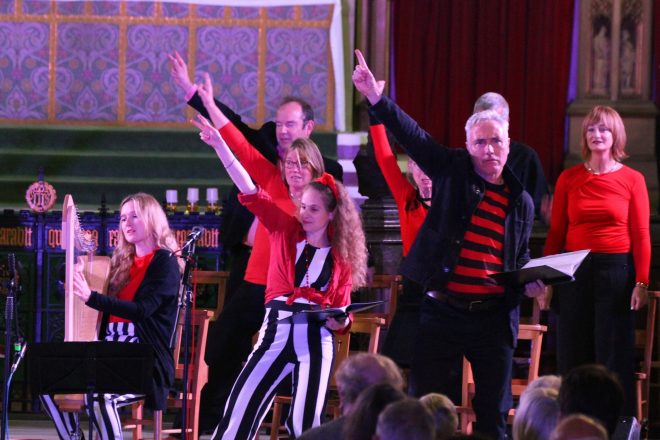
BREMF 2026 Festival Preview - full ensemble
© Nick Boston
After the interval, the remainder of the concert shifted focus to Florence as a true ‘City of Dreams’. The opening concert will trace 200 years of Florentine art and invention, and will feature the Monteverdi String Band (led by Oliver Webber), the BREMF Consort of Voices, and The Royal Sackbut Collective. Tonight’s music took us from ‘En vray amoure’, attributed to Henry VIII in the early 16th century through to music by Gabrieli, Caccini and Uccellini, taking us up to the mid 17th century. The Royal Sackbut Collective contrasted lively rhythms and virtuosic, rapid motion in the Henry VIII piece with sombre, dark tones and dynamic interest in Verdelot’s ‘Se l’ardor foss’ equale’. Oliver Webber then introduced the ‘lira da braccio’, an instrument designed specifically for accompanying the voice, often seen in renaissance art. Performing on the instrument for the first time, the blend of drone, ornamentation and harmony blended perfectly with Ely’s voice in Corteccia’s ‘O begli anni de l’oro’. In Marenzio’s ‘Belle ne fe' natura’, Ely, Foulkes and Webber weaved their three high lines in a perfect blend, then the four instrumentalists danced through Marini’s Sonata with fresh virtuosic energy. ‘Mater Hierusalem’, from an early 17th century manuscript (‘Carlo G.’) followed, full of decorative divisions and ornamentation from Webber and Ely, the complexity increasing and matched, one after the other. The Royal Sackbut Collective returned for the glorious ‘O Jesu Christe’ by Giovanni Gabrieli, the players warming their blend nicely from a quiet opening to a full sound, with gently rocking rhythms in the triplet sections. Caccini’s ‘Chi nel fior di giovinezza’ followed from Ely and the instrumentalists, the voice now playful, even skittish, with virtuosic melismas, and they then brought the evening to a close with an instrumental Aria Sopra la Bergamasca by Uccellini, launched by a ground bass from Buckoke on viola da gamba, and building to joyful virtuosity from Foulkes and Webber, their rapid flourishes running from one to the other. 
 
This whole final section was a wonderful reminder of the joys of the Florentine repertoire, and brought back memories of BREMF’s Florentine Intermedi (2012) and Four Weddings and Funeral (2010) with Musica Secreta. So lots of great music to look forward to in this year’s festival, presented in imaginative and innovative ways and continuing the BREMF tradition of exploring connections and challenging preconceptions of early music. The full programme will be launching soon, but for now, sign up on their mailing list here for more information.

(Pre-order The Royal Sackbut Collective's debut album here).

Wednesday, 19 March 2025

BREMF Consort of Voices - Palestrina 500: Music from Italy and the Sistine Chapel


Join BREMF Consort of Voices to celebrate the 500 anniversary of the birth of Giovanni Pierluigi da Palestrina in 1525, whose graceful polyphony was written to be performed in the Sistine chapel and whose influence quickly spread throughout Europe. They will also be performing motets by some of his contemporaries including Allegri, Victoria, Gabrieli, and Marenzio.

BREMF Consort of Voices
James Elias director

This concert is part of the Europe-wide celebration of Early Music Day 2025.

Tickets here.

BREMF Consort of Voices, performing at BREMF 2024
© Robert Piwko


Wednesday, 18 September 2024


Programme


Josquin des Prez (c.1450–1521) - Kyrie from Missa Pange lingua 

Thomas Tallis (c.1505-1585) - In manus tuas 

William Byrd (1539/40–1623) - Haec dies 

Robert Parsons (c.1535-1572) - Ave Maria 

Giovanni Palestrina (c.1525-1594) - Sicut cervus 

Tomás Luis de Victoria( c.1548-1611) - O quam gloriosum 


More details here.

Saturday, 20 April 2024

The Contenance Angloise - BREMF Consort of Voices sings 15th century polyphony

BREMF Consort of Voices, directed by Deborah Roberts, will be performing a programme of 15th century music at St Paul's Church, West St, Brighton on Saturday 4th May at 3pm.

There will be music by John Dunstable, Walter Frye and Guillaume Dufay. There will be more Frye and Dufay in the Brighton Early Music Festival this year, in October, so this one hour concert will be the perfect taster!

Tickets are £15 (£7.50 concessions), but £5 Prom/restricted view tickets will be available on the day. Details here.

You can also listen to recordings of most of the music in a specially created Spotify playlist here


Thursday, 26 October 2023

'To the Northern Star' - strong performances from Flauguissimo and friends of delightful chamber works for flute by 'the Father of Swedish Music', Johan Helmich Roman (1694-1758)

The ensemble Flauguissimo Duo (Yu-Wei Hu (flute) and Johan Löfving (theorbo/guitar)) first came to my attention when they were BREMF Live! artists at Brighton Early Music Festival back in 2012. Since then, they have released their debut album, A Salon Opera (my review here), and Löfving also released an album of music for guitar and string quartet with the Consone Quartet (also BREMF Live! participants in 2016) (my review here). So it is great to see them back with another release, and I was fortunate to see them performing works from the recording as they completed their album launch tour, appropriately enough at a satellite event prior to this year’s Brighton Early Music Festival. Their album, ‘To the Northern Star’, consists of chamber works by Johann Helmich Roman (1694-1758), and they are joined by Magdalena Loth-Hill (violin), Henrik Persson (viola da gamba) and Emily Atkinson (soprano). I have to confess, Roman was new to me, despite being hailed as ‘The Father of Swedish Music’. He studied alongside J. S. Bach’s brother, Johann Jacob, and then spent considerable time in London, performing at the King’s Theatre in Handel’s orchestra. He returned to Stockholm to the court of Frederick I and Queen Ulrica Eleonora, and he dedicated the publication of his Twelve Sonatas for flute and basso continuo to the Queen in 1727. Flauguissimo have recorded three of those sonatas here, and they are full of delightful invention, grace and elegance. Yu-Wei Hu makes her flute sing in the aria-like movements, such as the opening Largo of No. 4, and her rippling ornamentations flow effortlessly, as in the French overture-like Larghetto at the start of No. 10. The quicker movements dance along, and Löfving switches between theorbo and guitar to provide variety of texture. Persson’s viola da gamba provides an almost hurdy-gurdy effect in the rustic Piva of No. 10 around which the flute circles, and the closing Villanella feels even more rustic, with tapping and strumming accompaniment. Hu’s flowing lines are impressively fluid, with precise articulation and rare pauses for breath. Roman favours a lilting swing for his quicker movements – moments of rapid virtuosity are relatively few and far apart, but when they come, such as in the Allegro following the Adagio in No. 8, Hu’s precision is impressive, and here matched with swift articulation from Persson in response. Alongside the Sonatas, there are two Arias here. The first, ‘Süße Zeiten eilet nicht’, comes from the Cantata in einer Taffel-Music, opens with delightful cascading flute passages over a delicately falling bass line. Atkinson’s bright clear soprano joins with gently lilting lines, gradually picking up more ornamentation to match the flute, with Loth-Hill’s beautifully blended violin joining the action. Atkinson returns for the second aria, this time in Swedish, with ‘I eder bästa vår’ from Bröllops Music, written for an aristocratic wedding. Again, Atkinson demonstrates flowing virtuosity in the vocal lines, with bright and joyful communication of the text, although the recording balance is a little heavily in favour of the voice, so that the flute doubling of the vocal line is only just audible. But this aria is also striking for its violin part, with an extensive solo cadenza-like passage, full of Baroque string crossing and sequences, with more than a hint of Corelli, following the lyrical opening. Loth-Hill is impressive here, particularly when rising into the high registers, keeping a bright and clear tone throughout. They end their recording with their own arrangement of the Trio Sonata No. 3 in E minor, originally written for two violins and continuo, here performed with flute and violin on the top lines. The opening, sad Largo sounds like a Bach chorale, and Hu & Loth-Hill beautifully blend their instruments here. The Vivace that follows brings virtuosity and spirit for both instruments, with additional energy perhaps missing from the more stylish Sonatas. Persson matches their virtuosity with nimble syncopation here. More strumming from Löfving and swinging ornamented lines bring the Trio Sonata and their disc to a lively finish. It’s great to hear this delightful music receiving such strong and dedicated performances from Flauguissimo and friends, and hopefully there will be more Roman to come from them.
  

Monday, 27 March 2023

BREMF@Easter - Two Concerts from Brighton Early Music Festival to welcome the Spring


Brighton Early Music Festival is offering two concerts to welcome the Spring. First up is the BREMF Consort of Voices, conducted by Deborah Roberts, with a Double 'Bill' programme celebrating music by William Byrd and William Cornysh. (7pm, Saturday 1 April, St Martin's Church, Lewes Rd, Brighton BN2 3HQ). 
You can listen to their performance of Byrd's Ne Irascaris Domine from the European Day of Early Music in 2019 here:
 

Then Fair Oriana perform a programme of contemplative music for Holy Week from around Europe, including the beautiful Leçons de Ténèbres by Couperin. Fair Oriana are sopranos Angela Hicks & Penelope Appleyard, with Harry Buckoke (viola da gamba), Jonatan Bougt (theorbo) and David Wright (organ), and they are joined in the concert by the Celestial Sirens. (7.30pm, Friday 7 April, St Martin's Church, Lewes Rd, Brighton).

Here you can listen to Fair Oriana performing Handel's Eternal Source of Light Divine from their debut album Two Voices:


Tickets for both concerts available from BREMF here.

Monday, 24 October 2022

Brighton Early Music Festival 2022


My highlights from this year's Brighton Early Music Festival: 


Flutes & Frets

Tufnell Trio


BREMF Medieval Ensemble
Liturina


Tuesday, 7 June 2022

Brighton Early Music Festival – Midsummer Season, June 2022


Following a highly successful midsummer season last year, BREMF are back this summer with a weekend of events exploring Transition, which will form a year-round theme for the festival.


The weekend begins with In Transit to the Baroque – ensemble In Echo perform music by Semisy, Willaert, Bertali and Frescobaldi, exploring instrumental music’s journey from the Renaissance into the Baroque periods (7.30pm, Friday 24, St Bartholomew’s Church, Brighton).


Later that night, BREMF Consort of Voices perform sacred music and chant from the Night Offices of Compline and Matins, with music by Tye, Tallis, White, Sheppard, Browne, Palestrina and Victoria (9pm, Friday 24, St Bart’s).


Puppets and instruments combine for a performance by Rust & Stardust for ‘primary-aged children and the young in spirit’ – Endo the Earthworm explores nature in transition, with two performances (Saturday 25, 11am at Royal Spa, Brighton & 2.30pm at The Crew Club, Whitehawk).


Joglaresa are joined by the BREMF Community Choir for ¡Bailemos!, celebrating in style the legacy of founder, Belinda Sykes, who sadly passed away recently. Expect a joyful party of music-making! (5pm, Saturday 25, Royal Spa).


Folk in Transition
explores music from the British Isles to the New World, with traditional ballads, Irish jugs, Scottish reels and Appalachian bluegrass, performed by Brighton folk trio Hope Cove (8pm, Saturday 25, Royal Spa).


Aradhana Arts perform Indian Classical music and dance in The Daksha Yagna, a powerful mythological story from the ancient Hindu scriptures (3pm, Sunday 26, Royal Spa). 


And the Midsummer Season ends with Fair Oriana peforming Eliza is the Fairest Queen, with popular songs from the reigns of two queen Elizabeths, including Tudor-tinted arrangements of Vera Lynn, Aretha Franklin and The Beatles (6pm, Sunday 26, Royal Spa).


Some tickets voluntary, with suggested donations or pay what you can – check for details.


bremf.org.uk

Monday, 12 October 2020

Brighton Early Music Festival - ‘BREMF@home – across the Earth’


For obvious reasons, there will sadly be no live concerts to attend in this year’s Brighton Early Music Festival. However, undeterred, BREMF are presenting a series of events online instead. 
Events will be premiered at a fixed date and time on YouTube and will remain online for a week. Although the events will be freely available, BREMF are requesting that viewers make a donation in place of buying concert tickets in the normal way via their website. This is crucial, as most of their regular funders have diverted funds to emergency aid during the COVID-19 crisis. 

Events run from Friday 23 October to Sunday 1 November

Spiritato!

Pocket Sinfonia will perform classics by Mendelssohn and Beethoven, adapted for chamber proportions, with animation and film of the natural world. Meanwhile, Spiritato! take the music of Heinrich Biber, and use puppets made from recycled materials to present Birds, Bugs and other Beasts – a Musical Menagerie

Piers Adams (credit: Emma Bailey)

A fifteenth-century barn and the pastoral Sussex landscape are the setting for Ensemble Augelletti’s Arcadian Wilderness, with music by Handel, Corelli, Geminiani and others, whilst James Duncan from Sussex Wildlife Trust is joined by Piers Adams on recorders for Bird Charmer, a talk with music on the song birds of Sussex. 


Joglaresa (credit: Andrew Mason)
Father and son Dirk and Adam Campbell play new and traditional music on a variety of instruments from Africa and Asia in Connections, while Joglaresa introduce us to medieval songs of protest in Rebellion!, including songs challenging corrupt leaders, religion and even sexual norms. Continuing the Sussex theme, Musicke in the Ayre will perform Sweet Ayres of Arcadia, set in the house and gardens of St Mary’s House, Bramber, in the Sussex Downs. 

Despite not being able to audition new ensembles for their prestigious BREMF Live! scheme this year, previous ensembles will be showcased with past and new footage of their musical activities. 

And as ever, the festival will end with a celebration – The Four Faces of Gaia. Four regions of the earth (Africa, India, the Middle East and Europe) and the four elements (Earth, Air, Fire and Water) combine in a celebration through traditional and early music and dance. 

For more information, dates and times, and details of how to donate, go to bremf.org.uk.

Friday, 20 December 2019

CD Reviews - November & December 2019

Young Kentucky-born violinist Tessa Lark treads a well-worn path with the title of her debut recording, Fantasy. However, her choice of repertoire here is far from predictable, with three of Telemann’s Fantasies, and her own Appalachian Fantasy nestling amongst the more familiar Schubert Fantasie and Ravel’s Tzigane. Georg Philipp Telemann (1681-1767) was an incredibly prolific composer, and yet his work is still surprisingly often overlooked. The twelve Fantasies for solo violin are gems, and whilst clearly showing influences of Bach and Corelli, they have their own distinctive voice, and Lark gives us three of them here. The dark Grave of the first contrasts with its dancing Allegro sections, and the fourth has great energy in its outer sections. The fifth is perhaps the showiest of Lark’s selection here, but it too has a brief moment of calm in its brief Andante before the final dashing Allegro. In all of these, Lark’s tone is bright and full of life, and she brings out the challenging counterpoint and frequent double-stoppings with poise and ease. Schubert’s Fantasie for Violin and Piano is an extended single movement (at around 25 minutes in all), although it does have a number of distinct sections, and Schubert draws on one of his own songs, Sei mir gegrüsst for the basis of four variations that form the bulk of the piece, following a beautifully singing opening and a playful allegretto, with violin and piano in canon. Lark and Amy Yang (piano) enjoy the playfulness here, and both instruments have a lot to show off about in the challenging variations. Apart from wanting a tad more richness of tone in the opening, there is little to fault here, and this is definitely a performance of equals, with Yang relishing the rich textures of Schubert’s writing for the piano. Lark then follows the Schubert with a real treat – her own composition, Appalachian Fantasy, highlighting another side to her musical heritage as a traditional fiddler. With her violin retuned to produce the traditional open string double-stopping drones, she draws on the melody from the Schubert, as well as bringing in traditional Appalachian tunes, such as Cumberland Gap and Bonaparte’s Retreat, in a fabulously infectious demonstration of her phenomenal talent here. Fritz Kreisler’s (1875-1962) Viennese Rhapsodic Fantasietta, despite the mouthful of a title, is a typically delightful Kreisler encore concoction, harking back to the heyday of the Viennese waltz, and Lark and Yang give this warmth and a sense of sweet nostalgia. Ravel’s Tzigane is a bravura showpiece for violin, although again, the piano part is not to be sniffed at, and Yang rises to its challenges well. Lark throws off the virtuosic gypsy flourishes with appropriate abandon, making this a lively and exuberant finish to the disc. All in all, this is a highly impressive calling card, amply demonstrating the range of Lark’s talents.

Various. 2019. Fantasy. Tessa Lark, Amy Yang. Compact Disc. First Hand Records. FHR86.

You may have had the opportunity to catch Musica Secreta performing in the Brighton Early Music Festival, and launching their new CD, From Darkness Into Light, which includes the complete Lamentations of Jeremiah by Antoine Brumel (c.1460-1512/13), recently discovered by Musica Secreta co-director, Laurie Stras, in a Florentine manuscript. An abbreviated form of the work, consisting of just two verses and refrain, have been known and performed for many years, but incredibly, Laurie Stras found the complete set, with no fewer than an additional seventeen verses, hiding in plain sight in a sixteenth century manuscript. As a close supporter and friend of Musica Secreta, I can’t claim complete independence in terms of a review of their performances here (although they are stunning!), but this is incredible music by any measure, and the Brumel is joined on recording with a selection of music taken from a convent manuscript, including works by Josquin des Prez (c.1450/55-1521) and Loyset Compère (c.1445-1518). All the music is sung exquisitely here by the nine female voices of Musica Secreta, accompanied by Claire Williams on organ and Alison Kinder on viol. I can’t recommend this highly enough.

Various. 2019. From Darkness Into Light: Antoine Brumel, The complete Lamentations of Jeremiah for Good Friday. Musica Secreta, Deborah Roberts, Laurie Stras. Compact Disc. Obsidian Records CD719

The vocal ensemble Fieri ConsortBREMF Live! alumni, have released their third album, focussing on the music of Barbara Strozzi (1619-1677), ‘Virtuosa of Venice’. This gives them the chance to show off their considerable talents in more soloistic repertoire, with works for one, two or at most three voices. They are joined by Toby Carr (theorbo/baroque guitar), Aileen Henry (baroque harp) and Harry Buckoke (viola da gamba), and Carr and Henry also present delightful solo pieces by Giovanni Kapsberger and Ascanio Maione respectively, as well as a beautifully delicate duet from Buckoke and Carr by Bartolomeo Selma y Salaverde. Strozzi was one of the most prolific composers of her time, and the selection of pieces here demonstrates her remarkable expressive range. Sopranos Lucinda Cox and Hannah Ely have beautifully clear and blended voices in the sweetly flirtatious ‘I baci’ (Kisses), whilst Ely’s pairing with bass baritone Ben McKee in the more racy ‘Morso e bacio’ (Bite and kiss) has suitably more bite. Meanwhile Cox joins mezzo Nancy Cole for the gently throbbing ‘Sospira, respira’ (Sigh, breathe). The entwined virtuosic lines of ‘Il ritorno’  (The Return) are delivered with great sensitively and skill by Cox and tenor Tom Kelly. Tenors Kelly and Josh Cooter have great fun with the comically melodramatic ‘Al battitor di bronzo’ (To a brass door-knocker), whilst Ely enjoys the occasional unexpected sensuous chromaticisms amid the dancing lines of Benedetto Ferrari’s ‘Amanti’ (Lovers), with its swinging baroque guitar accompaniment. Monteverdi’s sweet ‘Si dolce e’l tormento’ (So sweet is the torment), as well as Nicolò Fontei’s gentle duet ‘Dio ti salvi pastor’ (God save you Shepherd) receive expressive readings. The disc ends with the passionately moving ‘Lagrime me’ (My tears) from Strozzi, sung with moving expression by Ely, followed appropriately by Cole, Kelly and McKee singing Strozzi’s ‘Conclusione dell’opera’ with great warmth and tenderness. A wonderfully constructed programme, demonstrating the variety of expression in Strozzi’s music, as well as the outstanding talents of these singers and players – highly recommended!

Various. 2019. Barbara Strozzi, Virtuosa of Venice. Fieri Consort. Compact Disc. Fieri Records FIER003VOV.

First Hand Records have a fascinating project on the go remastering early EMI stereo recordings from the 1950s. The third volume focusses on music for harpsichords – not just one, but for most of the disc, four. As contemporary harpsichordist Mahan Esfahani informs us in his disc notes, the instruments of that time, known as ‘revival harpsichords’, were hefty beasts, with iron frames and pedals more akin to pianos, rather than the more historically faithful reproductions that the early music movement has led us to expect. Surprisngly, these weighty instruments actually were capable of much less in terms of volume, so in recording with the Pro Arte Orchestra here, the harpsichordists took advantage of techniques such as shifting register to bring out melodies, and lots of sudden dampening effects. The orchestra also has to play pretty quietly most of the time, even though the harpsichords would have been very closely recorded. And the four harpsichordists? George Malcolm (whose own Variations on a Theme of Mozart appears here) was a conductor and composer as well as a harpsichordist, and Thurston Dart was a musicologist, and key figure in the British early music revival. They are joined by two Australians – pianist Eileen Joyce, more known for weighty romantic piano repertoire, and Denis Vaughan, conductor and performer. The four gave annual concerts together until the early 1960s. Here they play Vivaldi’s D minor Concerto for 4 harpsichords (arranged by Dart), as well as Bach’s arrangement of another Vivaldi Concerto, and Bach’s Concerto for 3 harpsichords (with Vaughan on continuo).The orchestral sound is definitely dated, with smooth strings, and plenty of vibrato, although there is still a surprisingly light energy for most of the time, and the jangling harpsichords, particularly in the faster movements creates a lively soundworld that takes the listener along on an enjoyable journey. Following this are four short solo pieces performed by another harpsichordist, the American, Ralph Kirkpatrick. His playing is definitely less showy than the quartet, and he achieves more of the expressive potential of the instrument in the Sweelinck and Pachelbel in particular. The disc (very generous at nearly 85 minutes) ends with a Bach Cantata, ‘Bide with us’, sung in English by the Bach Choir and unnamed soloists, with the Jacques Orchestra conducted by Reginald Jacques. The singing – both choral and solo – is overly warbly and without the clarity of focus we would now expect in such repertoire. However, there is some delightfully delicate playing from the solo oboist and cellist in the second and third movements. Overall, a fascinating insight here into a different period in music-making, and well worth it for the Kirkpatrick and some of the livelier 4 harpsichord movements.

Various. 2019. Early Stereo Recordings Volume 3. Thurston Dart, Eileen Joyce, George Malcolm, Denis Vaughan, The Pro Arte Orchestra, Boris Ord, The Bach Choir, Jacques Orchestra, Reginald Jacques. Compact Disc. First Hand Records FHR60


(Edited versions of these reviews first appeared in GScene, November & December 2019)

Friday, 26 July 2019

CD Reviews - July 2019

Edward Elgar's The Music Makers has received a frankly stunning reading from the BBC Symphony Orchestra and Chorus under Sir Andrew Davis, with Dame Sarah Connolly (mezzo-soprano).  From the orchestra's opening introduction, with its Enigma theme quotation, to the sequence of dramatic choruses delivered with excellent precision and clear diction, the combined BBC forces here are exemplary, and Davis manages the rapid tour through extremes of dynamics with rhythmic energy and drive.  Setting the Ode by Arthur O'Shaughnessy in its entirety, Elgar draws on a great deal of self quotation, including The Dream of Gerontius, the Sea Pictures, both his Symphonies and the Violin Concerto, as well as the Enigma Variations. Yet it is a work of remarkable coherency and feeling, and Connolly's heartfelt passion, backed by the full sound of the chorus, whips us along with the emotionally charged (if rather self-indulgent) text.  This is an excellent recording, with full dynamic range, rich orchestral textures and fine singing from soloist and chorus. The Spirit of England is setting of three poems by Laurence Binyon, written between 1915 & 1917. Composed for soprano or tenor soloist, chorus and orchestra, it is often performed with two soloists, and this is in fact the first recording with a tenor (Andrew Staples) taking all three sections.  This is Elgar in more ostensibly patriotic mode, and Staples' suitably declamatory delivery is supported by the incisive chorus in the opening 'The Fourth of August' (the date of declaration of war on Germany).  There are tender moments, but this is full-on Elgar, yet Davis never allows the weighty orchestration to totally overpower proceedings.  'To Women' has more stillness in its dark colours, and here Staples is allowed to show a greater dynamic range, in some particularly tender moments.  The final setting, 'For the Fallen', contains considerable variety in Elgar's detailed setting of the text, with dark irony in its almost jaunty march rhythms.  Once again, the chorus excels in its precision and diction throughout, and great tenderness when Staples joins them for the repetitions of 'We will remember them'.  Overall as a work, The Spirit of England has perhaps not travelled through the years as well as The Music Makers, but this is an excellent recording from all concerned. 


Ibrahim Aziz is a viola da gamba player from Malaysia, now living in London. He has recorded a fascinating programme, Risonanze, exploring what he sees as the particular resonances of the instrument, a member of the viol family and a fretted cousin of the cello, although with perhaps a darker tone and less power of projection.  He starts with a transcription of the Cello Suite No. 2 by J S Bach, and immediately we hear the difference - perhaps a less consistently warm tone, but a definite ringing, enhanced by a highly resonant recording. Aziz makes his instrument sing, particularly in the final dancing Gigue.  He follows this with 'Suite Estiu', by the Spanish composer, Carlos Martínez Gil (b.1959).  Estiu, an anagram of suite, also means summer in Catalan, and the five movements here correspond to the five senses, and the composer's recollections of the sensations of summers spent in northern Spain.  We begin in the sound world of Bach, but slowly, use of pizzicato, more jagged rhythms, or slightly unexpected harmonies in the rocking 'Roces' (meaning 'brushing lightly) take us in a subtly different direction, ultimately feeling like meditations on the earlier soundworld.  Next, Three unaccompanied pieces by composer and virtuoso gamba player, Carl Friedrich Abel (1723-1787).  The first is a beautifully rippling study, 'Arpeggio', and Aziz maintains a beautifully steady flow throughout its shifting harmonies.  A somewhat gentle 'Allegro' is followed by softly singing 'Adagio', and here again Aziz brings out a beautifully resonant tone.  Rebecca Rowe (b.1970), herself a viola gamba player, wrote 'Journeying' for Aziz in 2018.  Rowe uses resonant, spread chords, and there's a moody, almost eastern flavour to the brief snatches of melodic line, and Aziz performs this with assurance. The remainder of the disc is given over to the Sonata No. 5 by Johann Schenck (1660-1712).  We're back in Bach territory, although as a gamba player, Schenck’s set of seven movements, a suite in all but name, perhaps better captures the idiomatic resonance of the instrument that Aziz refers to. Aziz definitely achieves his aim of demonstrating the resonant qualities of his instrument, as well as his own considerable talent.


Flauguissimo Duo, Yu-Wei Hu (flute) and Johan Löfving (guitar) are alumni of Brighton Early Music Festival's BREMF Live! scheme, so will be familiar to some, and they specialise in historically-informed performance of 18th and 19th century music.  Music for the two instruments flourished in the salon culture of the time, and their debut recording takes inspiration from the fashion of taking tunes popular in the opera houses into domestic settings.  So the centrepiece of this disc entitled 'A Salon Opera' is their own arrangement of the Dance of the Blessed Spirits from Gluck's (1714-1787) opera, Orfeo ed Euridice.  Hu is allowed to shine in the opera's beautifully lyrical flute solo, and her breath control in its long sustained lines is impressive.  However, the Cantabile from virtuoso violinist-composer Paganini (1782-1840) is their delightful opener, allowing the duo to establish their delicate, sophisticated soundworld.  The recording is close, which suits the intimacy of the instruments and the repertoire.  Marginally less successful for me are the arrangements of three Schubert songs. Whilst it is certainly authentic to include such arrangements in a recreation of a domestic music-making gathering, it is hard not to miss the nuance of Schubert's expert setting of text. The arrangements here can't be faulted, and Hu's lyrical line is matched nicely by Löfving's deft accompaniment, with a suitably emphatic central section in Frühlingstraum from Winterreise, but it is hard to capture the full emotional contrast of love and loss inherent in Müller's text.  An die Nachtigall and Heidenröslein fair better, with their lighter melodies subtly ornamented by the flute.  Francesca Molino's (1768/75-1847) Notturno is a delight, with a particularly operatic Rondo, in which Hu enjoys the operatic coloratura to the full.  Fernando Sor's (1778-1839) Introduction and Variations on a Theme of Mozart, Op. 9 for guitar takes it's theme from Mozart's The Magic Flute, and after a dramatic introduction, the theme is presented in increasingly virtuosic variations, and here Löfving plays with great delicacy and bright tone.  After the Gluck, a dramatic Tarantelle for guitar by Johann Mertz (1806-1856) provides some welcome edge and rhythmic energy in an otherwise mostly lyrical programme, performed here with humour and bite.  They conclude with the Grande Serenade by Mauro Giuliani (1781-1829), with a graceful opening theme and variations movement, allowing both instruments to shine in turn.  Following a dainty minuet and slightly livelier trio, then a jaunty march, is an operatic 'Brillante' finale. Overall, a pleasing collection, performed with style.

Various. 2019. A Salon Opera. Flauguissimo Duo. Compact Disc. Resonus Classics. RES10233.

(Edited versions of these reviews first appeared in GScene, July 2019)