Showing posts with label Kapustin. Show all posts

Tuesday, 18 August 2026

'Chopin sans Chopin' - pianist Adam Golka excels in viewing wide-ranging 19th & 20th repertoire through the lens of the piano giant

Polish-American pianist Adam Golka already has three recordings with First Hand Records under his belt, with repertoire covering Beethoven, Brahms and Schumann. But with his new recording, Chopin sans Chopin, he takes a different turn. The fascinating premise covers a wide range of 19th and 20th century music, all through the lens of Chopin, without a note of Chopin actually played. Golka explains in his fascinating and personally reflective notes the significance but also the burden of Chopin for a pianist of Polish heritage. As the son of Polish parents, a pianist and a piano technician, Chopin’s music loomed large, and perhaps in reaction to this, he describes how he turned away from Chopin to other repertoire. The album is therefore part of his ‘wading upstream towards the river’s source’, a kind of return to Chopin and his Polish heritage. So for all the music here – some close to Chopin either chronologically or stylistically, some seemingly further removed – there is a rationale for us to view it in terms of being either directly or indirectly inspired by Chopin. 

So he begins with a beautifully flowing and calm reading of Fauré’s Nocturne No. 4, Op. 36. Fauré’s later Nocturnes push the boundaries of the form harmonically and scale-wise, but here, we’re very much in the moonlit, lyrical territory of Chopin’s. Yet listening with the earlier composer in mind immediately casts a different light on the work, and the same happens with Brahms’ Scherz, Op. 4 that follows. It’s hard to comprehend that Brahms allegedly denied any influence of Chopin on the piece, as both in terms of dramatic mood and specifics of repetition and octave passages, the links are strong. Golka’s performance here also manages to bring out the lighter moments that some weightier readings miss, making the connection even stronger, particularly with the opening mercurial figures, yet he doesn’t hold back on the drama either, especially driving to the wild conclusion. Several rather neglected Polish composers also receive attention, beginning with a delightful Mazurka from Natalia Janotha (1856-1932), a premiere recording, no less. She studied with Clara Schumann, and may also have had lessons from Brahms. Golka has combined elements of two published versions of this gem from 1894, and his delicate articulation around its engaging melodic line is contrasted well with the quirky, almost jazzy, even ragtime-esque central section, with a wild flourish into its closing section. Much wilder, more extravagant Romanticism comes next in the form of Scriabin’s surging Fantasie, Op. 28, steeped in his reverence for Chopin. Golka rides its glorious waves, and the build to the conclusion is nothing short of remarkable. Back to Poland next for another Mazurka, this time by Roman Maciejewski (1910-1998), subtitled Wieczorem (Upon Evening), probably dating from the composer’s time in Sweden, to where he emigrated at the start of World War II. It has glassy, Ravelian harmonies, as well as Stravinskian and Poulenc-infused bouncy rhythmic sections, yet there are still hints of Chopin’s melodic twists that remind us of the Mazurka form, and Golka’s warm tone and delicate articulation is a delight here. Next we travel to Mexico, for Manuel Ponce (1882-1948) and his Balada Mexicana, with its infectious folk melody with gently rocking accompaniment. A florid outburst leads to a more graceful, nostalgic central section based on another folk song, Acuerdate de mi (Remember me), and Golka ripples through the runs and trills before returning with virtuosic ebullience to the opening heart-on-sleeve melody. 

A slight left-turn next, to Gershwin’s Three Preludes. Chopin, you say? Well Chopin’s Prelude No. 2 is surely there in the left hand of Gershwin’s No. 2, and the movement has the same dark edge in its movement, perfect for the bluesy right hand. It’s often played slower than here, although it is marked andante con moto, and Golka’s sense of movement works well. Either side, the first has joyful rhythmic energy, and the third drives through like a Chopin Fantasie. Back to Poland again for Władysław Szpilman (1911-2000), known to most as the protagonist of Polański’s film The Pianist. His Mazurka is full of heartbreaking nostalgia, with self-evident homage to Chopin, and Golka infuses this miniature with moving simplicity. And finally, Golka heads into the jazzy world of Nikolai Kapustin (1937-2020), for two of his 8 Concert Etudes, Op. 40. No. 7, Intermezzo moves from laid-back jazzy swing into a virtuosic, theatrical display, and No. 8, Finale, with its train-like running rhythm gives Golka the chance to show off his command of its fiendish technical demands. The Chopin thread aside, the range of repertoire on this disc is extensive, and Golka is impressive throughout. And the trick of making us listen with Chopin in mind works remarkably well, bringing out new connections in the few familiar works here, but also demonstrating the wide-spread and sometimes unexpected influences Chopin has had on piano repertoire across the centuries since. I appreciate the baggage attached, but it would be great to hear Golka record some Chopin now – maybe reverse the lens from this disc, to some of the pieces mentioned that connect with this repertoire?

Various. 2026. Chopin sans Chopin. Adam Golka. Compact Disc. First Hand Records FHR168.

My review of Golka playing Schumann here.

Thursday, 21 April 2022

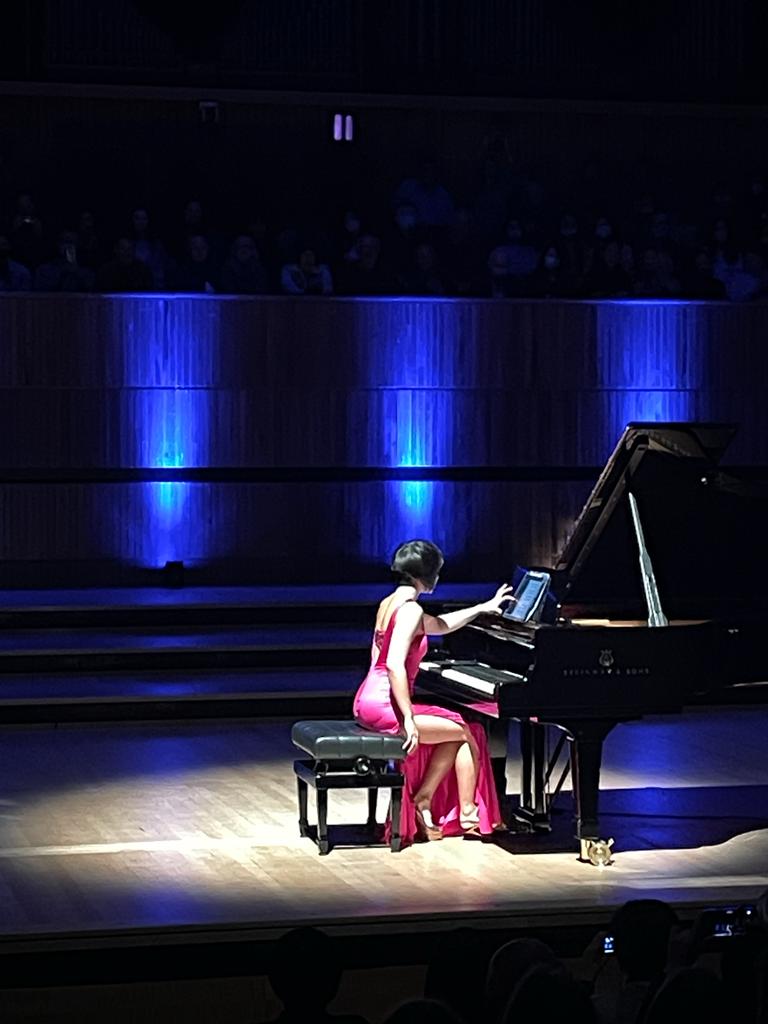
Artistry, focus and virtuosic fireworks from Yuja Wang in recital


Yuja Wang (© Ian Farrell)


Yuja Wang (piano)

7.30pm, Wednesday 20 April 2022

Royal Festival Hall, London

★★★★★


Ludwig Van Beethoven (1770-1827): Piano Sonata No. 18 in E flat major, 'Hunt', Op. 31 No. 3
Arnold Schoenberg (1874-1951): Suite, Op. 25
György Ligeti (1923-2006): Etude No. 6, 'Autumn à Varsovie' & Etude No. 13, 'L'escalier du diable'
Alexander Scriabin (1872-1915): Piano Sonata No. 3 in F sharp minor, Op. 23
Isaac Albéniz (1860-1909): Iberia, Bk 4: 'Málaga' & Bk 3: 'Lavapiés'
Nikolai Kapustin (1937-2020): Prelude in B major, Op. 53 No. 11 & Prelude in C sharp minor, Op. 53 No. 10

Encores:
Philip Glass (b.1937): Etude No. 6
Johann Sebastian Bach (1685-1750): Orchestral Suite No. 2 in B minor, BWV1067, Badinerie (arr. unknown)
Johannes Brahms (1833-1897): Intermezzo in C sharp minor, Op. 117 No. 3
Arturo Márquez (b.1950): Danzón No. 2 (arr. unknown)
Sergei Prokofiev (1891-1953): Toccata in D minor, Op. 11
Vladimir Horowitz (1903-1989): Carmen Variations
Franz Schubert (1797-1828): Gretchen am Spinnrade, D118 (transcribed by Franz Liszt (1811-1886))
Pyotr Ilych Tchaikovsky (1840-1893): Swan Lake, Op. 20, Dance of the Little Swans (arr. Earl Wild (1915-2010))
Giovanni Scambati (1841-1914): Mélodie (transcribed from Christoph Willibald Gluck (1714-1787): Dance of the Blessed Spirits from Orphée et Eurydice)

Yuja Wang (© Ian Farrell)
'While Wang more than delivered virtuosic fireworks, she gave so much more in her wide-ranging programme, showing phenomenal artistry and focus in well over two hours of performance'.

Schoenberg:
'Her Schoenberg that followed was, however, a revelation, with opening bite and edge followed by some remarkably delicate and intricate details'.

Ligeti:
'In ... Automne à Varsovie, Wang was into her astonishingly virtuosic stride, with hands at full stretch to either end of the keyboard. Yet it was her dynamic control that also impressed here'.

Scriabin:
'Wang’s dynamic control was impressive, with barely audible pianissimos expressing heartfelt longing'.

Encores:
'Dazzlingly rapid repetition in Glass followed by a crazy arrangement of ... Bach'.

Read my full review on Bachtrack here.


Wednesday, 11 February 2015

CD Reviews - February 2015


Clare Hammond is a fearless pianist, specialising in virtuosic repertoire from the 20th and 21st centuries, often championing the work of contemporary composers and premiering their work.  She performed in a stunning lunchtime recital at the 2013 Brighton Festival.  Her latest CD is ‘Étude’.  It includes 26 études, a form which began as study exercises for pianists to develop a particular aspect of technique, but largely through the efforts of Chopin and other pianist-composers after him, has become an art form in itself, with composers exploring the outer limits of technique and pushing the pianist to new extremes of virtuosity.  The disc begins with three from a set of twelve ‘Études d’exécution transcendante’ by Russian composer Sergei Lyapunov (1859-1924).  This set was dedicated to Liszt, and completed the cycle which Liszt had begun of studies in all the 24 major & minor keys.  Though whilst Liszt was clearly a major influence, this is undoubtedly music from the late Romantic Russian nationalistic school.  With surging rivers (‘Térek’), an atmospheric ‘Nuit d’été’ and an full-on raging ‘Tempête’, the three chosen here give Hammond a perfect opportunity to set the scene for some barnstorming playing.  The six Piano Études which follow are from South Korean composer Unsuk Chin (b.1961).  Often thinner in texture, yet no doubt more technically demanding, these pieces manage to convey remarkable energy and imagination within the potentially restrictive demands of studies based on repetition or scales, and are probably the most pianistically challenging works on the disc.  Hammond seems to relish the challenges set, yet also manages to find a sensitive touch in the delicate moments amid the fireworks.  Polish composer Karol Szymanowski’s (1882-1937) set of 12 Studies live in the same soundworld in many ways as Debussy’s études, composed just one year earlier than Szymanowski’s (in 1915).  These are short pieces, all under two minutes long, and Szymanowski does well to create a specific mood in such a short space of time, although there is perhaps less variety across the different études here, with the consistently bitonal harmonies creating an other-worldy feel throughout.  The disc ends with Ukranian pianist/composer, Nikolai Kapustin’s (b.1937) Five Études in Different Intervals, providing the perfect closing sequence for this astonishing disc.  Kapustin combines classical and jazz styles in a unique way, and here he takes a seemingly restrictive concept, a specific interval for each study, as a starting point for five exuberant and joyous confections, once again fiendishly challenging. 


The Six Concerti Armonici for strings and basso continuo were first published in 1740, but without an ascribed composer.  There have been many theories, and the most popular choice for many years was Pergolesi.  But the mystery was solved in 1980 by the Dutch musicologist, who found a manuscript of the concerti with a preface by Count Unico Wilhelm van Wassenaer (1692-1766).  A renowned Dutch diplomat, he was also admired for his compositions.  The Innovation Chamber Ensemble consists of principal string players from the City of Birmingham Symphony Orchestra, under the artistic direction of Richard Jenkinson, and they certainly show how much they enjoy this change of repertoire with stylish and spirited playing throughout.  This are not early instrument expert performances, but they play sensitively, and it is only perhaps in the slow movements where occasionally the sound is a little heavy for my liking.  However, these are beautiful concerti and contain great variety and invention, giving the Innovation Chamber Ensemble plenty of scope for varying tone and dynamics, which they do well.  Predominantly in the Italian style, they are nevertheless far from formulaic works, and many of the faster movements practically fizz with energy.


Harpsichordist Steven Devine performs regularly with the Orchestra of the Age of Enlightenment and London Baroque, and has performed on numerous occasions in events in the Brighton Early MusicFestival.  His Goldberg Variations recording won much deserved phrase, and he follows this with a further disc of J S Bach, including the ‘Italian’ Concerto and ‘French’ Overture, both from the second part of his ‘Clavier-Übung’.  But Devine starts his disc with the Chromatic Fantasia and Fugue, BWV 903.  Right from the word go, it is clear that this is full-blooded harpsichord playing, and and recorded sound from Chandos is appropriately warm and upfront.  It is refreshing to hear the harpsichord played with command and intent, and not in an overly sensitive and precious way, which is sadly often the case.  I like the rhythmic drive he gives, not allowing the rapid ornamentation in the Fantasia to upset a strong sense of pulse.  This is equally evident in the Aria variata which follows – a theme with 10 variations ‘in the Italian manner’.  The Fantasia in C minor, BWV 906 comes next, and again precision and rhythmic integrity is paramount here. Although the form of the ‘Italian’ Concerto which follows is clearly based on the concerti with orchestra, of Vivaldi, Bach takes this and uses dynamic contrast and varying textures to create a virtuoso concerto for the solo instrument.  Once again the opening movement has drive and energy, but in the central slow movement, Devine shows that he can also make the instrument sing, allowing the beautiful aria solo line to breathe, before the crashing Presto sweeps aside contemplation.  The ‘French’ Overture closes the disc, and opens with a long Ouverture movement which is a phenomenal construction in itself.  Here Devine’s programming makes perfect sense, with this great work offering the opportunity for him to bring together his strong virile approach with a lighter touch in the faster dance movements such as the Passpieds and Bourées, as well as giving us a touching Sarabande.  The closing Écho is given suitable panache, and he clearly enjoys the echo effects to their full – a joyful end to a stunning recording.


(Edited versions of these reviews first appeared in GScene, February 2015)