Showing posts with label Scriabin. Show all posts

Tuesday, 18 August 2026

'Chopin sans Chopin' - pianist Adam Golka excels in viewing wide-ranging 19th & 20th repertoire through the lens of the piano giant

Polish-American pianist Adam Golka already has three recordings with First Hand Records under his belt, with repertoire covering Beethoven, Brahms and Schumann. But with his new recording, Chopin sans Chopin, he takes a different turn. The fascinating premise covers a wide range of 19th and 20th century music, all through the lens of Chopin, without a note of Chopin actually played. Golka explains in his fascinating and personally reflective notes the significance but also the burden of Chopin for a pianist of Polish heritage. As the son of Polish parents, a pianist and a piano technician, Chopin’s music loomed large, and perhaps in reaction to this, he describes how he turned away from Chopin to other repertoire. The album is therefore part of his ‘wading upstream towards the river’s source’, a kind of return to Chopin and his Polish heritage. So for all the music here – some close to Chopin either chronologically or stylistically, some seemingly further removed – there is a rationale for us to view it in terms of being either directly or indirectly inspired by Chopin. 

So he begins with a beautifully flowing and calm reading of Fauré’s Nocturne No. 4, Op. 36. Fauré’s later Nocturnes push the boundaries of the form harmonically and scale-wise, but here, we’re very much in the moonlit, lyrical territory of Chopin’s. Yet listening with the earlier composer in mind immediately casts a different light on the work, and the same happens with Brahms’ Scherz, Op. 4 that follows. It’s hard to comprehend that Brahms allegedly denied any influence of Chopin on the piece, as both in terms of dramatic mood and specifics of repetition and octave passages, the links are strong. Golka’s performance here also manages to bring out the lighter moments that some weightier readings miss, making the connection even stronger, particularly with the opening mercurial figures, yet he doesn’t hold back on the drama either, especially driving to the wild conclusion. Several rather neglected Polish composers also receive attention, beginning with a delightful Mazurka from Natalia Janotha (1856-1932), a premiere recording, no less. She studied with Clara Schumann, and may also have had lessons from Brahms. Golka has combined elements of two published versions of this gem from 1894, and his delicate articulation around its engaging melodic line is contrasted well with the quirky, almost jazzy, even ragtime-esque central section, with a wild flourish into its closing section. Much wilder, more extravagant Romanticism comes next in the form of Scriabin’s surging Fantasie, Op. 28, steeped in his reverence for Chopin. Golka rides its glorious waves, and the build to the conclusion is nothing short of remarkable. Back to Poland next for another Mazurka, this time by Roman Maciejewski (1910-1998), subtitled Wieczorem (Upon Evening), probably dating from the composer’s time in Sweden, to where he emigrated at the start of World War II. It has glassy, Ravelian harmonies, as well as Stravinskian and Poulenc-infused bouncy rhythmic sections, yet there are still hints of Chopin’s melodic twists that remind us of the Mazurka form, and Golka’s warm tone and delicate articulation is a delight here. Next we travel to Mexico, for Manuel Ponce (1882-1948) and his Balada Mexicana, with its infectious folk melody with gently rocking accompaniment. A florid outburst leads to a more graceful, nostalgic central section based on another folk song, Acuerdate de mi (Remember me), and Golka ripples through the runs and trills before returning with virtuosic ebullience to the opening heart-on-sleeve melody. 

A slight left-turn next, to Gershwin’s Three Preludes. Chopin, you say? Well Chopin’s Prelude No. 2 is surely there in the left hand of Gershwin’s No. 2, and the movement has the same dark edge in its movement, perfect for the bluesy right hand. It’s often played slower than here, although it is marked andante con moto, and Golka’s sense of movement works well. Either side, the first has joyful rhythmic energy, and the third drives through like a Chopin Fantasie. Back to Poland again for Władysław Szpilman (1911-2000), known to most as the protagonist of Polański’s film The Pianist. His Mazurka is full of heartbreaking nostalgia, with self-evident homage to Chopin, and Golka infuses this miniature with moving simplicity. And finally, Golka heads into the jazzy world of Nikolai Kapustin (1937-2020), for two of his 8 Concert Etudes, Op. 40. No. 7, Intermezzo moves from laid-back jazzy swing into a virtuosic, theatrical display, and No. 8, Finale, with its train-like running rhythm gives Golka the chance to show off his command of its fiendish technical demands. The Chopin thread aside, the range of repertoire on this disc is extensive, and Golka is impressive throughout. And the trick of making us listen with Chopin in mind works remarkably well, bringing out new connections in the few familiar works here, but also demonstrating the wide-spread and sometimes unexpected influences Chopin has had on piano repertoire across the centuries since. I appreciate the baggage attached, but it would be great to hear Golka record some Chopin now – maybe reverse the lens from this disc, to some of the pieces mentioned that connect with this repertoire?

Various. 2026. Chopin sans Chopin. Adam Golka. Compact Disc. First Hand Records FHR168.

My review of Golka playing Schumann here.

Wednesday, 17 December 2025

Maturity of expression and astonishing virtuosity in Jaeden Izik-Dzurko's Wigmore Hall debut

Jaeden Izik-Dzurko
© Wigmore Hall/Darius Weinberg

Jaeden Izik-Dzurko (piano)

7.30pm, Monday 15 December, 2025
Wigmore Hall, London

★★★★★


Bach, Johann Sebastian (1685-1750): Partita No. 4 in D major, BWV828
Franck, César (1822-1890): Prélude, choral et fugue
Scriabin, Alexander (1872-1915): Fantasie, Op. 28
Rachmaninov, Sergei (1873-1943): 10 Preludes, Op. 23
Encores:
Medtner, Nikolai (1880-1951): Skazki (Fairy Tales), Op. 51 No. 6
Peterson, Oscar (1925-2007): Place St. Henri


Bach:
'Impressively mature Bach, setting out his stall as way more than a firework display'.

Franck:
'Izik-Dzurko’s opening Prelude was flowing and opaque, with the yearning melodic line surrounded by effortless cascades'. 

Scriabin:
'Izik-Dzurko showed he has the big guns, but also subtlety and finesse, and a deep understanding of this expressive yet at times darkly introspective work'.

Rachmaninov:
'An impressive reading throughout, capturing Rachmaninov’s shifts of mood, all with highly expressive and expansive tone'.

'Izik-Dzurko is definitely a talent to watch, and I am sure there’s a lot more to come'.

Read my full review on Bachtrack here.

Monday, 9 May 2022

CD Reviews - May 2022

Following on from their two volumes of Felix Mendelssohn’s String Quartets, the Doric String Quartet are now joined by Timothy Ridout (viola) for a disc of his String Quintets. Mendelssohn wrote just two of these, going with the viola added to string quartet combination, favoured by Mozart and Brahms, as opposed to adding a cello, which Boccherini and Schubert did. Mendelssohn’s String Quintet No. 1, composed when he was 17, came hot on the heels of the successful premiere of his glorious Octet. Ever the reviser, it was another five years before he published both. Its opening movement has a leisured warmth, with only brief hints of darker moods in its development, before it gently dances to a quiet ending. The Intermezzo, with its singing melodic idea is sensitive and elegiac. Intensity builds over warm lower strings, with the rhythmic pace of the throbbing repeated figure increasing. It never feels totally settled, despite its calm ending. We’re in ‘A Midsummer Night’s Dream’ territory in the Scherzo, with skittering fairy music led off by the first viola. The players here give this precision and clarity, yet avoid it becoming too dry, and there is some dramatic scraping from the cello, not holding back from a harshly biting timbre. Yet once again, the movement disappears into nothing. Whilst not quite reaching the heights of exuberance of the Octet, the finale is full of joyful energy, set up by its lively triplet upbeat. Alex Redington on first violin shines in the rippling runs, and sings over the rumbling lower instruments. Energy levels ramp up and up, leading to the joyous conclusion. The String Quintet No. 2 came some 18 or so years later, with much of the same sense of energy but perhaps less of the unfettered joyfulness of his youthful works. The opening movement has an athletic first violin part over a tremolo accompaniment. The whirling triplet rhythms mean there is always a sense of movement, and these drive on, becoming more insistent, building to a full-on emphatic conclusion. In the dancing, lilting staccato of the second movement, once again the players here avoid it becoming to picky, maintaining a sense of the melodic material and the dance in an masterclass of control. But it is the intense pathos of the slow movement – essentially a funeral march – that is most striking about this work. From a darkly pianissimo opening, cello scales rise and a slow relentless march emerges. There are drum-like battering effects, and heartfelt laments from the violins. A nostalgic A major melody provides some temporary relief, but it is short-lived, and the agitation of the march increases. Yet Mendelssohn can’t leave us totally in the dark, as the movement suddenly turns at the end to a triumphant D major, before subsiding into a gentle, calm end. The finale, perhaps a little incongruously after the deep intensity of the previous movement, bursts forth with a jolly, energetic theme. This theme provides most of the material here, and its contrapuntal development perhaps loses a little direction at times, but Mendelssohn eventually pulls everything to a suitably emphatic close. Throughout these fascinating and underperformed works, the Doric String Quartet and Ridout are alive to the Mendessohnian flashes of joy and energy, yet they are also alert to the finer detail. They know when to provide warmth, but also when to give edge to their sound too. Highly recommended.

Mendelssohn, F. The String Quintets. Doric String Quartet, Timothy Ridout. Compact Disc. Chandos CHAN 20218.

Arc I is the first of a series of three recordings by American pianist Orion Weiss. This first album features three works from the years 1911-1913. Weiss describes the trajectory of the series as like an inverted rainbow, and this first volume’s ‘steps here head downhill, beginning from hope and proceeding down to despair’. We’ll have to wait for the next disc to see things reach their lowest before renewal and rebirth are promised in the final volume. So here we begin with Enrique Granados’ (1867-1916) Goyescas, Op. 11, a Romantic masterpiece of invention. From the warmly expressive, watery cascades of the opening movement ‘Los reuiebros’ (Flattery), through to the macabre, stuttering dance of the final ‘Epilogo: Serenata del espectro’ (Epilogue: Serenade of the Ghost), this monumental and atmospheric suite is full of Granados’ extravagantly ornamented and improvisatory virtuosity. Weiss is commanding in the frenzied, passionate outbursts in ‘El Amor y la Muerte – Balada’ (Love and death – Ballade), but equally delicate in the nightingale’s song of the fifth movement. There’s a skip in his step in the moments of courting in the opening movement, and he ends the suite with ominous tolling bells before disappearing with a final mercurial wisp. Leoš Janáček’s (1854-1928) In the Mists follows – a shorter suite, and more introspective than the Granados. There are typical Janáček chromatic twists and turns in the melodies, and his motif of death, the falling minor third, features large. Weiss captures particularly well the claustrophobic, suppressed passion of the final movement, which breaks out with melismatic, singing outbursts and increasing intensity, before defeat in its dark sombre conclusion. Weiss ends with Alexander Scriabin’s (1871-1915) Piano Sonata No. 9, Op. 68, ‘Black Mass’. Full of ‘satanic’ tri-tones and chromaticism, begins hopeful but descends into darkness and despair, and Weiss makes the low rumblings and persistent trilling effects feel chillingly ominous. There is a real sense of the second, more hopeful melodic idea insistently writhing as if trying to escape, before being ultimately subsumed into a frightening march. This is an impressive display from Weiss, and sadly speaks to current anxieties and a sense of despair. Arc II promises to take us to the lowest point of grief and loss, but hopefully Arc II will bring us some hope for the future – much needed at present.

Various. 2022. Arc I - Granados, Janáček, Scriabin. Compact Disc. First Hand Records FHR127.

(Edited versions of these reviews first appeared in Scene, May 2022) 


Thursday, 21 April 2022

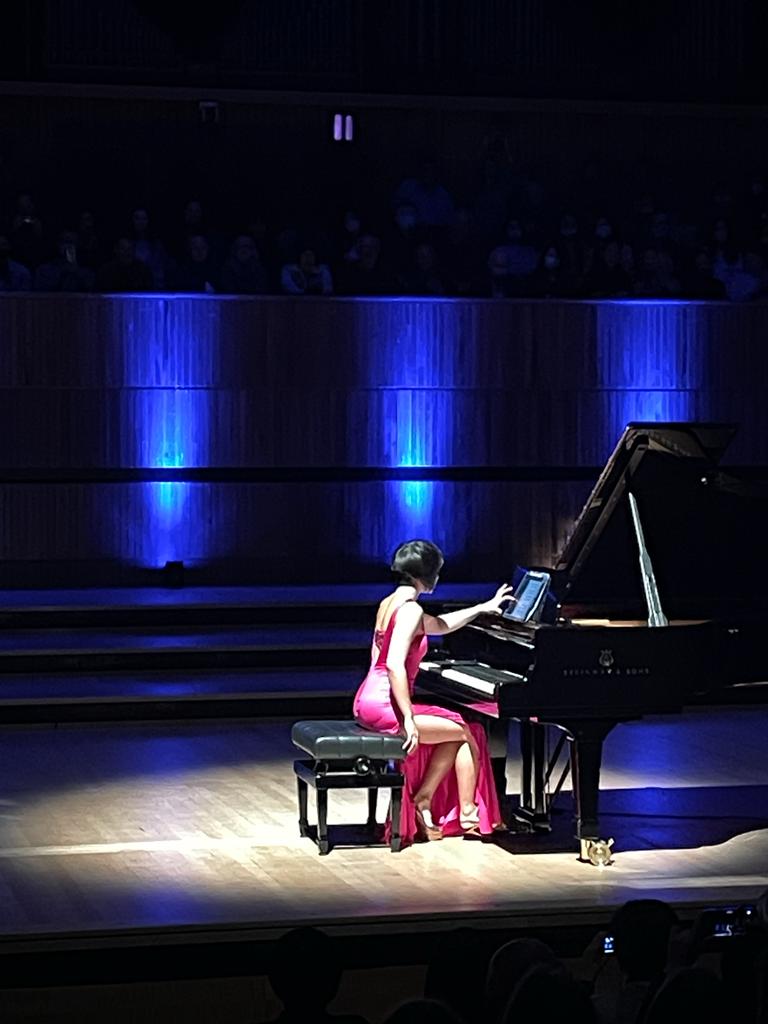
Artistry, focus and virtuosic fireworks from Yuja Wang in recital


Yuja Wang (© Ian Farrell)


Yuja Wang (piano)

7.30pm, Wednesday 20 April 2022

Royal Festival Hall, London

★★★★★


Ludwig Van Beethoven (1770-1827): Piano Sonata No. 18 in E flat major, 'Hunt', Op. 31 No. 3
Arnold Schoenberg (1874-1951): Suite, Op. 25
György Ligeti (1923-2006): Etude No. 6, 'Autumn à Varsovie' & Etude No. 13, 'L'escalier du diable'
Alexander Scriabin (1872-1915): Piano Sonata No. 3 in F sharp minor, Op. 23
Isaac Albéniz (1860-1909): Iberia, Bk 4: 'Málaga' & Bk 3: 'Lavapiés'
Nikolai Kapustin (1937-2020): Prelude in B major, Op. 53 No. 11 & Prelude in C sharp minor, Op. 53 No. 10

Encores:
Philip Glass (b.1937): Etude No. 6
Johann Sebastian Bach (1685-1750): Orchestral Suite No. 2 in B minor, BWV1067, Badinerie (arr. unknown)
Johannes Brahms (1833-1897): Intermezzo in C sharp minor, Op. 117 No. 3
Arturo Márquez (b.1950): Danzón No. 2 (arr. unknown)
Sergei Prokofiev (1891-1953): Toccata in D minor, Op. 11
Vladimir Horowitz (1903-1989): Carmen Variations
Franz Schubert (1797-1828): Gretchen am Spinnrade, D118 (transcribed by Franz Liszt (1811-1886))
Pyotr Ilych Tchaikovsky (1840-1893): Swan Lake, Op. 20, Dance of the Little Swans (arr. Earl Wild (1915-2010))
Giovanni Scambati (1841-1914): Mélodie (transcribed from Christoph Willibald Gluck (1714-1787): Dance of the Blessed Spirits from Orphée et Eurydice)

Yuja Wang (© Ian Farrell)
'While Wang more than delivered virtuosic fireworks, she gave so much more in her wide-ranging programme, showing phenomenal artistry and focus in well over two hours of performance'.

Schoenberg:
'Her Schoenberg that followed was, however, a revelation, with opening bite and edge followed by some remarkably delicate and intricate details'.

Ligeti:
'In ... Automne à Varsovie, Wang was into her astonishingly virtuosic stride, with hands at full stretch to either end of the keyboard. Yet it was her dynamic control that also impressed here'.

Scriabin:
'Wang’s dynamic control was impressive, with barely audible pianissimos expressing heartfelt longing'.

Encores:
'Dazzlingly rapid repetition in Glass followed by a crazy arrangement of ... Bach'.

Read my full review on Bachtrack here.


Monday, 13 July 2020

CD Reviews - June & July 2020

Richard Strauss’ (1864-1949) Eine Alpensinfonie, Op. 64 (Alpine Symphony) is a fabulous piece of extended tone poem writing, rather than a conventional symphony.  It requires a huge orchestra, including wind and thunder machines, cowbells, and the heckelphone (a member of the oboe family, similar to a cor anglais).  Yet it’s not just an overblown orchestral romp – there is some beautifully subtle music here too, and Strauss captures the drama and danger of the mountains, as well as the sheer beauty and simplicity of an alpine meadow, from sunrise to sunset. Vasily Petrenko with the Oslo Philharmonic is a revelation here in the third of their Strauss recordings – all the detail of this phenomenal journey is there, but there is always a sense of direction and forward momentum. The big, brassy moments are powerful, but never overblown, yet there is some beautifully delicate solo string playing, wandering by the stream in the forest, and the arrival at the summit is lushly climactic. In the ‘Vision’ that follows, Petrenko steers a steady path through the meandering harmonic instability, and the storm is dramatic and suitably scary, before a warm sunset and subdued sink into the night. Petrenko and the Oslo Philharmonic follow this masterpiece with a passionate reading of Strauss’ earlier tone poems, Tod und Verklärung, Op. 24 (Death and Transfiguration). The music depicts a dying artist reflecting back over his life, before reaching ultimate transfiguration in heaven. A consistent theme in Strauss’ tone poems is that idea of our hero defeated in the here and now, but somehow attaining victory, here in a final blaze of C major. Again, Petrenko is alert to detail here, but also the essential trajectory of Strauss’ story-telling arc. Highly recommended.

Strauss, R. 2020. Eine Alpensinfonie, Op. 64 & Tod und Verklärung, Op. 24. Oslo Philharmonic, Vasily Petrenko. Compact Disc. Lawo Classics LWC1192.

I reviewed Ibrahim Aziz’s solo viola da gamba album last year (here), and he’s now back, joined by harpsichordist Masumi Yamamoto in a recording of works for the two instruments by Georg Friedrich Handel (1685-1759). Here we have a mixture of his works transcribed by Handel himself, and also by Aziz from Sonatas originally for violin, and a keyboard Suite, as well as one Sonata attributed to Handel, but possibly by Johann Kress (1685-1728). But no matter, Aziz owns them for the viola da gamba with a beautifully warm tone and delicate ornamentation. The balance between Aziz and Yamamoto on harpsichord is well-judged, and despite some weighty double-stopping in the Allegro of the G major Sonata, for example, the light harpsichord is never overpowered. The Largo of this same Sonata is a beautiful gem, and Aziz makes his instrument ring with great energy in the final virtuosic Allegro. Aziz includes a stately Prélude in the French style from a Suite by Sainte-Colombe le Fils (c.1660-1720?), once again showing off his resonant tone and agility. Yamamoto follows with Handel’s Suite No. 4 for harpsichord, playing with vigour and precision in the opening Fuga, a flowing energy in the central Courante, and a joyful bounce to the final Gigue. Another transcription by Aziz next, a Prelude from one of Handel’s keyboard Suites, making particular use of the lower reaches of the instrument, again with that ringing, rich tone. The duo are reunited for the remainder of the disc, in another Aziz transcription of a keyboard Suite, and a final Sonata. The Suite concludes in a striking Chaconne, allowing both players to demonstrate their virtuosity. The Sonata, for Viola da Gamba and Obbligato Harpsichord puts the right hand of the harpsichord together with the viola da gamba in a melodic duet, particularly impressive in the two Allegros, giving the disc a suitably energetic and virtuosic conclusion. This is a delightful collection, and the two players’ commitment to and command of this repertoire shine throughout. 

Handel, G. F. 2020. Works for Viola da Gamba and Harpsichord. Ibrahim Aziz, Masumi Yamamoto. Compact Disc. First Hand Records FHR91.

Cellist Rohan de Saram is now 81, although this disc was recorded back in 2012, when he was a mere 73 years old. Born in Sheffield to Sri Lankan parents, de Saram studied with Gaspar Cassadó (1897-1966), as well as Cassadó’s teacher, Pablo Casals (1876-1973), and this heritage goes right through this recital, with transcriptions from both of them, as well as the disc’s title piece, Requiebros, by Cassadó himself, played here with clear passion and affection. Cassadó’s transcription of Granados’ Intermezzo from his opera Goyescas is another delightful gem, again played with gentle warmth. There are some old favourites here, such as Saint-Saëns’ Le cygne from Le carnaval des animaux, and Casals’ transcription of Fauré’s exquisite song, Après un rêve, both beautifully performed with touching simplicity. Yet de Saram’s commitment to performing contemporary works is also reflected, with premiere recordings of Chasse au moment by Oliver Frick (b.1973), and Toshio Hosokawa’s (b.1955) Lied III. The former is a mercurial attempt to capture a sequence of fleeting moments, and is highly atmospheric and evocative. Hosokawa aims to make a connection between the lieder of Schubert and his own musical traditions, and the result contrasts sustained, almost lyrical moments for the cello with sudden angular interjections by both cello and piano, made equally effective here by both players – de Saram is accompanied effortlessly throughout the disc by pianist Junko Yamamoto. Manuel de Falla’s Suite populaire espagnole originated as a suite for violin and piano, and six of the seven original movements were arranged by Maurice Maréchal for cello and piano. The piano accompaniment often mimics the guitar, and the themes emanate from different areas in Spain, from the Murcian El paño moruno, through the beautiful Andalusian lullaby, Nana, to the rhythmic character of Jota, from Aragon. Similarly, later in the collection, we have Schumann’s Fünf Stücke im Volkston, Op. 102, and here the folk-style influence is seen in the unusual rhythmic structures. In both sets, de Saram enjoys the rhythmic interest, whilst bringing out the folk melodies with a warm singing tone. Ravel’s Piece en forme de habanera is another popular encore piece, with its Cuban infused rhythms, and Saints-Saëns’ Allegro appassionata, Op. 43 that ends the disc also allows for a greater show of brilliance. This is a recital of exemplary performances, made all the more fascinating given the history and connections to some of the great traditions of twentieth century cello playing.

Various. 2020. Requiebros. Rohan de Saram, Junko Yamamoto. Compact Disc. First Hand Records FHR97.

Russian-born pianist Elisaveta Blumina moved to Germany in her teens, and whilst (as she points out in the notes for her latest double CD release) young pianists in Russia are often schooled in Austrian and German classical repertoire, she feels very much that Russian and Soviet music is ‘in her blood’. So this collection explores that heritage, beginning with Scriabin’s Five Preludes, Op. 16. These beautifully colourful miniatures (whilst probably not a synesthete himself, he was very much influenced by the concept, making strong associations between keys and specific colours, for example) show the influence of Chopin, but with hints of Scriabin’s stretching use of harmony. Prokofiev’s Visions fugitives that follow are equally fleeting miniatures, yet Blumina captures the individual moods wonderfully, even though none last for more than two minutes – she treats us to six here out of the complete set of twenty. Blumina has championed the revival of the music of Mieczysław Weinberg (1919-1996), a Polish-Jewish composer who fled the Nazis and spent the rest of his life in the Soviet Union. Here we have just two short Fugues, dedicated to Ludmila Berlinskaya, and the story goes that Weinberg wrote them for Ludmila who had forgotten to prepare two fugues for her homework at the Conservatory – she handed them in, but received very bad marks for them, perhaps because of their quirky yet subtle individuality, combined with some serious ‘rule-breaking’! The remainder of the first disc is given over to Griogori Frid’s (1915-2012) Hungarian Album, Op. 54. These are delightful character pieces, capturing evocative scenes such as The Amusement Park, an Evening at the River, At the Zoo, and a walk In the Forest. The longest here, at four and a half minutes, is a watery flowing Broad Danube, in great contrast to the bouncy Excursion outdoors with Hungarian Friends. These are not virtuosic pieces, but they require delicacy and intimate touch, as well as that ability once again to distil a mood in just a few moments, all of which Blumina excels at here. The second, shorter disc consists of twenty-two out of Giya Kancheli’s (1935-2019) 33 Miniatures for piano. The CD was recorded in 2018 when Kancheli was still alive, and Blumina discussed the pieces with him, particularly his original very slow tempi for some of the pieces. She clearly has a great affection for these warmly sentimental fragments drawn from the Georgian composer’s film music, and this is their first recording. They stand in stark contrast to the more incisive, angular music of the first disc, a welcome addition here, and overall, this collection of fleeting backward glances to Blumina’s homeland is a varied tribute to the power of the miniature to move and capture a mood or emotion in a moment.

Various. 2019. Memories from home. Elisaveta Blumina. Compact Discs (2). Deutschlandradio/Dreyer Gaido CD 21120.

Violinist Clare Howick joins pianist Simon Callaghan for a survey of British Violin Sonatas, and there are a surprising number to choose from – Tasmin Little recently released her third volume of them. Howick and Callaghan open with William Walton’s (1902-1983) Sonata, which consists of two substantial movements, essentially lyrical in style, despite the twelve-tone phrase in the second movement's theme.  The variations then give both players extended virtuosic and improvisatory passages on their own and together, and Howick immediately demonstrates a great range, with lyrical lines contrasting forensic precision in the more angular moments in the variations. This is followed by the Sonatina by William Alwyn (1905-1985). An earlier work (from c.1933) than Walton’s, Alwyn rejected the work later in his life, yet it is delightfully proportioned and melodically inventive, flowing effortlessly from its rippling opening, through the darkly lilting central Adagio, to the energetically bouncy finale. Again, Howick plays with warmth and lyricism, and both players use the full range of dynamics to great effect. Howick & Callaghan give premiere recordings here of three miniatures by Gordon Jacob (1895-1984), his sinuous Elegy, playfully virtuosic Caprice and delicate Little Dancer – all great programme fillers or encore pieces. Kenneth Leighton’s (1929-1988) Sonata No. 1 launches straight into a rich sound world with thick, swirling textures, particularly in its weighty piano part, played with command by Callaghan here, yet never overwhelming Howick’s rich tones. The slow movement’s beautiful chorale-like piano opening combines with an intensely nostalgic melodic line, and the emphatic finale nevertheless concludes with light hint of the chorale-like material. Alan Rawsthorne (1905-1971) wrote Pierrette: Valse Caprice as a wedding present in 1934 for his first wife, violinist Jessie Hinchliffe, and it has a light and joyful feel, played here with great tenderness. Lennox Berkeley’s Elegy and Toccata, Op. 33 Nos 2 & 3 were written for violinist Frederick Grinke (as was No. 1 from the set, variations for solo violin, not recorded here). The Elegy is tender and expressive, whilst the Toccata has an infectious drive from beginning to end. This disc amply demonstrates a huge variety of styles and textures, beyond the expected limits of forty or so years of British composition, and Howick and Callaghan deserve credit for this well thought out programme, elegantly performed throughout.

Various. 2020. British Violin Sonatas. Clare Howick, Simon Callaghan. Compact Disc. Somm Recordings SOMMCD 0610.

(Edited versions of these reviews first appeared in GScene, June & July 2020)

Thursday, 31 May 2018

CD Reviews - May 2018

Russian conductor, Vasily Petrenko is currently chief conductor of both the Royal Liverpool Philharmonic Orchestra and the Oslo Philharmonic Orchestra.  With the latter, he has already recorded two of Alexander Scriabin’s (1872-1915) five symphonies, and he now turns to the Symphony No. 2, Op. 29, which dates from 1902, and marks what is considered the end of Scriabin’s early period of composition. This is paired with Scriabin’s Piano Concerto, Op. 20, also an early work, from 1896.  Scriabin’s music from this period is highly romantic, but still has elements of the chromaticism and dissonance that would develop in his later works.  The Symphony’s lush, dark opening movement with its lyrical clarinet solo moves straight into the quicker second movement, which develops through very Wagnerian sweeps and surges into some full-on romantic writing.  The third movement’s opening, with its exquisite violin solo, supported by twittering birdcalls from the flute, is played here with precision and delicacy – a pity that neither the leader nor flautist gets a name check on the disc.  It is this movement (by far the longest, at just over eighteen minutes) that is in fact the highlight of the symphony, and also of this performance, with its simplicity and heart-on-sleeve idyllic beauty sincerely captured by the OPO players and Petrenko.  This is swept away by the nervy urgency of a stormy scherzo, which then leads to a rather bizarrely simplistic, triumphant finale.  It is this movement that has lead to the most criticism of the symphony and as a result, its somewhat infrequent performance.  This is a shame, as the earlier movements, particularly that slow movement, contain some beautifully imaginative and subtly orchestrated music.  However, Petrenko and the OPO do the finale justice, and almost convince of its merits – perhaps taken on its own, it could serve as an enjoyable overture, with its exciting, dramatic conclusion.  The even earlier Piano Concerto, from 1896, when Scriabin was just twenty-four, is a full-blooded affair, straight out of the Chopin-Liszt tradition, and it is surprising that it hasn’t established a stronger footing in the repertoire, given its evident appeal.  Russian pianist Kirill Gerstein gives an impressive performance here, balancing the weighty heft of the first movement with lightness of touch in the more expressive moments of the delightful central theme and variations.  The finale is a great crowd pleaser, but not without invention, and Gerstein, Petrenko and OPO bring their performance here to a fine, spirited conclusion.


Polish-American pianist Adam Golka has released a pleasing programme of Schumann (1810-1856).  With the Piano Sonata No. 1, Op.11, ‘Grosse Sonate’ as the centrepiece, he has included several pieces with an evening theme, and is joined by soprano Lauren Eberwein in two short songs as part of the programme.  The first of these songs, An Anna II, opens the disc, and it’s a setting Schumann composed when he was just eighteen.  It was not published in his lifetime, and only saw the light of day when Brahms published his collected works in 1893.  It’s a nostalgic, calmly passionate miniature, and Eberwein’s rich, full-bodied voice, combined with Golka’s sensitive accompaniment provides a great opener.  Its reason for preceding the Sonata is that Schumann took the melody as the basis for the Sonata’s second movement Aria.  The Sonata opens with a brooding song without words, and the full recording sound combined with Golka’s warmth of tone make for a striking beginning. As the first movement moves into the second allegro vivace section, Golka’s tempo feels slightly controlled – the turbulent wanderings could perhaps do with a little more sense of frenzy, although this does build, and Golka’s formidable technique comes to the fore as the drama builds towards the movement’s conclusion.  His Aria is delicate and sensitive, with full pedalling, lyrically sweet without being overindulgent.  A bouncy, quirky scherzo follows, with a strange, slightly pompous central Intermezzo, and the Finale ranges through fleeting mood changes, and here Golka exploits to the full the extremes of texture and emotion, leading to a swirling turbulent conclusion, leaving the instrument almost rattling at the end.  For the remainder of the disc, we move into Abend (Evening), with the nostalgic and tender ‘Des Abends’ from the Fantasiestücke, Op. 12.  This is followed by ‘Der schwere Abend’ (The oppressive evening) from 6 Gedichte und Requiem, Op. 90, with Eberwein joining Golka again for this brief dramatic mood piece.  The song suits Eberwein’s full, weighty tone, although perhaps aiming for the sense of oppressiveness, the sound is rather covered here.  The disc ends with Golka’s own arrangement for solo piano of Abendlied from the 12 Klavierstücke, Op. 85, originally for 4 hands. Golka’s version is very successful, and he captures the almost Mahlerian sense of stasis in a touchingly introspective reading.  Overall, this is a thoughtful programme (albeit rather short at just over fifty minutes), and Golka shows himself to be a force to be reckoned with.  


No review of this next disc, as I have to declare a personal interest here.  Last year, Brighton Festival Chorus (with whom I sing), had the pleasure to record a disc of lesser-known choral works by Sir Edward Elgar (1857-1934), with the BBC Concert Orchestra, conducted by Barry Wordsworth (well known to us locally as the conductor of the Brighton Philharmonic Orchestra).  The disc is now out, and includes the Scenes from the Bavarian Highlands, Op. 27, the Te Deum & Benedictus, Op. 34, and the motet Ecce sacerdos magnus, which gives the disc its title.   Do check it out!


Wednesday, 12 April 2017

CD Reviews - April 2017


Alexander Scriabin (1872-1915) was born just one year before fellow pianist-composer, Rachmaninov, with whom he also studied at the Moscow Conservatory.  Of course Rachmaninov outlived Scriabin by many years, but also Scriabin’s music quickly went in a much more dissonant and individual direction than the ostensibly more accessible and tonal music of his contemporary.  Scriabin was fascinated by synesthesia (where people ‘see’ sounds as colours, for example).  Whilst it is unlikely that he was actually synesthetic himself, it had a strong influence on his harmonic theory, together with a fascination with mysticism and theosophy.  Consequently, his music can be hard to make immediate sense of, but then as his ten Piano Sonatas demonstrate, once you join his soundworld, there is much to reward your attention.  Peter Donohoe remarkably performs all ten sonatas in a single concert (well over two hours of music).  There is a lot to be said for hearing all ten in sequence, as they amply demonstrate the composer’s progression through the 21 years of their composition, and the building complexity of his style draws you in.  In the first four sonatas, he alternated between a four-movement structure and his more favoured two-movement form of a slow/fast combination.  From the fifth sonata onwards, he used a single movement, although often still following that slow/fast pattern.  The first sonata was written when he was 20, when he had damaged his right hand from over-practising virtuosic works, and thought it was the end of his performing career.  It is moody and dark, with a funeral march as its finale, already looking forward from its Chopinesque roots.  A freer second sonata, inspired by his first sight of the sea in Latvia, is followed by the deeper, soul-searching third, with its chromatic lines and turbulent mood.  The Wagnerian harmonies of the fourth are almost jazz-like and improvisatory in places, and the fifth has an incredibly passionate climax, with hammering chords.  By the sixth sonata, conventional tonality is almost gone, and the mysterious harmonies are deeply unsettling – even Scriabin found it ‘frightening’ and wouldn’t play it in public.  The ‘White Mass’ nickname of the seventh builds on the combination of weighty textures, contrasted with extensive use of rippling trills.  The eighth is more anxious than overtly turbulent, which Donohoe brings out well, with some almost skittish, impetuous passages, before disappearing away to nothing. The ninth, ‘Black Mass’, is full of ‘satanic’ tri-tones and chromatic scales, whereas the final sonata, which he described as his ‘sonata of insects’, is full of light and radiance.  This two-disc set is rounded off by one of Scriabin’s last works from the year before his death.  ‘Vers la Flamme’ is his representation of rising heat, growing from nothing to brilliance, with the heat of the sun eventually destroying the world.  So, a mammoth range here, and Donohoe takes us on a wild journey through these highly individual works.  The weight of his playing, particularly in the rapturous seventh, as well as his anxious filigree in the eighth, and the full-on romantic flourishes of the fourth and fifth amply demonstrate his phenomenal range.  The virtuosic command on show here is almost forgotten as the depth of his performances of these dark and complex works engulfs you. 


German mezzo-soprano Gerhild Romberger, together with pianist Alfredo Perl, has recorded three of Gustav Mahler’s (1860-1911) most well-known song cycles.  Most of the songs present here are better known in their orchestrated versions, so it is good to hear them in this form.  One might assume the piano versions came first, but in fact some were written after the orchestrated versions.  Here we have the Rückert-Lieder, the Kindertotenlieder (also with texts by Friedrich Rückert), and the Lieder eines fahrenden Gesellen (‘Songs of a Wayfarer’).  Romberger has a rich mezzo voice, well suited for Mahler, and can regularly be heard in performances of the symphonies, appearing several times at the Proms.  Her full tones are demonstrated in ‘Blicke mir nicht in die Lieder’ from the Rückert-Lieder, yet in the first of this set, ‘Liebst du um Schönheit’, his private piece for Alma and the only one he didn’t orchestrate himself, the tender lifts to the high notes have great poise.  Romberger gives a heartfelt performance of ‘Ich bin der Welt abhanden gekommen’, although perhaps a little over controlled for this desperate plea.  The ‘Lieder eines fahrenden Gesellen’ have strong links with the first symphony, the rustic ‘Ging heut morgen…’ and the melancholic ‘Die zwei blauen Augen’ both appearing there.  However, it is in the third song here, ‘Ich hab’ ein glühend Messer’, that Romberger gives full vent, with wild anguish and high drama.  In the heartfelt Kindertotenlieder, which draw on some of the 428 poems Rückert wrote following the death of his two children, Romberger again shows great control in the rising lines of ‘Nun seh’ ich wohl’, and pianist Perl has the opportunity to shine in the first song of the cycle.  Overall, this is a commanding set, and Romberger and Perl present a strong argument for these pared down versions of Mahler’s finest songs.


The Doric String Quartet has released their second CD of String Quartets by Franz Schubert (1797-1828).  Following on from the success of the first, they remain in the later reaches of Schubert’s string quartet output, pairing the wonderful ‘Quartettsatz’, D703, a single movement of his projected but unfinished twelfth quartet, with his final String Quartet in G major, D887.  In the Quartettsatz, the Dorics open with glassy determination, giving this miniature masterpiece great clarity and energy.  The final String Quartet in contrast comes it at over fifty minutes, and is a mighty challenge.  Again, the Dorics attack this with high energy, intensity and precision throughout.  There is high drama here, and despite the G major key, Schubert shifts between major and minor right at the start, highlighting the conflicting moods that run throughout the work.  The Dorics give the frequent tremolandi an edge of anxiety, and the slow movement is dark and mournful.  It is only in the Trio of the Scherzo that follows that there is any sense of calm, and the players relish the successive duet writing here.  But the finale dashes all this to one side, and in its relentless race to the finish, the players never lose attention to detail, whilst maintaining impressive intensity and energy to the last.  Catch them in the Brighton Festival, playing Haydn, Brahms & Adams (26 May).

Schubert, F. 2017. String Quartet in G major, String Quartet in C minor 'Quartettsatz'. 

(Edited versions of these reviews first appeared in GScene, April 2017)