Showing posts with label Ligeti. Show all posts

Monday, 29 January 2024

'Wagner's Dream' - the Brighton Philharmonic Orchestra on great form, with Geoffrey Paterson conducting


Lotte Betts-Dean
© Ben Ealovega
Lotte Betts-Dean (Mezzo-soprano)

Brighton Philharmonic Orchestra

Geoffrey Paterson (Conductor)


Joanna MacGregor (Music Director)


7.30pm, Saturday 27 January 2024

Dome Concert Hall, Brighton


★★★★


Györgi Ligeti (1923-2006): Atmosphères

Luciano Berio (1925-2003):  Folk Songs

Richard Wagner (1813-1883): The Ring: An Orchestral Adventure

arranged by Henk de Vlieger (b.1953)


Geoffrey Paterson

The Brighton Philharmonic Orchestra were back at the Dome in their relatively new Saturday night slot, and whilst the concert hall wasn’t completely full, they had a good audience for one of their most ambitious programmes in recent years. The main draw for most will have bee Henk de Vlieger’s crazy arrangement of Wagner’s Ring Cycle (yes, all four operas, around 15 hours of music) into one orchestral concert work, coming in at around an hour and ten minutes. But more of that later.  

In the understandably short first half, the BPO gave us two challenging and highly contrasting twentieth century works, and there was no sense of these being there purely as filler. Ligeti’s Atmosphères may be known to some from its appearance in Kubrick’s 2001: A Space Odyssey, where it provides an other-worldly sense of suspension in time and space. Consisting of dense cluster chords of up to fifty or more pitches at once, these ‘sound masses’ create that sense of suspension, and what movement there is, is almost indiscernible within the density of textures, with the dynamic only rising above quiet on a couple of occasions. Conductor Geoffrey Paterson took the BPO through this with taut control, and by and large, they successfully achieved the desired effect. There were shimmering, strange oscillations and glassy strings, with the woodwind leading one of the crescendi up to four strikingly shrill piccolos. Towards the end two percussionists sweep and stroke the strings inside the piano, adding to the ethereal effect, as well as providing a little extra on-stage interest.


Lotte Betts-Dean,
Geoffrey Paterson & the BPO
© Nick Boston
This was followed by Luciano Berio’s Folk Songs, a set of eleven songs, drawn from eight different countries or regions, in as many different languages, written for and dedicated to his muse and wife at the time, Cathy Berberian. The BPO were joined tonight by the Australian mezzo-soprano, Lotte Betts-Dean, who gave us an incredibly assured and engaging performance. I have to confess, you’ll be surprised to hear, to having little Armenian, Sicilian or Genoese dialect, or Azerbaijani, Sardinian or Occitan for that matter, but none of these linguistic challenges appeared to phase Betts-Dean, and in every song, there was a clear sense of communication and variety of tone. Her range is impressive, from the gracefully held higher notes in Loosin yelav right down to the almost bluesy, yearning low notes of A la femminisca. And she also demonstrated nimble virtuosity in the La la las of Ballo, as well fluid expression over the droning cellos in Lo fiolaire. Paterson and the BPO enjoyed the lighter textures, from just two violas and harp at the start of Black is the Colour, to the orchestral woodwind and trumpet colours in the gently lilting La donna ideale. Only in a couple of places did Paterson allow the orchestra to get a little too loud, risking overpowering Betts-Dean, particularly in her lower range. But overall, this was a characterful performance from all of this delightful and engaging set of songs.
 

And so to Wagner. Despite the risk of being dismissed as a bit of a ‘greatest hits’ compilation, Henk de Vlieger’s arrangement nevertheless manages to include most of the major musical themes and motifs, with some vocal lines covered instrumentally, obviously, but also keeps much of the orchestral textures preserved, meaning that overall, this does actually work as a stand-alone orchestral piece. Here, programme notes taking us through the synopsis of the four operas, distilled by de Vlieger into fourteen sections, were supplemented by somewhat sketchy surtitles. The orchestra may well have been the largest iteration of BPO, certainly that I’ve ever seen, with a mammoth brass section including eight horns (four of whom doubled on Wagner tubas) – oh, and of course, the anvils. Paterson steered them through the adventure with remarkable energy and drive – this is definitely a feat of stamina, and to their credit, they kept the energy levels high right through. The frolicking Rhinemaidens were joyous, and the flowing Rhine itself from the strings had suitably swirling, watery atmosphere. On the whole, the brass delivered, particularly glorious when evoking the World’s Light appearing as Siegfried wakes Brünnhilde with a kiss, and Siegfried’s subsequent riding away on her steed. Inevitably with so much reliance on the brass, there were some lapses in precision later on, but overall, the excitement and commitment made up for the occasional lack of shine and finesse. The BPO woodwinds continue to show their proficiency, with some particularly evocative birds in the forest, and desperate cries at the death of Siegfried, whilst the string sound was rich and ensemble tight throughout. Hagen’s stabs that kill Siegfried could have had a little more strength and violence, but the final climactic fire of Valhalla, followed by the majestic overpowering by the Rhine brought things to a suitably exhilarating conclusion. Hats off to all concerned for an impressively dramatic performance – an orchestral adventure it certainly was!


Geoffrey Paterson & the Brighton Philharmonic Orchestra
© Nick Boston


Thursday, 21 April 2022

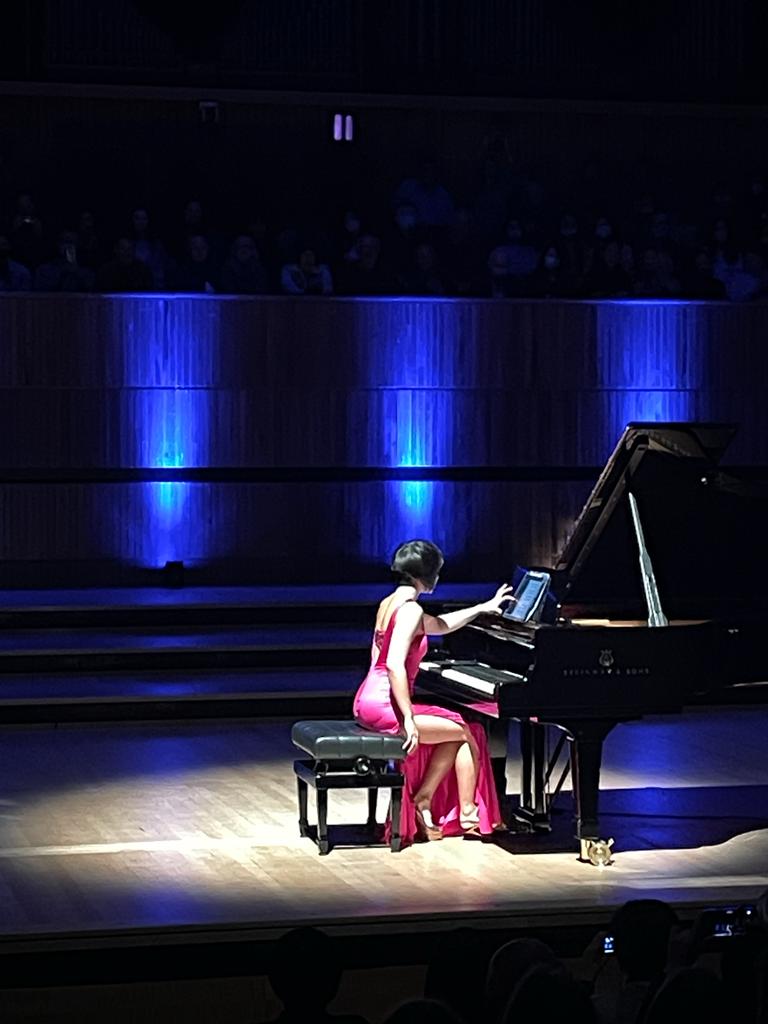
Artistry, focus and virtuosic fireworks from Yuja Wang in recital


Yuja Wang (© Ian Farrell)


Yuja Wang (piano)

7.30pm, Wednesday 20 April 2022

Royal Festival Hall, London


Ludwig Van Beethoven (1770-1827): Piano Sonata No. 18 in E flat major, 'Hunt', Op. 31 No. 3
Arnold Schoenberg (1874-1951): Suite, Op. 25
György Ligeti (1923-2006): Etude No. 6, 'Autumn à Varsovie' & Etude No. 13, 'L'escalier du diable'
Alexander Scriabin (1872-1915): Piano Sonata No. 3 in F sharp minor, Op. 23
Isaac Albéniz (1860-1909): Iberia, Bk 4: 'Málaga' & Bk 3: 'Lavapiés'
Nikolai Kapustin (1937-2020): Prelude in B major, Op. 53 No. 11 & Prelude in C sharp minor, Op. 53 No. 10

Encores:
Philip Glass (b.1937): Etude No. 6
Johann Sebastian Bach (1685-1750): Orchestral Suite No. 2 in B minor, BWV1067, Badinerie (arr. unknown)
Johannes Brahms (1833-1897): Intermezzo in C sharp minor, Op. 117 No. 3
Arturo Márquez (b.1950): Danzón No. 2 (arr. unknown)
Sergei Prokofiev (1891-1953): Toccata in D minor, Op. 11
Vladimir Horowitz (1903-1989): Carmen Variations
Franz Schubert (1797-1828): Gretchen am Spinnrade, D118 (transcribed by Franz Liszt (1811-1886))
Pyotr Ilych Tchaikovsky (1840-1893): Swan Lake, Op. 20, Dance of the Little Swans (arr. Earl Wild (1915-2010))
Giovanni Scambati (1841-1914): Mélodie (transcribed from Christoph Willibald Gluck (1714-1787): Dance of the Blessed Spirits from Orphée et Eurydice)

Yuja Wang (© Ian Farrell)
'While Wang more than delivered virtuosic fireworks, she gave so much more in her wide-ranging programme, showing phenomenal artistry and focus in well over two hours of performance'.

Schoenberg:
'Her Schoenberg that followed was, however, a revelation, with opening bite and edge followed by some remarkably delicate and intricate details'.

Ligeti:
'In ... Automne à Varsovie, Wang was into her astonishingly virtuosic stride, with hands at full stretch to either end of the keyboard. Yet it was her dynamic control that also impressed here'.

Scriabin:
'Wang’s dynamic control was impressive, with barely audible pianissimos expressing heartfelt longing'.

Encores:
'Dazzlingly rapid repetition in Glass followed by a crazy arrangement of ... Bach'.

Read my full review on Bachtrack here.


Monday, 5 June 2017

Stimulating programming and powerful performances from Lawrence Power, the Philharmonia and Gustavo Gimeno

Gustavo Gimeno (© Marco Borggreve)

Gustavo Gimeno (conductor)
Lawrence Power (viola)

Philharmonia Orchestra

Thursday 1 June 2017

Royal Festival Hall, London


Ligeti: Concerto Românesc

Salonen: Pentatonic Etude for Solo Viola

Bartók: Viola Concerto, Sz 120

Mahler: Symphony No. 1 in D major, 'Titan'

Ligeti: 'Gimeno elicited energy and spark from the Philharmonia players, as well as many commanding solos'.


Salonen: 'Power communicated with great conviction, proving a strong advocate for this striking miniature'.

Bartók: 'Power maintained the level of intensity (...) communicating constantly with Gimeno and the orchestral players'.


Mahler: A 'tightly controlled performance, with moments of great delicacy as well as power'.


Read my full review on Backtrack here.


Wednesday, 16 May 2012

Brighton Festival 2012 - Lunchtime Concerts, Part 1

Finally catching up on some of the first week of concerts in Brighton Festival.  The week began with me unfortunately having to miss a lunchtime concert (Saturday 5 May) of Jessica Grimes (clarinet) and Fiachra Garvey (piano) due to a rehearsal clash (see BREMF Consort of Voices concert below).  My partner went along instead, and despite some of the repertoire not being his cup of tea, he really enjoyed the concert, and was particularly impressed by the young duo's ability to communicate their obvious enthusiasm for the music, and their comfortable stage presence.  As a non musician, he also found her background explanations of the pieces performed helpful and insightful.  Grimes also performed the challenging Fantasie for solo clarinet by Jörg Widmann (you can see him perform the piece himself on YouTube).  Grimes described Widmann as one of her musical heroes, and she and Garvey both attended the concert the following day at Glyndebourne in which Widmann performed the Brahms Clarinet Quintet with the Hagen Quartet (see my review here).  


Then on Monday 7 May, another lunchtime concert - this time, Jayson Gillham on piano.  Another young performer, he also has great stage presence, with a natural ability to engage with the audience, again choosing to speak about the music too.  He performed Beethoven's Waldstein Sonata (No. 21 in C major, Op. 53), followed by four of Debussy's Études (numbers 6, 7, 8 & 11).  He concluded his programme with Chopin's Ballade No. 4 in F minor.  Born in Australia, Gillham settled in the UK in 2007, and has a number of competition prizes to his name, as well as a well established concert performance career, and two CDs to his name.  His Waldstein was powerful and robust, the Debussy beautifully delicate, and the Chopin was appropriately bravura and full-blooded.  We were also treated to a short encore, which Jayson kindly informed me via Twitter was the Étude No. 10, Der Zauberlehrling (The Sorcerer's Apprentice) by György Ligeti.  An impressive performance all round.


Tuesday 8 May - more lunchtime music from guitarist Michael Partington.  Born in Wales, he now lives in Seattle, and judging by his soft accent, he's been there a while.  Initially I feared the rather dead acoustic in the Pavilion Theatre would not favour the instrument, and I struggled to hear some of his sensitively quiet playing to start with.  However, I think in the end, this actually worked for him, in that I felt drawn in to listen more carefully to the intimacy and delicacy of the music.  Once again, we were given useful introductions and background notes on the music.  He began with a pleasant set of Variations, Op. 102 by Mauro Giuliani.  These were followed by his own arrangement of two Sonatas (K208 & K209) by Domenico Scarlatti.  As he explained, these keyboard sonatas fit remarkably well on the guitar, and his arrangements are fitting and effective.  Partington is also a great advocate of new music for the guitar, having commissioned and premiered many works.  He next performed Six Preludes by the Oregon based composer Bryan Johanson.  A great contrast to the rest of the programme, these showed a wide range of influences, as well as using some extended techniques on the instrument.  One, we were told beforehand, was even based around a Supremes song.  I spotted that it was the fourth, but couldn't identify the song - I heard him tell another audience member after, but didn't catch the title - so if you're out there, Michael... (update from the man himself - it was 'Keep Me Hanging On').  The highlight of his programme was the beautiful Tombeau sur la mort de M. le Comte de Logy.  Le Comte de Logy (or Jan Antonín Losy) was the 'Prince of the Lute' in his day, and Sylvius Leopold Weiss wrote this moving piece upon his death in 1721.  Interestingly, it uses one of the same 'extended' techniques we heard in the Johanson (string bending) to evoke wailing and grieving, and the rising scale towards the end depicts Le Comte's soul rising to heaven.  Despite a couple of memory lapses (I think), this was a touching performance, and made me want to seek this piece out again.  The programme ended in perhaps more familiar territory, with Tres Piezas Españolas by Joaquín Rodrigo.  


© Eric Richmond
The final lunchtime concert in this first week was very special, and for this we moved over to the Corn Exchange - although the concert was surprisingly not sold out (a top name pianist, for just a tenner...).  He began with Debussy's Children's Corner.  Despite their deceptive simplicity, these miniatures are not straightforward, but are equally not great virtuosic showpieces either.  It was nice to hear such a great pianist performing these graceful and witty pieces with such subtlety of expression, and they provided the perfect opener, before the more challenging Processional by George Crumb (b. 1929).  One of Crumb's few piano pieces that doesn't involve extended effects or preparations, this piece nevertheless does use on particular effect rather well - chords are placed silently following heavily attacked chords above or below, creating a curious resonance.  In the larger, slightly barn-like acoustic of the Corn Exchange, this proved rather effective, although it may not have carried completely to the back of the hall.  The lion's share of the programme was then taken up with Ravel's Miroirs, a mammoth work of five impressionistic and highly evocative pieces, containing huge challenges for the pianist.  The arpeggios of the third piece, Une barque sur l'océan, was particularly beautifully performed here, the music rippling and flowing almost endlessly.  The concluding bells of La vallée des cloches perfectly concluded a captivating and uplifting oasis in the middle of a miserably rainy day!