Showing posts with label Tchaikovsky. Show all posts

Tuesday, 9 December 2025

'A Fairytale Christmas' - the Brighton Philharmonic Orchestra combine a Christmas favourite with unfamiliar treats

Joanna MacGregor &
the Brighton Philharmonic Orchestra
© Sarah-Lousie Burns

Alise Siliņa (accordion)
Joanna MacGregor (conductor)
Ruth Rogers (leader) 

2.45pm, Sunday 7 December 2025


Delius, Frederick (1862-1934): Eventyr (Once Upon a Time)
Trojan, Václav (1907-1983): Fairy Tales: A Concerto for Accordion
Encore: unnamed
de Hartmann, Thomas (1885-1956): Koliadky: Noëls Ukrainiens, Op. 60
Tchaikovsky, Pyotr Ilyich (1840-1893): The Nutcracker Suite, Op. 71a


Alise Siliņa, Joanna MacGregor 
& the Brighton Philharmonic Orchestra
© Sarah-Louise Burns

‘A Fairytale Christmas’, a programme of orchestral music for Christmas from the Brighton Philharmonic Orchestra – can you guess what might have been on the programme? Well, true to Music Director Joanna MacGregor’s imaginative programming form, apart from Tchaikovsky’s The Nutcracker Suite, it’s unlikely that anyone would have guessed, or possibly even have recognised the other three works on offer today. If it was designed to bring in more families and children to the audience, then that certainly worked, as there were noticeably more youngsters and even toddlers in the Dome concert hall. Having said that, I’m not sure the programme was quite attractive enough to maintain young attention spans, beyond the interest of the accordion and The Nutcracker Suite at the end.

Delius’ unfamiliar tone poem Eventyr, or Once Upon a Time, opened the programme. Composed in 1917, it’s fair to say it’s not secured a footing in the repertoire, so it was great that the BPO gave it an airing, with support from the Delius Trust. Eventyr actually means Adventure, and the inspiration here was Norwegian folk tales – whilst a possible Christmas meal to tempt the trolls and hobgoblins is mentioned in Delius’ description, the Yuletide connection is limited, with the focus more on the mysterious creatures who need to be won over by hunters to ensure good luck. The music is suitably atmospheric, with a watery harp, tinkling celesta, glockenspiel and xylophone all providing delicate colour, and the BPO gave us a relatively committed performance, although Delius’ subtle orchestration was perhaps not enough to captivate the younger members of the audience, and noises off meant a few pickups from the orchestra were consequently a little distracted and tentative. It would be good to hear the work performed again on a less festive programme to fully appreciate its atmospheric colour. 


This was followed by Fairy Tales: A Concerto for Accordion, by the Czech composer Václav Trojan (1907-1983). Trojan was best known for his many scores for animated films in the 1940s and 50s, and this suite of seven short movements certainly has a filmic, often cartoon-like feel. The star here was the young Latvian accordionist, Alise Siliņa, currently studying for her Master’s at the Royal Academy of Music. The work allowed her to demonstrate the range of the lightly amplified instrument, from lyrical, wistful melodic lines in The Sleepy Princess, to playfulness in The Magic Box, and virtuosic display in The Naughty Roundabout. This movement and the next, The Sailor and the Enchanted Accordion, had pleasantly swaying waltz rhythms, with the latter more dreamily bluesy in places. The finale, The Acrobatic Fairy Tale was full of circus tumbling, almost like a cartoon chase, all building to a fun, swirling finish. Siliņa played with character throughout, and was well supported by  the orchestra, with some particularly atmospheric cor anglais solos, although the work surprisingly doesn’t foreground the accordion as much as one might expect. Siliņa then treated the audience to a highly engaging solo encore, a touchingly wistful melodic line following a darkly lilting opening, and here we could really hear her command of the instrument. 


Alise Siliņa
© Nick Boston

Ukranian-born Thomas de Hartmann (1885-1956) is better known to me for his connection to his spiritual teacher, George Gurdjieff, many of whose works de Hartmann transcribed for piano, forming some four volumes of sacred inspired hymns and rituals. Influenced by Gurdjieff’s mystic ‘Fourth Way’ spirituality, de Hartmann and his wife were closely entwined with Gurdjieff and other follows for many years, and this music has a meditative, ethereal quality. The work on today’s programme, Koliadky: Noëls Ukraniens, Op. 60, is much more closely linked to Ukranian folk culture, although de Hartmann stressed that he was influenced by folk tunes, rather than drawing directly on traditional melodies. Having been performed in 1946, it is thought that today’s performance may have been its second ever in the UK. The opening Chant spirituel began with a cello solo, who was then joined by the strings for a haunting hymn, its Ukranian roots also sounding reminiscent of Vaughan Williams’ modal harmonies. Next, a bouncy quartet for cor anglais, clarinets and bassoon, Viens, Koladá, viens, followed by a dark, slow dance from horns, oboes and bassoons to herald Les rois mages (The Three Wise Men). This is a fascinating work, with such short glimpses of colour from de Hartmann that you are definitely left wanting more, from Górecki/Pärt tinged moments for low strings against violins, to thick brass and ringing bells, and a lively dance, Goussak (Gander Dance) as a brief finale. Thanks to Joanna MacGregor for bringing it to our attention, and to the BPO for presenting it so convincingly.


Joanna MacGregor & the BPO
© Nick Boston

And so to the popular Christmas highlight, Tchaikovsky’s The Nutcracker Suite. Unfortunately the attention spans of some of the children in the audience had long since waned, so sadly some had now left before the piece on the programme that would have surely most grabbed their attention. But those that remained clearly enjoyed the lively and familiar tunes, with some particularly spirited conducting from one young girl in the front row of the circle during the Waltz of the Flowers. The BPO delivered it all with enthusiasm, although ensemble was occasionally a little shaky, with MacGregor not quite martialling the accelerando in the Chinese Dance, and some untidy rapid scales in the Dance of the Mirlitons. A few intonation issues in the outer first violins in the Miniature Overture, and some rather rustic brass in the March all pointed towards perhaps more rehearsal time being dedicated, understandably, to the three unfamiliar works on the programme. This left the Tchaikovsky to rely on familiarity, which was a pity. That being said, it was a joyful enough performance, and a hit with the audience to end the afternoon.

Wednesday, 10 September 2025

Beauty of sound dilutes the passion in Welser-Möst and the Vienna Philharmonic's Tchaikovsky

Franz Welser-Möst
© BBC/Chris Christodoulou

Vienna Philharmonic
Franz Welser-Möst (conductor)

BBC Proms
7.30pm, Sunday 31 August, 2025
Royal Albert Hall, London


Mozart, Wolfgang Amadeus (1756-1791): Symphony No. 38 in D major, K504 'Prague'
Tchaikovsky, Pyotr Ilyich (1840-1893): Symphony No. 6 in B minor, Op. 74 'Pathétique'


The Vienna Philharmonic at the BBC Proms
© BBC/Chris Christodoulou
'It almost goes without saying that the Vienna Philharmonic sounded exquisite at all times, the orchestra never knowingly emitting anything uneasy on the ear'.

Mozart:
'Welser-Möst was the epitome of restrained poise, with razor-sharp ensemble from the offbeat violins, before they fizzed in the Allegro'.

'Despite impressive agility from the woodwinds ... and skittering violins, there was not much to get the heart racing here'.

Tchaikovsky:
'Welser-Möst kept a lid on things until build to the climax, with violins and woodwinds swirling into the tutti march, one of the evening’s first truly spectacular moments'.

'At least a handful of grit in the mix would have better captured the symphony’s “Pathétique” essence'.

Read my full review on Bachtrack here.


Saturday, 28 September 2024

Exciting Stravinsky and powerful Tchaikovsky to kick off Brighton Philharmonic Orchestra's 100th season

Aidan Mikdad, Joanna MacGregor
& the Brighton Philharmonic Orchestra
© Fernando Manoso-Borgas

Aidan Mikdad (piano)
Joanna MacGregor (conductor)

2.45pm, Sunday 22 September 2024


Pyotr Ilyich Tchaikovsky (1840-1893): Piano Concerto Nol 1 in B flat major, Op. 23
Encore:
Franz Liszt (1811-1886): Liebestraüme, S451, No. 3 in A flat major

Igor Stravinsky (1882-1971): Le Sacre du printemps (The Rite of Spring)


Conductor Joanna MacGregor and Brighton Philharmonia Orchestra kicked off their 100th season with an afternoon of barnstorming greats of the repertoire. They opened with Tchaikovsky’s ever-popular Piano Concerto No. 1, with Dutch pianist (and former pupil of MacGregor’s at the RAM), Aidan Mikdad at the keyboard. But when their ambitious 100th season programme was first published, the big question was, could they pull off Stravinsky’s The Rite of Spring, notoriously challenging, and requiring greater forces than are usually assembled by the BPO on the Brighton Dome stage. And it's not just size – The Rite of Spring calls for instrumentation at the far ends of most of the woodwind and brass sections – Wagner tubas, bass clarinets, alto flute, bass trumpet and trombone at the low end, and high E-flat and D clarinets at the top. The virtuosity required of the players is significant, with solos shared around most of the orchestra at one point or another. Were they up to the challenge?


Joanna MacGregor conducting the
Brighton Philharmonic Orchestra
© Fernando Manoso-Borgas

But first the Tchaikovsky. After a slightly nervy horn opening, a rich string sound soon took over, and Mikdad immediately responded with weighty, full chords. Things took off at a lilting pace, then Mikdad injected greater pace and energy with the folk melody that follows. The strings sounded particularly warm, not always matched in tone by the drier woodwind sound, however. Mikdad’s cadenza cross rhythms and subsequent trills against the returning tune were commandingly secure and confident. Although the following orchestral pickup was not totally secure, MacGregor and Mikdad nonetheless built to an impressively strong finish. The pianissimo pizzicato strings at the opening of the second movement slowly quietened the enthusiastic audience, and retiring Principal Flute, Christine Messiter delivered the melody with tender lightness. MacGregor did well to keep the strings at bay when the piano entered proceedings, although later, the orchestra and offbeat piano got momentarily out of kilter with each other. The Finale had great energy and enthusiasm, with some thundering octave runs from Mikdad. The orchestral surges could have taken more contrast, and once again here, timing was once or twice a slight issue, but Mikdad’s show of excellence was impressive, and the conclusion was suitably exciting. He then treated the eager audience to a technically assured rendition of Liszt’s Liebestraum No. 3 to conclude his contribution to the afternoon’s programme, although it was pleasing to note that he joined the audience for the second half.


Joanna MacGregor
& the Brighton Philharmonic Orchestra
© Fernando Manoso-Borgas

And then to the Stravinsky. Principal Bassoon Jonathan Price led things off with a fine delivery of the twisted, high introduction, leading into birdcalls from each woodwind instrument in turn. This signalled what was to be a secure performance from all, and MacGregor and the players certainly rose to the challenges set by Stravinsky. MacGregor’s guidance through the complex rhythms was clear, and only very occasionally did the orchestral rhythms not gel perfectly. They produced a suitably huge sound when required at the various ritual sections, and the final Sacrifical Dance had stabbing, scary energy. The thrashing string chords in The Augurs of Spring needed greater violence and malevolence, and there could have been a greater sense of the edge of chaos and riot, and there was occasionally a sense that they needed to keep everything under control. However, MacGregor and the BPO did pull it off with an exciting performance, once again demonstrating their continued growth and development as they push the boundaries of their expected repertoire. If this was ambitious for the BPO, wait for later in the season, and in particular, their Centenary Gala on 13 April 2025 – Messaien’s mighty Turangalîla Symphony. On today’s evidence, this will certainly be something to watch out for. 


Tuesday, 28 November 2023

Järvi and the Philharmonia hammer home the terrors of war in Prokofiev 6

James Ehnes
© Benjamin Ealovega
James Ehnes (violin)
Paavo Järvi (conductor) 

3pm, Sunday 26 November 2023


Claude Debussy (1862-1918): Prélude à l’après-midi d’un faune

Pyotr Ilyich Tchaikovsky (1840-1893): Violin Concerto in D major, Op. 35

Encore:

Eugene Ysaÿe (1858-1931): Sonata for Solo Violin in D minor 'Ballade', Op 27 No. 3

Sergei Prokofiev (1891-1953): Symphony No. 6 in E flat minor, Op. 111


Paavo Järvi
© Kaupo Kikkas
Debussy:

Järvi’s take on Faune was languorous and warm, yet with a kind of mystical reverence.


Tchaikovsky:

'Ehnes’ unquestionable virtuosity is such that this performance felt almost understated, in a good way. Nothing appeared to be any effort at all, so even in the craziest runs every note was clearly articulated'.


'Järvi et al had great fun with the finale’s rustic drones, and Ehnes’ gunshot spiccato got faster and faster, with a frankly crazy but exhilarating race to the end'.


Prokofiev:

'Järvi put the Philharmonia through their paces, with some particularly unforgiving tempo, especially in the finale, but they were up to the challenge'.


'This was surely Prokofiev’s anger at the horrors of war, and Järvi and the Philharmonia duly delivered the required sense of terror'. 


Read my full review on Bachtrack here.


Monday, 13 February 2023

Tchaikovsky's Fifth lifts Gergely Madaras' LPO debut

Gergely Madaras
© Marco Borggreve

Zlatomir Fung (cello)
London Philharmonic Orchestra
Gergely Madaras (conductor)

7.30pm, Saturday 11 February 2023


Pyotr Ilyich Tchaikovsky (1840-1893):
 Romeo and Juliet: Fantasy Overture
 Variations on a Rococo Theme for cello and orchestra, Op. 33
 Symphony No. 5 in E minor, Op. 64


Romeo & Juliet:
'Madaras and the LPO gave a sound reading, with tight ensemble and precision throughout, as well as moments of delicacy from muted violins and smooth woodwind textures'.

'Greater edge and urgency was needed in the string accents and surges, and the passionate explosion of the consummating love theme lacked ecstasy, giving us a Romeo and Juliet within a somewhat narrowed bandwidth'.

Rococo Variations:
'Zlatomir Fung performed with an openness and delicate simplicity, whilst delivering the not inconsiderable virtuosic demands with a lightness of touch throughout'.

Symphony No. 5:
'From the start, Madaras exploited a much broader range of dynamics, with surging strings following on from the sombre woodwind opening, and a blistering climax before the movement gallops off into the dark, bass-register distance'.

'By the finale, it felt like Madaras and the LPO were fully settled in, with rushing string waves, fateful brass calls and the woodwind once again nimble and precise'.

Read my full review on Bachtrack here.

Gergely Madaras & the London Philharmonic Orchestra
© N Boston 


Thursday, 21 April 2022

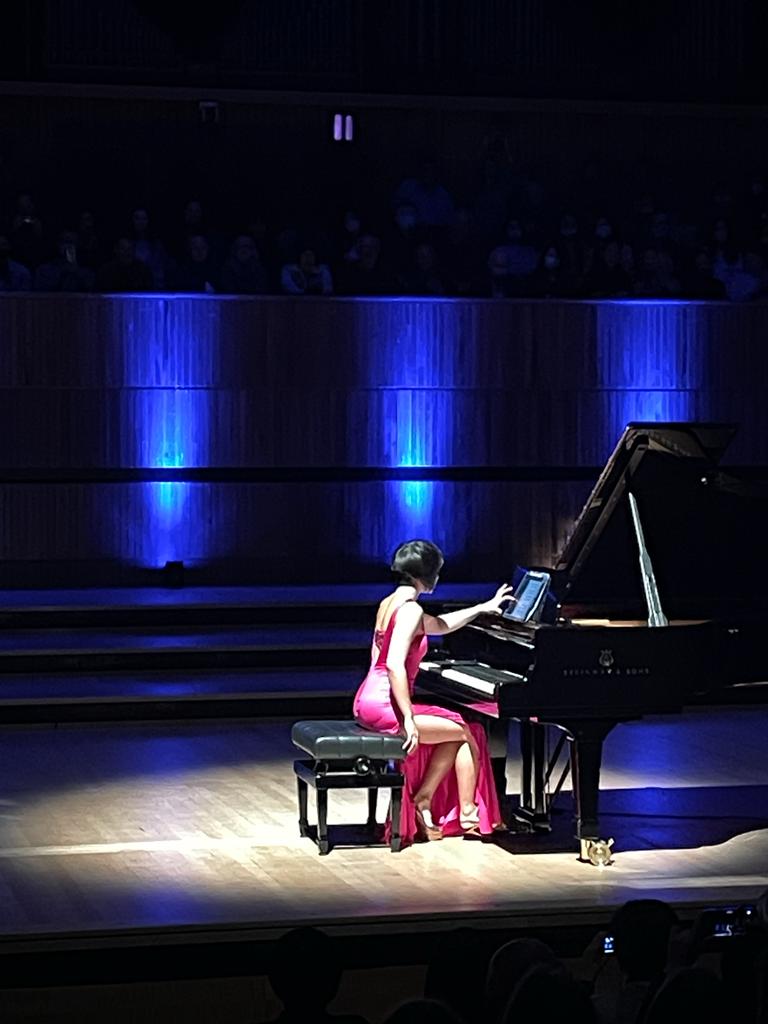
Artistry, focus and virtuosic fireworks from Yuja Wang in recital


Yuja Wang (© Ian Farrell)


Yuja Wang (piano)

7.30pm, Wednesday 20 April 2022

Royal Festival Hall, London


Ludwig Van Beethoven (1770-1827): Piano Sonata No. 18 in E flat major, 'Hunt', Op. 31 No. 3
Arnold Schoenberg (1874-1951): Suite, Op. 25
György Ligeti (1923-2006): Etude No. 6, 'Autumn à Varsovie' & Etude No. 13, 'L'escalier du diable'
Alexander Scriabin (1872-1915): Piano Sonata No. 3 in F sharp minor, Op. 23
Isaac Albéniz (1860-1909): Iberia, Bk 4: 'Málaga' & Bk 3: 'Lavapiés'
Nikolai Kapustin (1937-2020): Prelude in B major, Op. 53 No. 11 & Prelude in C sharp minor, Op. 53 No. 10

Encores:
Philip Glass (b.1937): Etude No. 6
Johann Sebastian Bach (1685-1750): Orchestral Suite No. 2 in B minor, BWV1067, Badinerie (arr. unknown)
Johannes Brahms (1833-1897): Intermezzo in C sharp minor, Op. 117 No. 3
Arturo Márquez (b.1950): Danzón No. 2 (arr. unknown)
Sergei Prokofiev (1891-1953): Toccata in D minor, Op. 11
Vladimir Horowitz (1903-1989): Carmen Variations
Franz Schubert (1797-1828): Gretchen am Spinnrade, D118 (transcribed by Franz Liszt (1811-1886))
Pyotr Ilych Tchaikovsky (1840-1893): Swan Lake, Op. 20, Dance of the Little Swans (arr. Earl Wild (1915-2010))
Giovanni Scambati (1841-1914): Mélodie (transcribed from Christoph Willibald Gluck (1714-1787): Dance of the Blessed Spirits from Orphée et Eurydice)

Yuja Wang (© Ian Farrell)
'While Wang more than delivered virtuosic fireworks, she gave so much more in her wide-ranging programme, showing phenomenal artistry and focus in well over two hours of performance'.

Schoenberg:
'Her Schoenberg that followed was, however, a revelation, with opening bite and edge followed by some remarkably delicate and intricate details'.

Ligeti:
'In ... Automne à Varsovie, Wang was into her astonishingly virtuosic stride, with hands at full stretch to either end of the keyboard. Yet it was her dynamic control that also impressed here'.

Scriabin:
'Wang’s dynamic control was impressive, with barely audible pianissimos expressing heartfelt longing'.

Encores:
'Dazzlingly rapid repetition in Glass followed by a crazy arrangement of ... Bach'.

Read my full review on Bachtrack here.


Tuesday, 6 October 2015

Fireworks of the right kind from Matsuev, Temirkanov & the Philharmonia

Yuri Temirkanov
© Sasha Gusov

Denis Matsuev (piano)
Yuri Temirkanov (conductor)
Philharmonia Orchestra

Tchaikovsky: Piano Concerto No. 1, Op. 23
Tchaikovsky: Méditation, Op. 72 No. 5 (Encore)

Brahms: Symphony No. 4, Op. 98

Royal Festival Hall, Sunday 4 October 2015


'Refreshing performances of these familiar masterpieces.'

'A performance with plenty of fireworks, but the right kind for a change: power, virtuosity and drama for sure, but extreme contrasts, fine detail and moments of high intimacy too.'

'Temirkanov produced real drama here, ... a powerful finish to this taut reading, one of the strongest I’ve heard in a long time.'

Read my full review on Bachtrack here.

Monday, 3 December 2012

CD Reviews - December


American choral composer René Clausen (b.1953) is perhaps less well-known here than Lauredsen, or the ubiquitous Whitacre, but in fact has a substantial catalogue of choral works, and the latest disc from the Kansas City Chorale, under the direction of Charles Bruffy, entitled 'Life and Breath' is a great showcase for his work.  Many of the texts set will be familiar - compare Lauredsen's O magnum mysterium, or Tavener's The Tyger and The Lamb, for example.  Yet this added to the interest of this collection for me.  Whilst Clausen's settings don't necessarily improve on these well-known settings, they do offer a refreshing different take.   The Lamb in particular has a striking luminosity, combined with gentle tenderness.  Here, as in nearly all the pieces on the disc, Clausen adds a soprano solo, all taken from the choir members, all highly competent.  Sarah Tannehill deserves special mention for her bell-like solo in the Credo of the Mass for Double Choir, the most substantial work, which forms the centrepiece of the programme.  There is more harmonic interest here, and the shifting dissonances in the Kyrie provide significant challenge for the singers, which they certainly meet.  The obligatory use of tone clusters is here, but Clausen makes good use of rhythmic interest, and his word-setting is strong.  His interweaving of the well-known Lutheran chorale O Sacred Head, Now Wounded into his other double choir work here, O vos omnes, is also highly effective.  An enjoyable disc, and a choral composer deserving of the exposure and expert advocacy given here by the excellent Kansas City Chorale.
Mikhail Pletnev has nearly reached the end of his second recorded cycle of Tchaikovsky symphonies with the Russian National Orchestra on SACD with Pentatone.  With just the Third to come, I've been listening to the somewhat less popular Symphony No. 2, the 'Little Russian', so called because of its use of Ukranian folk tunes.  It perhaps doesn't have the intensity or drama of the later symphonies, but there is considerable interest in his use and variation of the folk melodies, possibly at the expense of overall structure.  This performance is tight, with some exemplary wind and brass playing in particular.  The original score was composed in 1872, but Tchaikovsky revised the work, changing the first movement and making cuts to the finale, as well as reorchestrating the scherzo.  It is the revised version that is most often performed, but Pletnev also includes the original first movement here as well as the revised.  Strangely, given the disc's short playing time of just over 48 minutes, the original finale is not included.  However, hearing both first movements, one can see why Tchaikovsky made the changes, although a few interesting ideas were lost in the process.  Nevertheless, this is pretty much a faultless performance, and the quality of the recording is spot on.

Tchaikovsky, Peter Ilyich. Symphony No. 2 in C minor, Op. 17. Russian National Orchestra, Mikhail Pletnev. 2012. Hybrid Super Audio Compact Disc. Pentatone PTC 5186 382.

The Russian National Orchestra return for another Pentatone SACD recording, this time under Vasily Petrenko (also Principal Conductor of the Royal Liverpool Philharmonic Orchestra), to perform the two Violin Concertos by Prokofiev, with the German violinist, Arabella Steinbacher.  Steinbacher produces a beautifully rich tone, and the RNO are once again on fine form.  Prokofiev's two concertos are a wonderful combination of full-blooded romanticism and his ability to spike this with a edge of quirky rhythmic sarcasm.  Steinbacher has the measure of this match – she plays with real lyricism (particularly noticeable in the second concerto’s slow movement), yet explodes with energy when Prokofiev calls for it.  The second’s Finale feels particularly sparky and perfectly on the edge of almost bacchanalian chaos.  Steinbacher finishes off the disc with Prokofiev’s Sonata for Solo Violin.  This piece was actually intended to be played in unison by a group of violins – this is rooted in the pedagogic tradition in Russia where students would learn to play in unison groups.  It is perhaps not the most virtuosic of sonatas for the instrument, but it requires subtle attention if it is not to sound like an academic study.  Steinbacher achieves this, and the middle movement Theme and variations are particularly delicately performed.  A delightful close to a successful recording.

Prokofiev, Sergei. The Two Violin Concertos, Sonata for Violin Solo. Arabella Steinbacher, Russian National Orchestra, Vasily Petrenko. 2012. Hybrid Super Audio Compact Disc. Pentatone PTC 5186 395. 

William Byrd's (c.1540-1623) 'Great Service' may have been written for the fortieth anniversary of Elizabeth I's accession to the throne - so perhaps a recording is fitting in this jubilee year.  And Musica Contexta have decided to perform the work set within an idea a liturgical setting in the Chapel Royal, where it may or may not have been performed - this means including motets, anthems and psalm settings, and separating the mass movements out into Matins, Communion and Evensong.  They have also introduced instruments to accompany the singers in various sections - these are the forces of the excellent English Cornett and Sackbut Ensemble.  Their further nod to 'authenticity' is their use of historically informed Elizabethan vowel pronunciation.  As worthy as the dedication to such academic accuracy is, such projects can sometimes collapse under the weight of such detail, and there are times where the seriousness of their endeavours obscures the joy of the actual music for me.  However, the overall standard of performance is strong, and the addition of two interludes for organ played by Steven Devine are an added bonus.  A well-executed project, certainly, to which one might return occasionally, but possibly not a performance for regular listening.  

Byrd, William. The Great Service in the Chapel Royal. Musica Contexta, Steven Devine, The English Cornett and Sackbut Ensemble, Simon Ravens. 2012. Compact Disc. Chandos CHAN 0789.

(These reviews first appeared in GScene magazine)