Tuesday, 28 February 2023

CD Reviews - February 2023

John Wilson is back with the Sinfonia of London with a great new disc to follow up on their acclaimed 2021 recording of English String Music. This time, alongside two stalwarts of the repertoire, Vaughan Williams’ (1872-1958) Fantasia on a Theme by Thomas Tallis, and Elgar’s (1857-1934) Introduction & Allegro for strings, are the sorely overlooked Concerto for String Orchestra by Herbert Howells (1892-1983), and a delightful gem, Late Swallows, by Frederick Delius (1862-1934). As with previous recordings, the Sinfonia of London string sound is rich, and the Chandos recording is equally full of depth. Wilson is precise and always clear as a bell, never allowing for any wallowing in the often thick textures of these works for strings. Vaughan Williams’ Fantasia has beautiful shimmering moments, but accents are strong, almost violent in places. Tempi are driven – Wilson never hangs about, avoiding the forementioned wallowing, so this is a less relaxed performance than some, but that brings out the precision and complexity of Vaughan Williams’ layered writing all the more. Wilson and the players give full weight when needed, but also exploit the contrasts between the three groupings – string quartet, and two orchestral ensembles, small and large. Their Elgar is similarly driven, right from the strident, energetic opening, yet the viola, immediately warm in contrast, has great emotional weight. This captures a key element of Wilson’s approach, always contrasting almost clinical precision and momentum with passion and emotional impact in the right places. Some recordings of this music achieve one or the other, but rarely both. The climaxes are quick – and the cold, spiky fugue builds to a phenomenal frenzy, with a thrilling race to the finish. Late Swallows is actually an arrangement by Eric Fenby (suggested by Barbirolli) of the slow movement from his String Quartet. It perhaps lacks the drama and contrasts of the other works here, but it is full of beautifully evocative swoops and dives, given lush expression here by the Sinfonia of London strings. Howells’ orchestral works have never achieved the same level of recognition as his choral works, which is a pity, as he clearly knew how to write for orchestral forces. He set out to write his Concerto for String Orchestra as a tribute to Elgar who had recently died, but he also then suffered the loss of his own nine-year-old son, and the resulting dedication of the work was to them both. He even said of the slow movement, ‘
it was inspired by the countryside between the Malverns and the Cotswolds, and by two people – one old and one young – who knew and loved that part of England’. Yet the opening movement is strident, even harsh, with bursts of energy throughout, contrasting with a plaintive, slower central section. That central slow movement is definitely full of soulful yearning, with the passion increasing to pleading cries in places. So here, as before, Wilson delivers the emotional impact when it’s required, whilst maintaining the overall sense of direction of the work. The final movement launches off, immediately strident and angular once again, yet this is also full of contrasts, with jazzy rhythms, lighter, more plaintive moments, and urgent chords bringing things to a sudden conclusion. As with the Elgar, which clearly inspired Howells, the solo viola features strongly throughout, successfully providing a thread tying the work together. This recording is worth attention purely for the Howells, but lively and energetic readings of the Elgar & Vaughan Williams, and the Delius rarity, make this another strong release all round for Wilson and the Sinfonia of London.


The ensemble ZRI take their name from Zum Roten Igel, the 19th century Vienna coffee house that was a hub for many composers, such as Brahms and Schubert, but also many folk and gypsy musicians of the time, creating a musical melting pot of influences and ideas. Here, in  Cellar Sessions, the five-piece ensemble, consisting of clarinet (Ben Harlan), violin (Max Baillie), cello (Matthew Sharp), accordion (Jon Banks) and santouri (a member of the dulcimer family) (Iris Pissaride), have embraced this idea of melding together classical repertoire with gypsy and folk material, but bringing that up to the present day, adding contemporary pop influences such as Donna Summer, Taylor Swift and Solange into the mix. This works remarkably well, with playful, dancing works such as Tokay by George Boulanger (1893-1958), and the swinging Horă din Budești by Aurel Gore (1928-1989), both Romanian violinists and arrangers, sitting alongside the ensemble’s take on classical works. They give a gloriously mysterious rendition of Schubert’s ethereal Andante from the Piano Trio No. 3, with a wonderful santouri introduction giving a nod to his nickname as the ‘Knight of the Cimbalom’, due to his fascination for Hungarian traditional music. From this introduction, Schubert’s slow movement emerges out of a gently pulsing rhythm, with burbling clarinet and sweet violin capturing the intensity of the original, and following some improvisatory exploration by the clarinet, low cello rumblings herald the return of the haunting sadness of the santouri. The Presto from Bach’s Violin Sonata No. 1 receives the ZRI treatment too, with the clarinet swinging the cross rhythms over gentle plucking from strings, building to some great rippling flourishes from the clarinet. Donna Summer’s I Feel Love opens with a bouncing accordion, but it’s the cello that sets up the iconic driving rhythm, whilst ethereal violin harmonics take on the melodic line. This all builds to a crazy clarinet riff, before a gradual fade. Taylor Swist’s Shake it Off is combined with a klezmer melody Lebedik un Freylach by Abe Schwartz (1881-1963), from a mournfully atmospheric beginning through to a racing, dancing conclusion. Matthew Sharp even gives us an expressive, cabaret-style baritone for Jay Gorney’s (1896-1990) Brother can you spare a dime?, with a shimmering accompaniment developing into swinging jazz. Brahms makes an indirect appearance, in the form of Isteni Csárdás by Miska Borzó (1800-1864), itself no doubt drawn from an older Hungarian tune, but better known to us now from Brahms’ Hungarian Dance No. 1, here full of the tune’s wildness and virtuosic energy in ZRI’s interpretation. They end with a delicate tango, Rote Rosen by Helmut Ritter (1907-1988), full of gentle nostalgia, before fading off into the distance. Overall, an extremely clever and inventive collection of repertoire, performed with joy and spirit throughout.


Greek-born pianist Alexandra Papastefanou studied in Moscow, Budapest and the US, and has had lessons from Alfred Brendel. She has performed all of Bach’s keyboard works, and recorded most of them too. Here she brings us a collection of transcriptions – so we’re immediately moving beyond the issue of performing his keyboard works on a modern piano, as here we have a trio sonata, chorales and cantatas, all in her own transcriptions, apart from Myra Hess’ famous arrangement of Jesus bleibet meine Freude (‘Jesu, joy of man’s desiring’), with which she ends her recording. Along the way, there are a couple of surprises too, with Papastefanou adding her own jazzy variation on top of her transcription of the chorale Allein Gott in der Höh sei Her, calling her addition appropriately Playing (with) Bach. The bouncy repeated figures here are effective, with the increasingly clashing harmonies providing an unusual counterpoint. We also get A Tribute to Bill Evans combined with An Wasserflussen Babylon (which also gives the album its title, Tears from Babylon). Here, she draws on Evans’ Peace Piece, with her own extemporisations entwined with the chorale melody in a particularly effective way, making this in fact the disc’s highlight for me. The Trio Sonata No. 5, BWV 529’s opening Allegro is clean, bright and lively, whilst the Largo that follows is tender and expressive. Papastefanou captures these contrasts throughout the recording, with joyful spirit for Sei Lob und Preis mit Ehren, carefully bringing out the chorale melody from within the busy moving textures, whilst using a softer, more expressive tone for the Aria, Meine Seufzer, meine Tränen. The plodding bass line for Gott hat alles wohlgemacht from BWV35 works well, as does the energetic Sinfonia from BWV18. Ending with Myra Hess’ transcription is a fitting tribute to all those that have gone before, transcribing and arranging Bach’s music, and Papastefanou’s rendition of Hess’ classic is captivating. Throughout this collection, Papastefanou captures the essence of Bach’s music, whilst taking us in some new and unexpected directions too. 


Bach, J. S./Papastefanou, A. Tears from Babylon: J. S. Bach Piano Transcriptions. Alexandra Papastefanou. Compact Disc. First Hand Records FHR141.

Tuesday, 14 February 2023

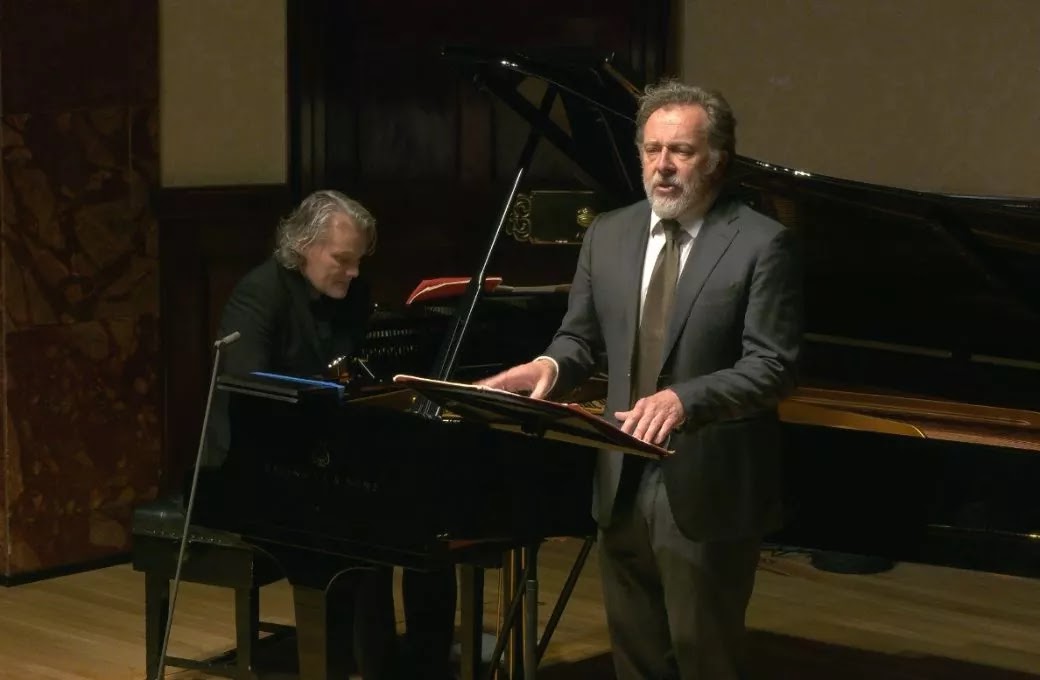
Emotionally compelling Lenau settings from Gerhaher and Huber at Wigmore Hall

Christian Gerhaher & Gerold Huber
© Wigmore Hall Trust

Christian Gerhaher
(baritone)
Gerold Huber (piano)

7.30pm, Sunday 12 February 2023

Wigmore Hall, London

★★★★★


Heinz Holliger (b.1939): Elis: Verkündigung des Todes, Todesangst und Gnade, Himmelfahrt

Hugo Wolf (1860-1903): Abendbilder

Heinz Holliger: Lunea: Wirf o Thor, Die Jahre flogen, Die Himmelsschlange, Ich will, Weit, Dein Blick, Transsubstantiatio, Der Mensch, Ich habe, Serenum, Der Eisenhammer, Ein Tropfen, Verächtlich, Man grüsst, Der Schwimmer, Mein Widerhall, Der Frühling, Der schwarze Schleier, Der Zweifel, Der Himmel, Der Mond, Die Wüstenwanderer, Einklang (Nachwort)

Robert Schumann (1810-1856): 4 Husarenlieder, Op. 117: Der Husar, trara!, Der leidige Frieden, Den grünen Zeigern, Da liegt der Feinde gestreckte Schar, 

Othmar Schoeck (1886-1957): Elegie, Op. 36: An den Wind, Herbstgefühl, Verlorenes Glück, Das Mondlicht, Herbstentschluss, Welke Rose

Robert Schumann: 6 Gedichte von N Lenau und Requiem, Op. 90: Lied eines Schmiedes, Meine Rose, Kommen und Schieden, Die Seine, Einsamkeit, Der schwere Abend, Requiem

Encore:
Othmar Shock: Elegie, Op. 36: Zweifelnder Wunsch

Christian Gerhaher
© Wigmore Hall Trust
Holliger:
'Gerhaher ... immediately drew us into the dark, introspective world that would pervade the programme to come. Huber’s glassy, ethereal playing, with layered pedalling also set a darkly atmospheric scene'.   

'Gerhaher delivered the twistingly tormented, leaping lines with remarkable, chilling clarity, with striking stillness on stage, oblivious to Huber’s frequent forays into the piano’s interior'.

Schoeck:
'Gerhaher gave us pleading, icy tones, and the final journey of Herbstentschluss dripped with sadness, before the heartbreaking Welke Rose, Huber’s soft-toned accompaniment in the distance'.

Schumann:
'But it was with the Sechs Gedichte von N Lenau that Gerhaher truly tugged the heartstrings. Words were exquisitely pointed in Meine Rose, with a wishful blossoming on “freudig”. Despite some gloriously ringing tone at the top of his range, he returned to oppressive darkness for Einsamkeit'.

Read my full review on Bachtrack here.

Watch the concert streamed by the Wigmore Hall here.


Monday, 13 February 2023

Tchaikovsky's Fifth lifts Gergely Madaras' LPO debut

Gergely Madaras
© Marco Borggreve

Zlatomir Fung (cello)
London Philharmonic Orchestra
Gergely Madaras (conductor)

7.30pm, Saturday 11 February 2023

★★★


Pyotr Ilyich Tchaikovsky (1840-1893):
 Romeo and Juliet: Fantasy Overture
 Variations on a Rococo Theme for cello and orchestra, Op. 33
 Symphony No. 5 in E minor, Op. 64


Romeo & Juliet:
'Madaras and the LPO gave a sound reading, with tight ensemble and precision throughout, as well as moments of delicacy from muted violins and smooth woodwind textures'.

'Greater edge and urgency was needed in the string accents and surges, and the passionate explosion of the consummating love theme lacked ecstasy, giving us a Romeo and Juliet within a somewhat narrowed bandwidth'.

Rococo Variations:
'Zlatomir Fung performed with an openness and delicate simplicity, whilst delivering the not inconsiderable virtuosic demands with a lightness of touch throughout'.

Symphony No. 5:
'From the start, Madaras exploited a much broader range of dynamics, with surging strings following on from the sombre woodwind opening, and a blistering climax before the movement gallops off into the dark, bass-register distance'.

'By the finale, it felt like Madaras and the LPO were fully settled in, with rushing string waves, fateful brass calls and the woodwind once again nimble and precise'.

Read my full review on Bachtrack here.

Gergely Madaras & the London Philharmonic Orchestra
© N Boston 


Thursday, 26 January 2023

Dazzling Tippett from Steven Osborne and the London Philharmonic

Edward Gardner (conductor)

7.30pm, Wednesday 25 January 2023


★★★★


Samuel Coleridge-Taylor (1875-1912): Solemn Prelude, Op. 40

Michael Tippett (1905-1998): Piano Concerto

Keith Jarrett (b.1945)/Steven Osborne (b.1971): Vienna Concert, opening (improvisation)

Edward Elgar (1857-1934): Symphony No. 1 in A flat major, Op. 55


Coleridge-Taylor:
'The LPO and Edward Gardner gave a lusciously rich performance, the orchestra's impressive string sound in particular setting out their stall well for the Elgar later in the evening'.

Tippett:
'Steven Osborne was on dazzling form technically, but also expertly managed the complicated interplay with the orchestra'.

'Gardner kept a tight rein on proceedings too, controlling the dynamics of the richly textured, often spikily polyphonic orchestration'. 

Elgar:
'Gardner took the scurrying second movement at a pace, and the LPO responded with energy and precision'.

'Gardner allowed the detail to emerge, holding onto the building tension, giving the final return of the noble theme added power, bringing a fine performance to a triumphant conclusion'. 

Read my full review on Bachtrack here.

Sunday, 22 January 2023

Energetic Glass at the heart of adventurous programming from MacGregor and the Brighton Philharmonic Orchestra


Joanna MacGregor (piano/director)
Sian Edwards (conductor)
Kathy Hinde (visual projections)
Matthew Fairclough (sound design)

Nicky Sweeney (leader)

7.30pm, Saturday 21 January, 2023

★★★★

Rolf Wallin (b.1957): Twine

John Luther Adams (b.1953): songbird songs

Philip Glass (b.1937): Glassworks

John Luther Adams: Drums of Winter

Jonny Greenwood (b.1971): Suite from 'There Will Be Blood'

Einojuhani Rautavaara (1928-2016): Cantus Arcticus: Concerto for Birds and Orchestra, Op. 61


Joanna MacGregor
Credit: Pal Hanson
It was great to see the Brighton Philharmonic Orchestra filling the Brighton Dome on a Saturday night, a welcome compliment to their traditional Sunday afternoon slot. Philip Glass’s (b.1937) seminal work Glassworks clearly attracted a broader demographic of audience, and Joanna MacGregor’s clever programming of this ensemble piece alongside some exciting solo percussion pieces, as well as works for the fuller orchestra, amply demonstrated that there is appetite for more adventurous orchestral concerts going beyond the standard repertoire. Taking up the position of Music Director just prior to the pandemic, it is good to see her plans for the orchestra taking shape this season. (More on their full season here). 

Their concert began with a work by Norwegian composer Rolf Wallin (b.1957), Twine, for marimba and xylophone. Performed with enthusiastic showmanship by two members of Ensemble Bash (who contributed three quarters of tonight's percussion section), the piece contrasts the softer, warmer tones of the marimba with the harsher, metallic timbre of the xylophone. Starting from pulsing on repeated notes, the instruments gradually expand out to explore the extremes of their ranges, and flashing glissandi add fireworks to the climax.

Two works by American composer John Luther Adams (b.1953) also showcased percussion, but the first piece, songbird songs also saw the percussionists joined by the BPO’s flautists, Christine Messiter and Christine Hankin, here on piccolos and ocarinas. Across four short vignettes, Adams ranges from delicate morning birdsong evocation through to the mournful calls of doves (with Messiter and Hankin roaming the stage with their intermittent ocarina calls), and culminating in wild, joyful explosions of noise from marimba, bass drum, timpani and temple blocks. The second work by Adams, which launched the concert’s second half, was Drums of Winter, for all four percussionists. A movement form this cycle, Earth and the Great Weather, this is a visceral piece, exploiting the power of four drummers, sometimes with complex cross rhythms, but with tremendous energy when combined in unison rhythms, providing a great curtain raiser for the second half.

Sian Edwards
Glassworks was the highlight of the evening’s programme, however. Written and recorded by Glass’ own ensemble in 1981, it brought minimalism to a wider audience, and was an instant success, remaining hugely popular to this day. It is scored for two flutes, four saxophones, two horns, violas, cellos and piano/keyboard. The trick here is to avoid the rapid yet constantly shifting repeated figures sounding like a feat of hard work and concentration - which of course it is. This was mostly achieved here, with conductor Sian Edwards giving clear direction and keeping the tempo tight and on track. Only occasionally did ensemble stray slightly with the sudden changes of figuration. From Joanna MacGragor’s hypnotic Opening on the piano through to the surging insistence of Floe, the players here kept the drive and energy going, and the mournful soprano saxophones of Façades were particularly hypnotic. The amplification did highlight the odd moment of imprecise tuning in the strings, and a tentative entry from the horns, but otherwise, this was a strong performance of a challenging work.

Jonny Greenwood (b.1971), known to many as the lead guitarist from Radiohead, composed the soundtrack from the 2007 epic film, There Will Be Blood, starring Daniel Day Lewis. The film explores the destructive power of capitalism through the story of a silver miner who becomes a ruthless oilman, destroying those around him in his pursuit of wealth. Greenwood produced a six movement suite from the score for string orchestra, with imaginative use of the swooping glissandi, glassy scrapings and a lively pizzicato movement, as well as some more conventionally atmospheric string writing. The BPO players performed with precision and enthusiasm, particularly excelling in the pizzicato movement, and Sian Edwards shaped the dynamics with clear direction throughout.

The evening ended with the full orchestra performing Einojuhani Rautavaara’s (1928-2016) wonderfully evocative Cantus Articus: Concerto for Birds and Orchestra, Op. 61. Finnish composer Rautavaara studied at the Sibelius Academy, before Sibelius himself recommended him for a scholarship at the Juliard School in New York, where he was taught by Aaron Copland amongst others. In this work, he combines his own field recordings of Lapland birdsong with his richly romantic orchestral scoring. The melancholic calls of the shore lark accompany the middle movement, with lively spring birds in the opening and soaring whooper swans in the final movement. Rautavaara's atmospheric writing was expertly sculpted by Edwards in conjunction with the recorded birdsong, and the BPO players were sensitively responsive throughout.

The evening’s performances were accompanied throughout by beautiful visual projections by Kathy Hinde, using a variety of effective film drawing on nature and bird life. Rushing water accompanied the more frenzied passages of the Glass, and stunning footage of starling murmurations and dancing cranes complemented the Rautavaara, and various birdlife and mountain landscapes provided a backdrop for the Adams. The films provided an overall cohesion to the varied programme, and avoided the risk of distracting from the impact of the music itself.

Hats off to Joanna MacGregor, Sian Edwards and the BPO for highly stimulating performances, and long may their adventurous and imaginative programming continue to provide a welcome breath of fresh air to the Brighton classical music scene.

Friday, 13 January 2023

It's Simply Showtime! - New release from tenor Ian Farrell

Never one to let the grass grow under his feet, Brighton-based tenor Ian Farrell is back with another album, this time focussing on the world of musical theatre. It's Simply Showtime features ten tracks, some well-known and a few lesser-known gems, with a common strand of hope and the search for self-belief running through the collection. 

It was back in 2020 just before things went crazy that Ian released Ten for Ten, celebrating 10 years of being sober. A global pandemic didn't stop him, with il Significato di te showcasing classical repertoire following in 2021. This new album is his most accomplished to date, demonstrating the strength and range of his voice in the musical theatre repertoire, showing strong technical command in some tricky songs here. But it also feels the most intimate album to date - despite some big numbers, Ian's approach is definitely to draw us into the world of the songs, rather than bombard us with glitzy showtime alone, despite the album's title. So for example, Somewhere (from West Side Story) is not belted out as it often is, and this is a more contemplative reading, building gradually to the final climax, with stronger understanding of the song's shape. Ian also talked to me about the broader meaning of the song, and that it can be interpreted as being about anybody who is struggling to find their place in the world, particularly relevant for all of us in the LGBTQ+ world today. This is echoed in the dark longing of She's a Woman from Kiss of the Spider Woman, the longing quest for love in Ian's voice in Where is Love (from Oliver), and more searching for a place in life in the deceptively perky Corner of the Sky (from Pippin), with a spectacular closing high note from Ian. 


Bring Him Home from Les Misérables opens the disc, and Ian's reading of this classic has incredible tenderness, with some beautifully floated high registers, especially on the final extended note. Again, this can often be delivered as a straightforward belter, but it is all the more effective when controlled like this. Again, it is with touching tenderness that he takes us on the journey of the classic Send in the Clowns, full of introspection and reflection on disappointments of the past.

Ian draws on Billy Porter's wonderful rendition of On The Steet Where You Live (from My Fair Lady) for insipiration, yet he gives the familiar lines his own individuality and control, as well as a glorious melismatic climax. Tomorrow (from Annie) is generally not one of my favourite songs, often too saccharine and rather trite, but here Ian gives it a slow, introspective 'lounge' feel, which works very well, giving the song more nuance.
 

But the two numbers that stand out for me are Let me Fall, from Cirque du Soleil's show, Quidam, subsequently covered by Josh Groban, and the track that ends the album, You Will Be Found, from the musical Dear Evan Hansen. The former is all about taking risks and being allowed to fall, and taking chances - clearly carrying a double-meaning for Cirque du Soleil's highwire acts, but also life in general, and something that clearly has echoes for Ian. And it is in this song I hear his fullest expression, with power at the top of his range, and defiant strength throughout. That same depth of emotion is expressed in You Will Be Found, with its message of hope, again following on from that sense of searching expressed in Somewhere. 


It should also be mentioned that Ian is accompanied throughout by Joss Peach, with some great piano and instrumental arrangements perfectly echoing Ian's intimate approach.


The album is available to download for free from his website (although financial contributions are welcome), on Spotify, and CDs are available on request. Ian's plans for 2023 include getting out there and performing live, hopefully appearing soon in Brighton and London - so watch this space for dates, and check out his social media links for more info.


@iandavidfarrell
(Instagram/TikTok/ twitter/YouTube) 

Wednesday, 28 December 2022

CD Reviews - January 2023

The first volume of pianist Orion Weiss’ series focussed on piano works leading up to the First World War, and with the second volume, Arc II we are into times of war and grief, with works by Ravel, Brahms and Shostakovich. Ravel’s (1875-1937) Le Tombeau de Couperin was composed between 1914 and 1917, and each movement of the suite is dedicated to friends who died in the war. The idea of the ‘tombeau’ is a 17th century term for a memorial piece, and Ravel is also paying homage to Couperin in its imitation of a baroque suite. The opening Prélude has a watery flow, yet Weiss’s articulation is always crystal clear, and this is a feature of his playing throughout, never allowing the impressionistic soundscapes to obscure the detail. The angular, meandering Fugue becomes more insistent as it progresses, and the Forlane has a swaying, almost jazzy energy. The quirky energy of the Rigaudon’s opening is contrasted well with its darker central section, and the Menuet moves from a gentle feeling of longing to a huge climax, and then a delicate ending. The rapid repeated notes of the Toccata never feel hammered, and Weiss has incredible lightness here, despite the waves of building turbulence. Brahms’ (1833-1897) Variations on a Theme by R. Schumann, Op. 9 take us back to 1854, and again a memorial to a friend, although he was still alive at this point, but following his attempted suicide, he had entered the sanatorium where he would subsequently die. The piece is in fact dedicated to Robert’s wife Clara, and as well as the theme (from Robert’s Bunte Blätter, Op. 99), he quotes from other compositions by both Robert and Clara, and it is a deep expression of grief for the loss of the relationships he had developed with the couple. Across the 16 variations, there is a wide range of styles and emotions, but there is an ever present longing and lyricism, to which Weiss is constantly alert. Yet he also brings out Brahms’ jerky rhythms, Mendelssohnian fairy lightness and weightier complex textures. The final variation’s tolling bass line with hints of the melodic motifs on top has a particular disintegrating poignance which Weiss captures perfectly. Shostakovich’s (1906-1975) Piano Sonata No. 2, Op. 61 moves us forward to 1943, and it is dedicated to his friend and teacher, Leonid Nikolayev, who died in the mass evacuation from Leningrad. Its opening movement starts deceptively easygoing, with a simple melodic line emerging from dancing rapids, but it quickly develops into a kind of nightmarish world, with an eerily distant march and then a steady build in ferocity. Weiss brings out the sense of unease in the moments of seeming calm, as well giving full power to the violent climaxes. The strange, jazzy half waltz of the middle movement is full of questioning sadness and an ominous throb on the first two beats of the bar, and Weiss leaves the final pianissimo line hanging in the air. The finale, with its long angular theme is pure Shostakovich, with its Bachian invention and increasing complexity, with repeated notes and spiky dotted rhythms. After such exhausting tension, Weiss finishes with two of Brahms’ Chorale Preludes for organ, in Busoni’s piano arrangements. ‘Herzlich tut mich verlangen’ has a warm, even-toned sadness in its longing, and ‘O Welt, ich muß dich lassen’ sums up the overwhelming sense of grief here, with its moments of more assertive certainty swept away by faltering sadness and a pianissimo conclusion of resignation. This is a powerfully emotive programme, performed with such sensitivity and passion, and I look forward to the final volume that promises times of joy.

Various. 2022. Arc II. Orion Weiss. Compact Disc. First Hand Records FHR128.


The Mariani Klavierquartett return with the second release in their cycle pairing Brahms’ Piano Quartets with those of Friedrich Gernsheim (1839-1916). Gernsheim’s music suffered from a ban in Nazi Germany, and never really recovered, and it still deserves greater exposure than it receives, so this cycle is to be welcomed. In the first pairing, Gernsheim’s quartet stood alongside his friend’s admirably. Here, perhaps Gernsheim suffers a little next to Brahms’ mammoth A major Piano Quartet, Op. 26, weighing in at nearly 50 minutes. The opening movement is full of passion and is of epic proportions, yet the Marianis ensure there is a lightness of touch where needed, and Gerhard Vielhaber on piano never overly dominates the texture, which is also testament to the excellently balanced recording here. The piano is freed a little in the romance of the slow movement, with comments from the strings pulsing around it. Again, the Marianis achieve admirable lightness in the Scherzo, despite Brahms’ weighty approach, and they give the Finale energetic drive, with its stomping second beat rhythms, yet pull back expertly for the lighter moments, and the slowing train is beautifully judged before the final race to the end. Gernsheim’s Piano Quartet, Op. 47 is much lighter in mood, and the Marianis bring out the hints of ballroom swing in the opening movement. There is plenty of invention throughout, and galloping energy in the second movement is contrasted with warm lyricism. The slow movement is warm and lilting. Here Gernsheim ruminates on his melodic material to the point of slightly rambling, but the ending is sublimely touching nevertheless. The finale’s jaunty theme is treated to lots of fugal treatment and running accompaniments in its variations, with the piano in particular getting to show off with racing, cascading scale passages, and hefty chords are combined with more wild scales for the exuberant finish. Another illuminating release, and I look forward to the final volume. 


Various. 2022. Brahms & Gernsheim Piano Quartets. Mariani Klavierquartett. Compact Disc. Audax Records ADX11202.


In the sixth volume of his survey, pianist Barry Douglas tackles the second set of Impromptus, D935 and the Piano Sonata in A minor, D845 by Schubert (1797-1828). The Sonata was the last of three in the same key, and the most substantial of these. Douglas takes a weighty approach here, giving the opening movement the heft of a Chopin Polonaise, emphasising the drama. His tempi throughout tend towards the slow side, and this holds up some of the second movement’s variations, yet there is a spring in his step for the third movement scherzo, and the finale has suitable wildness in places. For the Impromptus, the first has smoothly flowing hand crossing and bell-like tone at the top, but the second is taken at a very slow tempo indeed, which means that the central bubbling triplets lose their urgency, particularly for the plunge into the minor key for its second half, and the return of the opening is in danger of grinding to a halt. The Rosamunde-esque dance of the third has poise and delicacy, but again could benefit from a little more flowing tempo, although the tempo does pick up as the variations’ complexity increases, and by the end there is a delightful flow in the rapid motion of Schubert’s decorative writing. The fourth has incredibly virtuosic running scales, and Douglas takes this at a suitably furious lick, making me wish there had been more of this fire elsewhere. After the exuberance of this comes Liszt’s gloriously rich transcription of Schubert’s Ave Maria to finish, and Douglas gives this great warmth and expression, as well as effortless virtuosity. Overall, a mixed contribution to his otherwise exemplary Schubert survey so far. 


Schubert, F. 2022. Schubert: Works for Solo Piano, Volume 6. Barry Douglas. Compact Disc. Chandos CHAN 20253.