Friday, 20 May 2022
Singing melodies and rapid-fire showmanship from Alexei Grynyuk in Brighton
Monday, 9 May 2022
CD Reviews - May 2022
Following on from their two volumes of Felix Mendelssohn’s String Quartets, the Doric String Quartet are now joined by Timothy Ridout (viola) for a disc of his String Quintets. Mendelssohn wrote just two of these, going with the viola added to string quartet combination, favoured by Mozart and Brahms, as opposed to adding a cello, which Boccherini and Schubert did. Mendelssohn’s String Quintet No. 1, composed when he was 17, came hot on the heels of the successful premiere of his glorious Octet. Ever the reviser, it was another five years before he published both. Its opening movement has a leisured warmth, with only brief hints of darker moods in its development, before it gently dances to a quiet ending. The Intermezzo, with its singing melodic idea is sensitive and elegiac. Intensity builds over warm lower strings, with the rhythmic pace of the throbbing repeated figure increasing. It never feels totally settled, despite its calm ending. We’re in ‘A Midsummer Night’s Dream’ territory in the Scherzo, with skittering fairy music led off by the first viola. The players here give this precision and clarity, yet avoid it becoming too dry, and there is some dramatic scraping from the cello, not holding back from a harshly biting timbre. Yet once again, the movement disappears into nothing. Whilst not quite reaching the heights of exuberance of the Octet, the finale is full of joyful energy, set up by its lively triplet upbeat. Alex Redington on first violin shines in the rippling runs, and sings over the rumbling lower instruments. Energy levels ramp up and up, leading to the joyous conclusion. The String Quintet No. 2 came some 18 or so years later, with much of the same sense of energy but perhaps less of the unfettered joyfulness of his youthful works. The opening movement has an athletic first violin part over a tremolo accompaniment. The whirling triplet rhythms mean there is always a sense of movement, and these drive on, becoming more insistent, building to a full-on emphatic conclusion. In the dancing, lilting staccato of the second movement, once again the players here avoid it becoming to picky, maintaining a sense of the melodic material and the dance in an masterclass of control. But it is the intense pathos of the slow movement – essentially a funeral march – that is most striking about this work. From a darkly pianissimo opening, cello scales rise and a slow relentless march emerges. There are drum-like battering effects, and heartfelt laments from the violins. A nostalgic A major melody provides some temporary relief, but it is short-lived, and the agitation of the march increases. Yet Mendelssohn can’t leave us totally in the dark, as the movement suddenly turns at the end to a triumphant D major, before subsiding into a gentle, calm end. The finale, perhaps a little incongruously after the deep intensity of the previous movement, bursts forth with a jolly, energetic theme. This theme provides most of the material here, and its contrapuntal development perhaps loses a little direction at times, but Mendelssohn eventually pulls everything to a suitably emphatic close. Throughout these fascinating and underperformed works, the Doric String Quartet and Ridout are alive to the Mendessohnian flashes of joy and energy, yet they are also alert to the finer detail. They know when to provide warmth, but also when to give edge to their sound too. Highly recommended.
Arc I is the first of a series of three recordings by American pianist Orion Weiss. This first album features three works from the years 1911-1913. Weiss describes the trajectory of the series as like an inverted rainbow, and this first volume’s ‘steps here head downhill, beginning from hope and proceeding down to despair’. We’ll have to wait for the next disc to see things reach their lowest before renewal and rebirth are promised in the final volume. So here we begin with Enrique Granados’ (1867-1916) Goyescas, Op. 11, a Romantic masterpiece of invention. From the warmly expressive, watery cascades of the opening movement ‘Los reuiebros’ (Flattery), through to the macabre, stuttering dance of the final ‘Epilogo: Serenata del espectro’ (Epilogue: Serenade of the Ghost), this monumental and atmospheric suite is full of Granados’ extravagantly ornamented and improvisatory virtuosity. Weiss is commanding in the frenzied, passionate outbursts in ‘El Amor y la Muerte – Balada’ (Love and death – Ballade), but equally delicate in the nightingale’s song of the fifth movement. There’s a skip in his step in the moments of courting in the opening movement, and he ends the suite with ominous tolling bells before disappearing with a final mercurial wisp. Leoš Janáček’s (1854-1928) In the Mists follows – a shorter suite, and more introspective than the Granados. There are typical Janáček chromatic twists and turns in the melodies, and his motif of death, the falling minor third, features large. Weiss captures particularly well the claustrophobic, suppressed passion of the final movement, which breaks out with melismatic, singing outbursts and increasing intensity, before defeat in its dark sombre conclusion. Weiss ends with Alexander Scriabin’s (1871-1915) Piano Sonata No. 9, Op. 68, ‘Black Mass’. Full of ‘satanic’ tri-tones and chromaticism, begins hopeful but descends into darkness and despair, and Weiss makes the low rumblings and persistent trilling effects feel chillingly ominous. There is a real sense of the second, more hopeful melodic idea insistently writhing as if trying to escape, before being ultimately subsumed into a frightening march. This is an impressive display from Weiss, and sadly speaks to current anxieties and a sense of despair. Arc II promises to take us to the lowest point of grief and loss, but hopefully Arc II will bring us some hope for the future – much needed at present.
(Edited versions of these reviews first appeared in Scene, May 2022)
Friday, 6 May 2022
Roderick Williams & Paul Cibis capture the passion of youth with energetic immediacy at Kings Place
Franz Schubert (1797-1828): Die schöne Müllerin, Op. 25: Das Wandern
George Butterworth (1885-1916): Six Songs from A Shropshire Lad
Rebecca Clarke (1886-1979): 8 o’clock
Aufblick
Robert Schumann (1810-1856): Album für die Jugend, Op. 68 No. 21
Liederkreis, Op. 24, Nos. 1-3
Rebecca Clarke: Stimme im Dunkeln
Robert Schumann: Album für die Jugend, Op. 68 Nos. 8 & 16
Liederkreis, Op. 24, Nos. 4-5
Franz Schubert: Die schöne Müllerin, Op. 25: Wohin? & Halt
Interval
Franz Schubert: Die schöne Müllerin, Op. 25: Am Feierabend, Der Neugierige & Ungeduld
Ralph Vaughan Williams (1872-1958): Songs of Travel: The Vagabond
Charles Wilfred Orr (1893-1976): A Shropshire Lad: Along the field
Frédéric Chopin (1810-1849): Prelude, Op. 28 No. 10
Ralph Vaughan Williams: Songs of Travel: Roadside Fire, Whither must I wander? & Bright is the Ring of Words
Charles Wilfred Orr: A Shropshire Lad: When I watch the living meet
Frederic Chopin: Prelude, Op. 28 No. 23
Charles Wilfred Orr: A Shropshire Lad: The Lent Lily
Franz Schubert: Die schöne Müllerin, Op. 25: Die liebe Farbe, Die böse Farbe, Der Müller und der Bach
Encore:
Ralph Vaughan Williams: The House of Life, No. 2: Silent Noon
'Most striking was Williams’ immediacy of communication, often singing as if speaking conversationally'.
'Williams’ control at the higher end of his register was also impressive, with particular lightness on the opening note of Loveliest of trees'.
'Williams’ Schubert had energy and impatience, with a bright twinkle for Das Wandern, and expertly voiced different characters in Der Neugierige'.
'Williams’ ability to shift the emotions as quickly as they turn in these songs is what made this recital so captivating throughout'.
'Cibis also deserves credit for the range of his playing, both in the varied accompaniments and in his solo pieces'.
Read my full review on Bachtrack here.
Friday, 29 April 2022
Collaboration not conflict: dazzlingly virtuosic Dean from Gerhardt and the LPO
![]() |
| Alban Gerhardt (© Kaupo Kikkas) |
Alban Gerhardt (cello)
Thursday, 21 April 2022
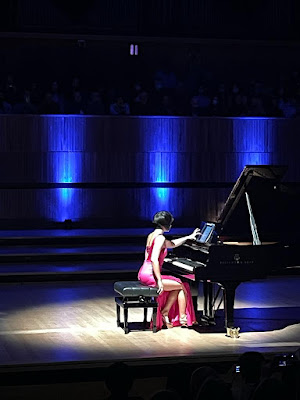
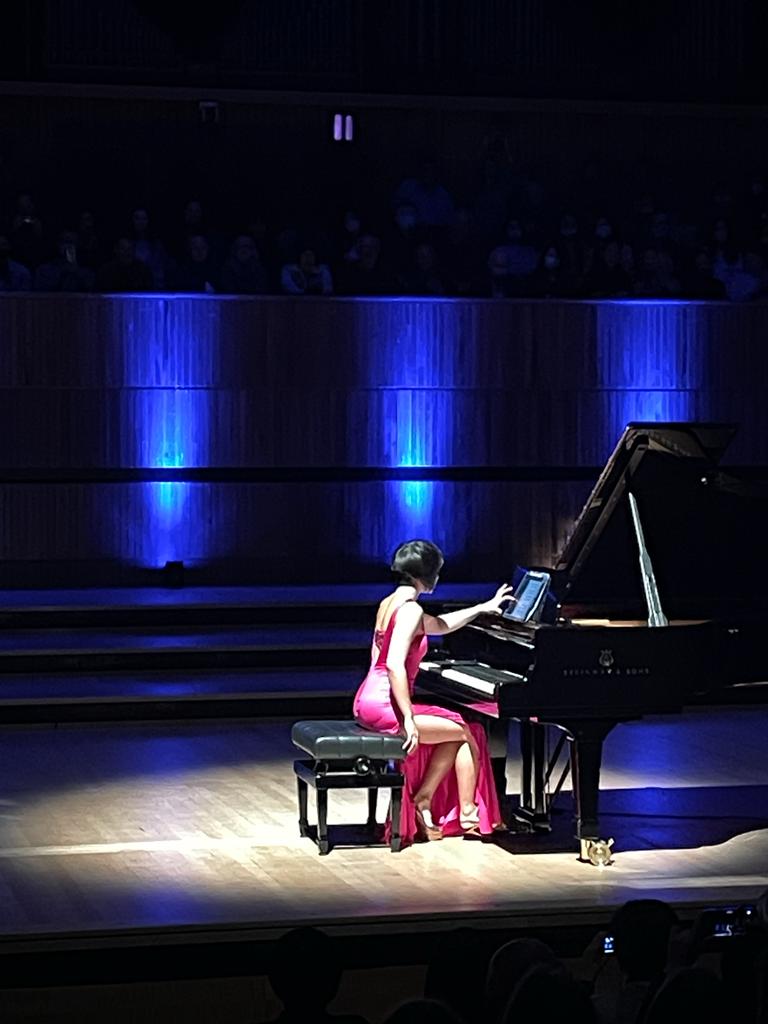
Artistry, focus and virtuosic fireworks from Yuja Wang in recital
![]() |
| Yuja Wang (© Ian Farrell) |
Monday, 4 April 2022
CD Reviews & Concert Listings - April 2022
Fasch, C. F. C. 2020. Works for Keyboard. Philippe Grisvard. Compact Disc. Audax Records ADX 13725.
Pianist Simon Callaghan joins the BBC National Orchestra of Wales, conducted by Martyn Brabbins for a great selection of obscure British Piano Concertos. ‘New’ piano concertos, often for modest orchestral forces, were a popular feature of concert programmes in the early half of the twentieth century, but by their very nature, many of them failed to achieve longevity and often disappeared without trace. Yet there are some great pieces here, ranging from the light and almost comical to more weightily, expressive offerings. Only one of the works here has been previously recorded (the Benjamin), and that was back in 1959. John Addison’s (1920-1998) Wellington Suite kicks things off, and this is a great, playful romp. Scored for two horns, piano, percussion and strings, the horns actually take centre stage with some really challenging and rapid exchanges, deftly handled here by Tim Thorpe and Meilyr Hughes. Written in 1959, we can hear the film music that Addison was best known for (eg. Reach for the Sky, A Taste of Honey). He relocated to Los Angeles in 1975 – receiving an Emmy for his signature tune for Murder, She Wrote. There are cartoon capers in the opening movement, with sliding piano lines and bright horns. The horns are slinkier in the more reflective second movement, with delicate piano pecks over gentle strings, before concluding with a lumbering march. Delicate pizzicato strings, played with great control by the BBC NOW build towards an almost Shostakovich-like comic second section. A light, halting waltz ends with vaudeville piano tremolos, before a playfully jaunty ride lead by the horns, with quickening pace in the piano and strings exchanges to finish. Australian born Arthur Benjamin (1893-1960) studied and later taught at the Royal College of Music, where Britten was one of his pupils. His Concertino for Piano and Orchestra (1927) was influenced by the popularity of Gershwin’s Rhapsody in Blue, and its single movement has its bluesy movements courtesy of the addition of an alto saxophone. Perhaps less extrovertly extravagant than Gershwin, it nevertheless has effective passages of sweeping strings with the piano providing energetic counterpoint. Callaghan delivers the racing light piano ripples and the wandering cadenza towards the end with elegant panache. Elizabeth Maconchy (1907-1994) was another RCM alumnus, and was an important figure in the world of new music composition, becoming the first woman chair of the Composers’ Guild of Great Britain in 1959, and the president of the Society for the Promotion of New Music in 1976, succeeding Britten. Her Concertino for Piano and String Orchestra (1949) is dramatic and virtuosic for the piano, with angular strings and intense, insistent rhythms throughout. The middle movement has more lyricism, but here still the jagged rhythmic knocks are unsettling. Insistence continues in the final movement, with rapid motion passed between piano and orchestra, and repetition of ideas hammering home its darkly infectious spirit. Humphrey Searle’s (1915-1982) short Concertante for Piano, Percussion & Strings (1954) is full of spiky rhythms and interchanges between piano and orchestra, with slinky strings and birdlike piano interjections. Following a short cadenza at the centre, the atmospheric sliding strings become more frenzied to great effect. Edmund Rubbra’s (1901-1986) ‘Nature’s Song’, a tone poem for orchestra, piano and organ (1920) is up next, and this is perhaps the most immediately engaging work here, with its filmic, rich scoring and expressive melodic lines. The sea’s ‘rich roar’ surges in the strings, and Callaghan is particularly expressive in the solo section towards the end, before the flute and oboe rise up to the sky over quiet strings to finish. Geoffrey Bush’s (1920-1998) A Little Concerto on themes of Thomas Arne (1939) is definitely of its time, yet his delicate arrangement of music taken several of Arne’s Harpsichord Sonatas and the Keyboard Concerto No. 3 is surprisingly delicate and refined. He keeps the textures relatively light, and here Callaghan weaves the piano part, often running in octaves, around the bare string textures. Overall, this is a fascinating collection. With a range of styles on offer, the Rubbra and Maconchy stand out for their overall depth, but the Addison is a comic gem.
Various. 2022. British Piano Concertos. Simon Callaghan, BBC NOW, Martyn Brabbins. Compact Disc. Lyrita SRCD407.
Concerts
![]() |
| Jess Gilham (credit Robin Clewley) |
![]() |
| Daniel Pioro (credit: David James Grinly) |
![]() |
| Cristian Grajner de Sa |
![]() |
| John Hancorn |
(Edited versions of these reviews first appeared at Scene, April 2022)
Thursday, 31 March 2022
Still Life - Oli Spleen
Tomorrow, 1 April, sees the release of Oli Spleen's fifth studio album, Still Life. Oli describes the album as being 'about life in the shadow, and in spite of death'. He goes on to say that 'some of the themes within express global concerns, depicting the balancing forces of nature, the environment, displaced people, fears around climate change and mass extinction of species. Other themes are more personal, ranging from our own mortality, terminal illness, the grief of seeing a loved one slip away from us, and the general anxieties of life in these unpredictable times'.
Oli has collaborated with members of the band Birdeatsbaby, and their front person Mishkin Fitzgerald worked with Oli on most of the tracks and on production. Other local musicians, including Nick Hudson, Stuart Warwick, klezmer musicians Merlin and Polina Shepherd, and pianist Tristram Arnold. This range of musicians adds considerable variety in terms of musical style and texture, from the twisting clarinet and Russian vocals in the darkly disturbing empassioned cry of Refugee, to the lounge piano and accordion backing to the ethereal torch song, These Days Will Pass. Oli's voice is rich and deep, but he is not afraid to explore its more extreme capabilities, with quavering falsetto used to great effect in The Garden, and Bowie-esque ominous delivery in Thundercloud. Whilst a lot of the music is sombre and dark-toned, the album begins and ends with tracks with livelier, turning rhythms, with Out of the Dirt expressing the cycle of life and death, and Still Life offering some sense of hope (although perhaps that hope is snatched away by the final flatline...).