Tuesday, 7 June 2022

CD Reviews - June 2022

In 2018, conductor John Wilson relaunched the Sinfonia of London, a session orchestra with a long history, particularly in recording film music, and for their second recording with Chandos, they focus on German and Austrian composers, post World War II. Richard Strauss (1864-1949) composed his Metamorphosen, for 23 solo strings in 1945, and it is a heartfelt elegy and a musical realisation in many ways of the horrors that had been experienced in the preceding war. The Sinfonia of London strings here produce a deeply resonant and rich sound, and Chandos deserve credit for achieving precision in the balance, especially when all 23 lines are active. No detail is obscured, and Wilson steers the dynamic swells expertly too. In Strauss there are many climactic moments, and it can lose direction, but here there is a definite trajectory to the warmer major passionate centre, before the opening tragic lamenting material returns following a sudden violent stop. Yet despite the title, there is no metamorphosis into a positive new world – Strauss marks the end ‘In Memoriam’, and the subside into quiet darkness is achingly sad. The short Intermezzo for String Orchestra, Op. 8 by Franz Schreker (1878-1934) is an interesting work, with an opening reminiscent of Schoenberg’s Verklärte Nacht (written at around the same time), but moments of sweet, pastoral string writing too, and perhaps less overall bite. It is given a richly sensitive reading here, with Wilson’s attention to dynamic contrasts providing shape to its overt romanticism. The second half of the disc is given over to the Symphonische Serenade, op. 39 by Erich Korngold (1897-1957). This was composed just before Korngold returned to Austria from the US, during which time he had carved out a successful career in Hollywood, pretty much establishing the Hollywood movie soundworld of the time, and just after he had a heart attack which required him to step back from recording and conducting. Its opening movement shows an immediate shift from the more obvious ‘Hollywood’ sound, with some strident harmonies and tensely dramatic writing. The second movement Intermezzo has virtuosic pizzicato writing, and here the Sinfonia of London players excel, with tight ensemble and rhythmic energy, making the strange brief interjections of glassy bridge bowing and swoops stand out even more. The Lento religioso is heartfelt, but with a Mahlerian profundity that is arresting, and Wilson and the players give this sumptuous weight without any wallowing, and the repeated notes throb with insistent intensity. The violent outburst which interrupts the solace of the central solo passage is positively shocking here, and Wilson certainly extracts maximum drama from the score. The Finale sets off at a cracking pace, and is full of urgent energy. Wilson and the Sinfonia of London are highly impressive throughout these performances, bringing energy, precision and a glorious string sound to this rich repertoire.

Various. 2022. Metamorphosen - Strauss/Korngold/Schreker. Sinfonia of London, John Wilson. Hybrid Super Audio Compact Disc. Chandos CHSA 5292.

Now for Bach with a difference. The ensemble incantati, which consists of Emma Murphy (recorders), Rachel Stott (viola d’amore) and Asako Morikawa (viola da gamba), have collected together a selection of J. S Bach’s (1685-1750) keyboard works to perform in various combinations of instruments. Pianists will be familiar with the Two-Part Inventions and Sinfonias – basically pieces with two and three separate lines, with an educational intent, to develop playing the independent lines together. The same applies to his Trio Sonatas, or Organ Trios as they were actually written, which involve three parts – essentially two hands and the feet. In playing these with two or three separate instruments, immediately the individual lines come into their own, and no fluidity is lost through trying to negotiate playing them together on a keyboard. But it is in the different timbres of the instruments that add something new here. And that’s where the flexibility of Murphy’s different recorders and voice flutes is a bonus – so sometimes a warm tenor recorder is matched with the sonorous viola da gamba, or a brighter soprano recorder is paired with the slightly more brittle sound of the viola d’amore. They are also careful here in their selection, with the darker, more sombre pieces (eg. the Sinfonia No. 4, or the mournfully sighing No. 9) contrasted with the bright, lighter examples (Inventions Nos. 1 and 2, for example). There are also beautiful renditions of Bach’s chorale tune arrangements, such as the prayerfully lilting Allein Gott in der Höh sei Ehr, and the joyful, dancing Herr Jesu Christ, dich zu uns wend. They end their disc with the Trio Sonata No. 3, with more virtuosic lines for the alto recorder in its first movement, a lightly singing central movement, and a bright (if slightly stately for ‘vivace’) finale. This is then followed by a wonderfully graceful reading of the Aria from the Goldberg Variations, with the viola d’amore this time taking centre stage, and the tenor recorder and viola da gamba providing subtle inner and lower lines. A delightful collection, highly recommended.

Brighton Early Music Festival – Midsummer Season, June 2022


Following a highly successful midsummer season last year, BREMF are back this summer with a weekend of events exploring Transition, which will form a year-round theme for the festival.


The weekend begins with In Transit to the Baroque – ensemble In Echo perform music by Semisy, Willaert, Bertali and Frescobaldi, exploring instrumental music’s journey from the Renaissance into the Baroque periods (7.30pm, Friday 24, St Bartholomew’s Church, Brighton).


Later that night, BREMF Consort of Voices perform sacred music and chant from the Night Offices of Compline and Matins, with music by Tye, Tallis, White, Sheppard, Browne, Palestrina and Victoria (9pm, Friday 24, St Bart’s).


Puppets and instruments combine for a performance by Rust & Stardust for ‘primary-aged children and the young in spirit’ – Endo the Earthworm explores nature in transition, with two performances (Saturday 25, 11am at Royal Spa, Brighton & 2.30pm at The Crew Club, Whitehawk).


Joglaresa are joined by the BREMF Community Choir for ¡Bailemos!, celebrating in style the legacy of founder, Belinda Sykes, who sadly passed away recently. Expect a joyful party of music-making! (5pm, Saturday 25, Royal Spa).


Folk in Transition
explores music from the British Isles to the New World, with traditional ballads, Irish jugs, Scottish reels and Appalachian bluegrass, performed by Brighton folk trio Hope Cove (8pm, Saturday 25, Royal Spa).


Aradhana Arts perform Indian Classical music and dance in The Daksha Yagna, a powerful mythological story from the ancient Hindu scriptures (3pm, Sunday 26, Royal Spa). 


And the Midsummer Season ends with Fair Oriana peforming Eliza is the Fairest Queen, with popular songs from the reigns of two queen Elizabeths, including Tudor-tinted arrangements of Vera Lynn, Aretha Franklin and The Beatles (6pm, Sunday 26, Royal Spa).


Some tickets voluntary, with suggested donations or pay what you can – check for details.


bremf.org.uk

Friday, 20 May 2022

Singing melodies and rapid-fire showmanship from Alexei Grynyuk in Brighton


1pm, Thursday 19 May, 2022 


Felix Mendelssohn (1809-1847): Variations Sérieuses in D minor, Op. 54

Franz Schubert (1797-1828): Four Impromptus, D899

Franz Liszt (1811-1886): LitanieS562/1, piano transcr. from Schubert's Am Tage Aller Seelen, D343

Franz Liszt: Hungarian Rhapsody No. 9 in E flat major 'Carnival in Pest', S244/9

Mendelssohn:
'From his opening prayerful statement of the theme onwards, he ensured the melody sang through at all times'.

Schubert:
'Grynyuk opened the C minor with a captivating pianissimo, and the dynamic contrasts here were arresting'.

Liszt/Schubert:
'Grynyuk’s warm tone made the lyrical melody sing out of the rich texture'.

Liszt:
'Grynyuk also took great delight in the jaunty rhythms and cheeky ornamentation as each melody was introduced – I’m sure there was a twinkle in his eye once or twice – before the fireworks took over each time'.

Read my full review on Bachtrack here.

Monday, 9 May 2022

CD Reviews - May 2022

Following on from their two volumes of Felix Mendelssohn’s String Quartets, the Doric String Quartet are now joined by Timothy Ridout (viola) for a disc of his String Quintets. Mendelssohn wrote just two of these, going with the viola added to string quartet combination, favoured by Mozart and Brahms, as opposed to adding a cello, which Boccherini and Schubert did. Mendelssohn’s String Quintet No. 1, composed when he was 17, came hot on the heels of the successful premiere of his glorious Octet. Ever the reviser, it was another five years before he published both. Its opening movement has a leisured warmth, with only brief hints of darker moods in its development, before it gently dances to a quiet ending. The Intermezzo, with its singing melodic idea is sensitive and elegiac. Intensity builds over warm lower strings, with the rhythmic pace of the throbbing repeated figure increasing. It never feels totally settled, despite its calm ending. We’re in ‘A Midsummer Night’s Dream’ territory in the Scherzo, with skittering fairy music led off by the first viola. The players here give this precision and clarity, yet avoid it becoming too dry, and there is some dramatic scraping from the cello, not holding back from a harshly biting timbre. Yet once again, the movement disappears into nothing. Whilst not quite reaching the heights of exuberance of the Octet, the finale is full of joyful energy, set up by its lively triplet upbeat. Alex Redington on first violin shines in the rippling runs, and sings over the rumbling lower instruments. Energy levels ramp up and up, leading to the joyous conclusion. The String Quintet No. 2 came some 18 or so years later, with much of the same sense of energy but perhaps less of the unfettered joyfulness of his youthful works. The opening movement has an athletic first violin part over a tremolo accompaniment. The whirling triplet rhythms mean there is always a sense of movement, and these drive on, becoming more insistent, building to a full-on emphatic conclusion. In the dancing, lilting staccato of the second movement, once again the players here avoid it becoming to picky, maintaining a sense of the melodic material and the dance in an masterclass of control. But it is the intense pathos of the slow movement – essentially a funeral march – that is most striking about this work. From a darkly pianissimo opening, cello scales rise and a slow relentless march emerges. There are drum-like battering effects, and heartfelt laments from the violins. A nostalgic A major melody provides some temporary relief, but it is short-lived, and the agitation of the march increases. Yet Mendelssohn can’t leave us totally in the dark, as the movement suddenly turns at the end to a triumphant D major, before subsiding into a gentle, calm end. The finale, perhaps a little incongruously after the deep intensity of the previous movement, bursts forth with a jolly, energetic theme. This theme provides most of the material here, and its contrapuntal development perhaps loses a little direction at times, but Mendelssohn eventually pulls everything to a suitably emphatic close. Throughout these fascinating and underperformed works, the Doric String Quartet and Ridout are alive to the Mendessohnian flashes of joy and energy, yet they are also alert to the finer detail. They know when to provide warmth, but also when to give edge to their sound too. Highly recommended.

Mendelssohn, F. The String Quintets. Doric String Quartet, Timothy Ridout. Compact Disc. Chandos CHAN 20218.

Arc I is the first of a series of three recordings by American pianist Orion Weiss. This first album features three works from the years 1911-1913. Weiss describes the trajectory of the series as like an inverted rainbow, and this first volume’s ‘steps here head downhill, beginning from hope and proceeding down to despair’. We’ll have to wait for the next disc to see things reach their lowest before renewal and rebirth are promised in the final volume. So here we begin with Enrique Granados’ (1867-1916) Goyescas, Op. 11, a Romantic masterpiece of invention. From the warmly expressive, watery cascades of the opening movement ‘Los reuiebros’ (Flattery), through to the macabre, stuttering dance of the final ‘Epilogo: Serenata del espectro’ (Epilogue: Serenade of the Ghost), this monumental and atmospheric suite is full of Granados’ extravagantly ornamented and improvisatory virtuosity. Weiss is commanding in the frenzied, passionate outbursts in ‘El Amor y la Muerte – Balada’ (Love and death – Ballade), but equally delicate in the nightingale’s song of the fifth movement. There’s a skip in his step in the moments of courting in the opening movement, and he ends the suite with ominous tolling bells before disappearing with a final mercurial wisp. Leoš Janáček’s (1854-1928) In the Mists follows – a shorter suite, and more introspective than the Granados. There are typical Janáček chromatic twists and turns in the melodies, and his motif of death, the falling minor third, features large. Weiss captures particularly well the claustrophobic, suppressed passion of the final movement, which breaks out with melismatic, singing outbursts and increasing intensity, before defeat in its dark sombre conclusion. Weiss ends with Alexander Scriabin’s (1871-1915) Piano Sonata No. 9, Op. 68, ‘Black Mass’. Full of ‘satanic’ tri-tones and chromaticism, begins hopeful but descends into darkness and despair, and Weiss makes the low rumblings and persistent trilling effects feel chillingly ominous. There is a real sense of the second, more hopeful melodic idea insistently writhing as if trying to escape, before being ultimately subsumed into a frightening march. This is an impressive display from Weiss, and sadly speaks to current anxieties and a sense of despair. Arc II promises to take us to the lowest point of grief and loss, but hopefully Arc II will bring us some hope for the future – much needed at present.

Various. 2022. Arc I - Granados, Janáček, Scriabin. Compact Disc. First Hand Records FHR127.

(Edited versions of these reviews first appeared in Scene, May 2022) 


Friday, 6 May 2022

Roderick Williams & Paul Cibis capture the passion of youth with energetic immediacy at Kings Place

Roderick Williams
(© Benjamin Ealovega)

Paul Cibis (piano)

7.30pm, Thursday 5 May, 2022

Kings Place, London


Franz Schubert (1797-1828): Die schöne Müllerin, Op. 25: Das Wandern

George Butterworth (1885-1916): Six Songs from A Shropshire Lad

Rebecca Clarke (1886-1979): 8 o’clock

                                                Aufblick

Robert Schumann (1810-1856): Album für die Jugend, Op. 68 No. 21

                                                   Liederkreis, Op. 24, Nos. 1-3

Rebecca Clarke: Stimme im Dunkeln

Robert Schumann: Album für die Jugend, Op. 68 Nos. 8 & 16

                               Liederkreis, Op. 24, Nos. 4-5

Franz Schubert: Die schöne Müllerin, Op. 25: Wohin? & Halt


Interval


Franz Schubert: Die schöne Müllerin, Op. 25: Am Feierabend, Der Neugierige & Ungeduld

Ralph Vaughan Williams (1872-1958): Songs of Travel: The Vagabond

Charles Wilfred Orr (1893-1976): A Shropshire Lad: Along the field

Frédéric Chopin (1810-1849): Prelude, Op. 28 No. 10

Ralph Vaughan Williams: Songs of Travel: Roadside Fire, Whither must I wander? & Bright is the Ring of Words

Charles Wilfred Orr: A Shropshire Lad: When I watch the living meet

Frederic Chopin: Prelude, Op. 28 No. 23

Charles Wilfred Orr: A Shropshire Lad: The Lent Lily

Franz Schubert: Die schöne Müllerin, Op. 25: Die liebe Farbe, Die böse Farbe, Der Müller und der Bach


Encore: 

Ralph Vaughan Williams: The House of Life, No. 2: Silent Noon 


'Most striking was Williams’ immediacy of communication, often singing as if speaking conversationally'.


'Williams’ control at the higher end of his register was also impressive, with particular lightness on the opening note of Loveliest of trees'.


'Williams’ Schubert had energy and impatience, with a bright twinkle for Das Wandern, and expertly voiced different characters in Der Neugierige'.


'Williams’ ability to shift the emotions as quickly as they turn in these songs is what made this recital so captivating throughout'.


'Cibis also deserves credit for the range of his playing, both in the varied accompaniments and in his solo pieces'.


Read my full review on Bachtrack here.

Friday, 29 April 2022

Collaboration not conflict: dazzlingly virtuosic Dean from Gerhardt and the LPO

Alban Gerhardt (© Kaupo Kikkas)

Alban Gerhardt (cello)
Edward Gardner (conductor)

7.30pm, Wednesday 27 April 2022


Benjamin Britten (1913-1976): Sinfonia da Requiem, Op. 20

Brett Dean (b.1961): Cello Concerto (UK premiere)

Ralph Vaughan Williams (1872-1958): Symphony No. 5 in D major

Edward Gardner (© Mark Allan)
Britten:
'Gardner’s conducting was suitably controlled and precise, yet he also brought out the dark emotions beneath the surface'.

Dean:
'Gardner’s beat was incredibly precise throughout ... and the LPO players have also embraced the work, so that it never felt like an arduous exercise in counting and rhythm'.

'A highly engaging concerto, performed with incredible precision and commitment by soloist and orchestra alike'.

Vaughan Williams:
'Gardner and the LPO gave us reassuring warmth ... and assured solos from across the orchestra'.

'Gardner expertly built towards the radiant climax ... with a masterfully controlled slowing down to the peaceful close'. 

Read my full review on Bachtrack here.

Thursday, 21 April 2022

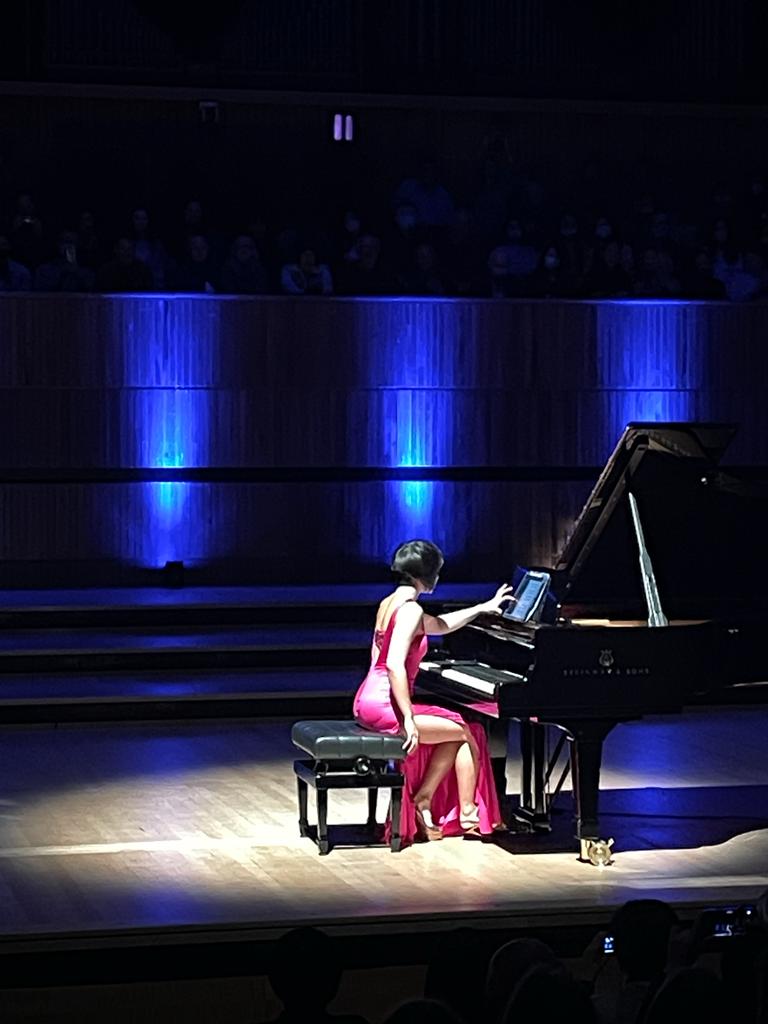
Artistry, focus and virtuosic fireworks from Yuja Wang in recital


Yuja Wang (© Ian Farrell)


Yuja Wang (piano)

7.30pm, Wednesday 20 April 2022

Royal Festival Hall, London


Ludwig Van Beethoven (1770-1827): Piano Sonata No. 18 in E flat major, 'Hunt', Op. 31 No. 3
Arnold Schoenberg (1874-1951): Suite, Op. 25
György Ligeti (1923-2006): Etude No. 6, 'Autumn à Varsovie' & Etude No. 13, 'L'escalier du diable'
Alexander Scriabin (1872-1915): Piano Sonata No. 3 in F sharp minor, Op. 23
Isaac Albéniz (1860-1909): Iberia, Bk 4: 'Málaga' & Bk 3: 'Lavapiés'
Nikolai Kapustin (1937-2020): Prelude in B major, Op. 53 No. 11 & Prelude in C sharp minor, Op. 53 No. 10

Encores:
Philip Glass (b.1937): Etude No. 6
Johann Sebastian Bach (1685-1750): Orchestral Suite No. 2 in B minor, BWV1067, Badinerie (arr. unknown)
Johannes Brahms (1833-1897): Intermezzo in C sharp minor, Op. 117 No. 3
Arturo Márquez (b.1950): Danzón No. 2 (arr. unknown)
Sergei Prokofiev (1891-1953): Toccata in D minor, Op. 11
Vladimir Horowitz (1903-1989): Carmen Variations
Franz Schubert (1797-1828): Gretchen am Spinnrade, D118 (transcribed by Franz Liszt (1811-1886))
Pyotr Ilych Tchaikovsky (1840-1893): Swan Lake, Op. 20, Dance of the Little Swans (arr. Earl Wild (1915-2010))
Giovanni Scambati (1841-1914): Mélodie (transcribed from Christoph Willibald Gluck (1714-1787): Dance of the Blessed Spirits from Orphée et Eurydice)

Yuja Wang (© Ian Farrell)
'While Wang more than delivered virtuosic fireworks, she gave so much more in her wide-ranging programme, showing phenomenal artistry and focus in well over two hours of performance'.

Schoenberg:
'Her Schoenberg that followed was, however, a revelation, with opening bite and edge followed by some remarkably delicate and intricate details'.

Ligeti:
'In ... Automne à Varsovie, Wang was into her astonishingly virtuosic stride, with hands at full stretch to either end of the keyboard. Yet it was her dynamic control that also impressed here'.

Scriabin:
'Wang’s dynamic control was impressive, with barely audible pianissimos expressing heartfelt longing'.

Encores:
'Dazzlingly rapid repetition in Glass followed by a crazy arrangement of ... Bach'.

Read my full review on Bachtrack here.